Refrigerator Electricity + Maintenance Cost Calculator
See what your fridge really costs to run — BEE star-based units, monthly bill and 5-star payback — plus the annual upkeep a refrigerator quietly adds. Set type, litres, star rating and usage. India-first, instant and editable.
~₹3,165/yr
avg yearly refrigerator cost (electricity + upkeep), Indian home
1. Your refrigerator
Pick the type closest to your fridge, then set litres and star rating. Check the label inside the door for all three.
Not sure how many litres you need? Set your household size below — the sizing check tells you.
BEE star rating
At 300 L: 3★ ≈ 348 kWh/yr · 5★ ≈ 244 kWh/yr
Stars compare models of similar size and type — the kWh/year figure printed on the BEE label is the exact number for a specific model.
2. Your household & usage
Litres sizing and real-world usage. A hot kitchen with frequent door openings pushes units above the lab-tested label.
Indian rule of thumb: 50–80 litres per person, plus a buffer if you cook in bulk.
Typical Indian home: 30–60 a day. Every opening lets warm, humid air in that the compressor has to re-cool.
Batch cooking, monthly grocery runs or festival loads — adds 75 L to the recommended size. Sizing only; it doesn't change the energy estimate.
Recommended for your household: 300–400 L · yours: 300 L
3. Your running costs
India-first defaults: ₹6.5 per kWh and a ₹900/yr upkeep reserve for this type. Edit both to match your bill and service history.
Typical: ₹6.5/kWh
Typical ₹700–₹1,200/yr by type · verified Sep 2026
One paid service visit a year, plus gas refills and minor parts amortised. Frost-free and multi-door models have more components that can fail.
Why your refrigerator's running cost matters
A refrigerator is the only appliance in your home that runs every hour of every day, so efficiency hits your bill harder than anything else on the spec label. You can't simply use a fridge less the way you can a microwave or geyser — the units tick up 24×7 for the 10–15 years a fridge typically stays in service. Two 300-litre models can differ by 100–150 units a year, and that gap repeats every single year.
Three things decide the bill: size and cooling type (a compact direct-cool single door can use fewer absolute units than a larger 5★ frost-free, because it cools less space — so compare within the same bracket), the BEE star rating (annual units fall roughly 12–15% per star, and the real kWh/year figure is printed on the label), and how you actually use it — door openings, kitchen heat and load push real consumption above the lab-tested number. This calculator adds all three and prices them at your editable rates.
Defaults are India-first: ₹6.5 per kWh and a ₹900/yr upkeep reserve for a double-door frost-free — one paid service visit a year, with gas refills and minor repairs amortised. Edit both to match your bill and service history, and use the sizing check to see whether your litres match your household.
How your estimate is worked out
We estimate annual units the way a BEE label does, then adjust for real use: annualUnits = litres × type base (0.95–1.15 kWh/L/yr at 3★) × star factor (×1.35 for 1★ down to ×0.70 for 5★) × usage factor (0.85 + 0.004 × door openings/day). Cost is units × your ₹/kWh plus the annual upkeep reserve. The sizing check compares your capacity against 50–80 litres per person (150–200 L for one person, 250–300 L for a couple, 300–400 L for a family, 400 L+ for five or more), plus a 75 L buffer for bulk cooking.
| Assumption | Value |
|---|---|
| Base energy at 3★ | 0.95 kWh/L/yr direct cool · 1.15 frost-free double door · 1.05–1.10 large formats |
| Star factors | 1★ ×1.35 · 2★ ×1.18 · 3★ ×1.00 · 4★ ×0.85 · 5★ ×0.70 |
| Usage adjustment | 0.85 + 0.004 × door openings/day (40× → ×1.01) |
| Worked example | 300 L frost-free 3★, 40 openings → ≈348 kWh/yr |
| Upkeep reserve | ₹700 direct cool · ₹900 double door · ₹1,200 side-by-side / French door |
| Sizing rule | 50–80 L per person, table above, +75 L if you cook in bulk |
| Annual → monthly / daily | Annual ÷ 365 · Monthly ×30.44 |
| Default tariff | ₹6.5/kWh |
| Formula | Total = units × rate + upkeep reserve |
Estimates only — the BEE label's kWh/year for your exact model beats any estimate. Real draw varies with ambient temperature (peak summer adds roughly 10–20%), load, thermostat setting and defrost habits. Upkeep varies with brand, gas refill prices and local service rates. Star factors and upkeep reserves last verified Sep 2026.
What each star rating costs you
At your current 300 L double door, 40 openings/day, ₹6.5/kWh and typical ₹900/yr upkeep. Only the rating changes — same capacity and cooling type.
| Rating | Annual units | Monthly elec. | Annual elec. | Annual total | vs 5★ |
|---|---|---|---|---|---|
| 1★ | 470 kWh | ₹255 | ₹3,058 | ₹3,958 | +₹1,472 |
| 2★ | 411 kWh | ₹223 | ₹2,673 | ₹3,573 | +₹1,087 |
| 3★ · selected | 348 kWh | ₹189 | ₹2,265 | ₹3,165 | +₹679 |
| 4★ | 296 kWh | ₹160 | ₹1,925 | ₹2,825 | +₹340 |
| 5★ | 244 kWh | ₹132 | ₹1,585 | ₹2,485 | — |
A higher rating usually costs more upfront. The 5★ check in the results estimates payback at a typical premium for this type — compare the actual kWh/year figures on the two labels you're considering.
Cut the cost of running your fridge
Keep it at 4°C / −18°C
Every degree colder than needed burns extra units for no benefit. Use a fridge thermometer, and don't set the thermostat to maximum in summer — it makes the compressor run continuously.
Cut down door openings
Every opening lets warm, humid air in that has to be re-cooled — and in humid weather it also builds frost. Decide what you need before opening, and take out several items at once.
Defrost direct-cool on time
A frost layer thicker than ~5 mm acts like insulation on the evaporator, so the compressor runs longer to hit temperature. Defrost before the ice gets thick, not after.
Clean the back grille
Dust on the condenser coils at the back or bottom is one of the biggest reasons a fridge starts drawing more power. Vacuum or brush them every few months.
Leave clearance around it
Heat has to escape. Keep 5–10 cm behind and above the fridge, away from direct sun, the stove and tight cabinetry — a boxed-in fridge runs hotter and harder.
Keep it reasonably full
Food and bottles act as thermal mass, so a fuller fridge holds temperature and recovers faster after opening. Fill empty space with water bottles, but don't block the air vents.
Frequently asked questions
How many units does a refrigerator use per day in India?
A typical 300 L double-door frost-free 3★ runs about 0.95 units (kWh) a day — roughly ₹6/day at ₹6.5/kWh. A 190 L direct-cool single door uses about 0.5 units/day, while a large 550 L side-by-side can cross 1.5 units/day. The exact number is on the BEE label as annual kWh.
How much does it cost to run a refrigerator per month in India?
Most Indian homes pay ₹150–₹400 a month in electricity for a fridge at ₹6.5/kWh. Our default — 300 L frost-free 3★ — works out to about ₹189/month of electricity plus a ₹75/month upkeep reserve, so ≈₹264/month and ≈₹3,165/year all-in.
Is a 5-star refrigerator worth the extra price?
Usually, if you keep it for its full life. On our default 300 L frost-free, moving from 3★ to 5★ cuts roughly 105 units a year — about ₹680/year at ₹6.5/kWh. At a typical ₹3,000 premium that pays back in about 4.4 years, and a fridge typically lasts 10–15 years. Compare the actual kWh/year figures on the two labels you're considering.
Is a direct cool fridge cheaper to run than frost-free?
Yes — of similar size and star rating, direct cool uses roughly 15–20% fewer units because it skips the defrost heater and fan. But direct cool demands manual defrosting, and efficiency drops as ice builds up. Frost-free costs a little more to run but holds even temperatures with almost no upkeep.
Does a refrigerator use more electricity in summer?
Yes. The BEE label is tested at a standard ambient temperature; in a 35–40°C Indian kitchen the compressor runs longer, adding roughly 10–20% to consumption in peak summer. Use the door-openings slider to see how usage pushes your units above the label — or add 10–20% mentally during May–June.
How much should I budget for refrigerator service and maintenance?
Simple direct-cool fridges: about ₹500–₹800 a year. Frost-free double doors: ₹700–₹1,100. Side-by-side and French-door models with more electronics: ₹1,000–₹1,500. That covers one paid service visit a year plus gas refills and small parts amortised. The bigger risk is the compressor once the warranty ends — which is why stabiliser protection matters.
Do inverter compressors really save electricity?
Yes — they modulate speed instead of switching fully on and off, typically using 15–30% less than a fixed-speed compressor of the same size. Most 4★ and 5★ models sold in India are inverter models, so the star rating already captures much of the saving. An inverter also tolerates voltage swings better.
What size refrigerator does my family need?
Budget 50–80 litres per person: 150–200 L for one person, 250–300 L for a couple, 300–400 L once you have children, and 400–500 L+ for a joint family of five or more. Add 50–100 L if you cook in bulk or stock up for festivals — the sizing check above does the maths for your household.
Why is my fridge using more units than the BEE label says?
The label is tested under standard lab conditions with controlled openings and ambient temperature. A hot kitchen, 60+ door openings a day, overloading that blocks air vents, a bad door gasket or skipped defrosting can add 10–30%. Fix the cheap things first — gaskets, clearance, thermostat — before suspecting the compressor.
Does a refrigerator need a voltage stabiliser?
Many fridges sold in India have built-in stabilisation, which handles moderate fluctuation — check your manual before buying an external one. In areas with severe or frequent swings, an external stabiliser (₹1,500–₹2,500) is cheap insurance: repeated sags and spikes shorten compressor life, and a compressor replacement can cost a large fraction of a new fridge — with some warranties excluding voltage damage.
More refrigerator buying guides
Capacity, star rating, cooling type and service guides to help you pick the right fridge — with specs and real prices.
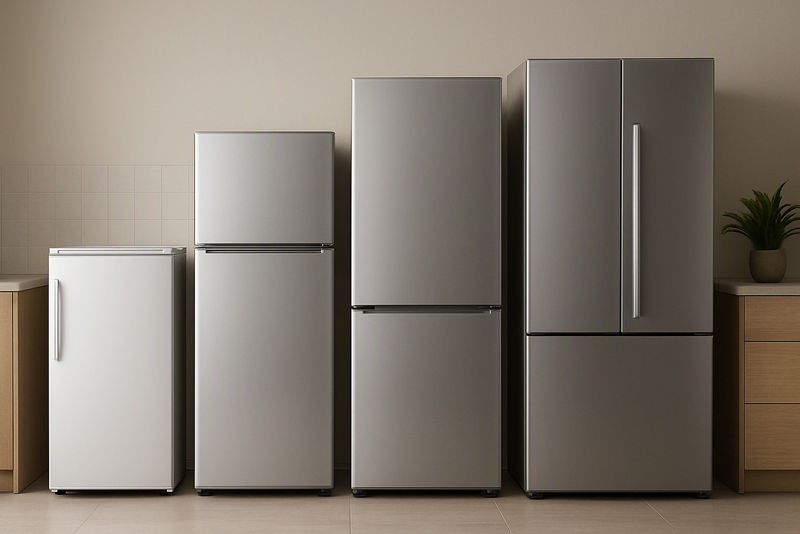
Choosing the Right Refrigerator for Indian Homes A Practical Guide
A practical refrigerator buying guide for Indian homes — pick the right type, capacity, star rating and budget, and plan for power cuts and service.
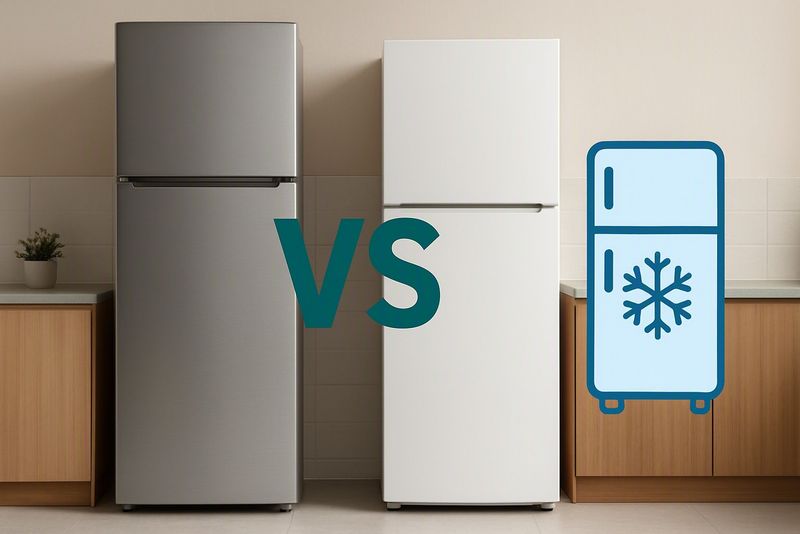
Frost-Free vs Direct Cool Refrigerators: Read This Before You Choose
Direct cool needs manual defrosting, frost-free doesn't — but that convenience costs more upfront and in power bills. Know the maintenance, price, running cost and pick which type of Refrigerator actually fits your need., from ₹8,500 upward.
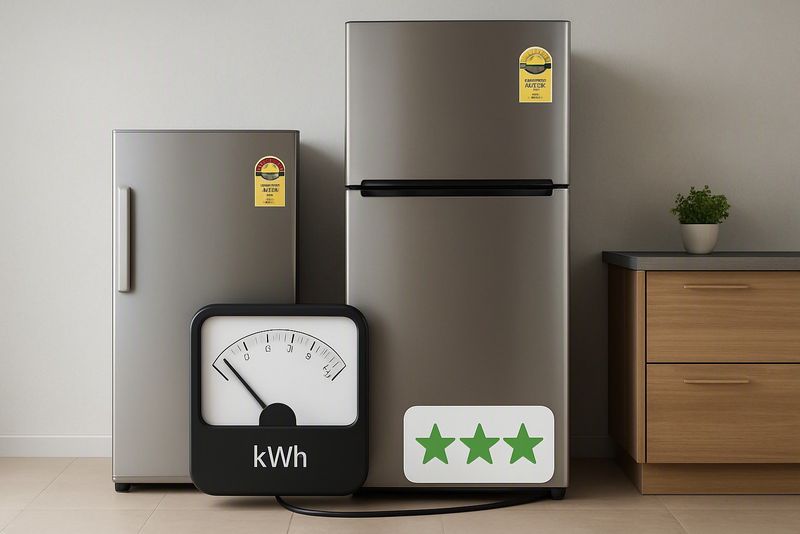
Refrigerator Star Ratings and Power Consumption Explained
Higher BEE star ratings save money steadily, but how much depends on capacity and cooling type. Use annual kWh to see what 5 stars is worth on your bill.