Refrigerator Star Ratings and Power Consumption Explained
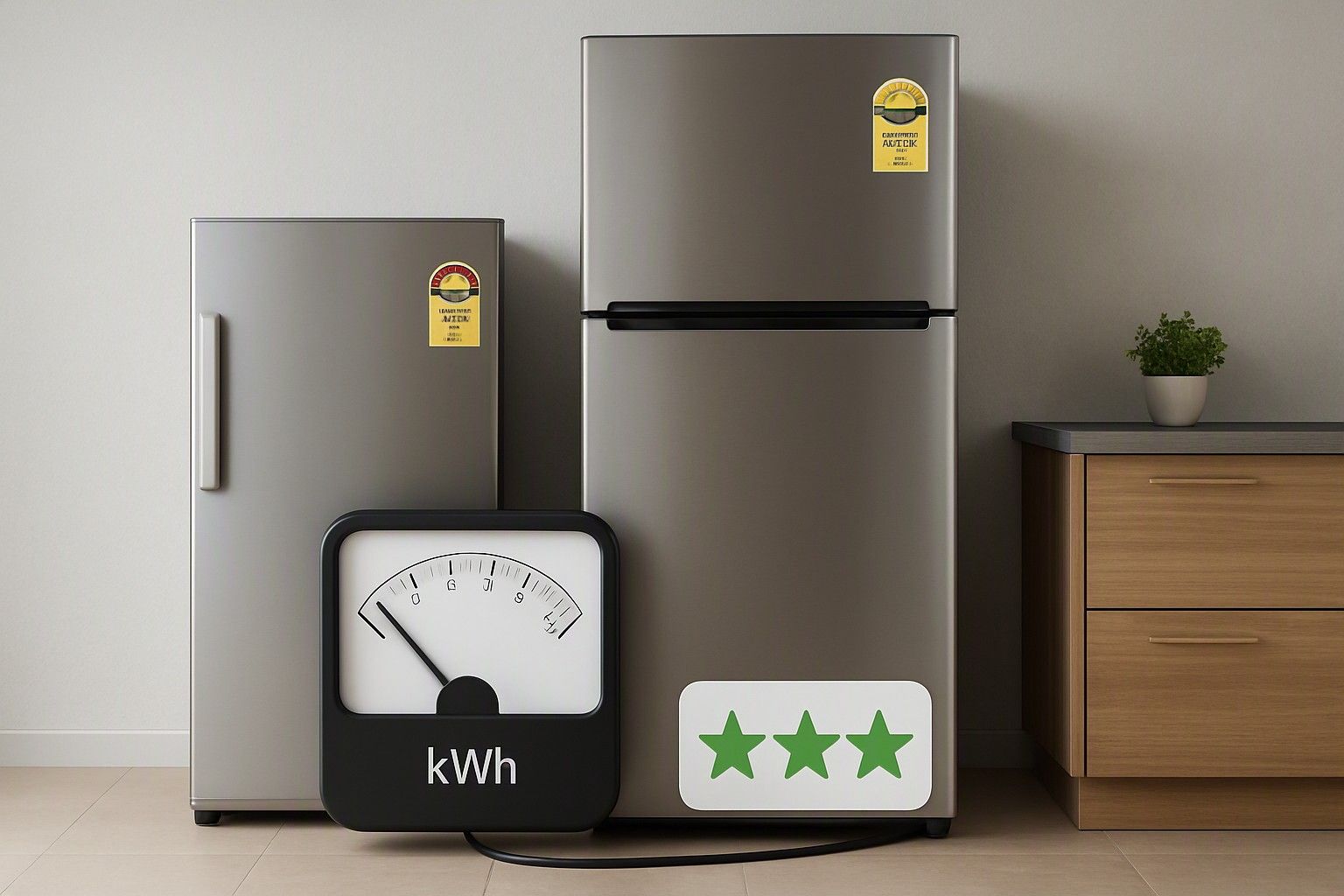
A refrigerator runs every hour of every day, so its star rating matters more to your wallet than almost any other spec on the label. This piece breaks down what those stars actually measure, how to turn them into rupees on your monthly bill, and whether paying more upfront for a 5-star model is worth it for how you actually use a fridge.
What BEE Star Ratings Actually Mean
The Bureau of Energy Efficiency (BEE) star label on a refrigerator tells you how much electricity that specific model consumes to do its job, relative to other refrigerators of similar size and type, not relative to every fridge on the market. A 5-star fridge and a 3-star fridge of the same capacity are being judged against each other on annual energy consumption, tested under standard conditions in a lab, not in your actual kitchen. This matters because two 3-star fridges from different years or different capacity slabs are not directly comparable unless you check the actual kWh/year figure printed on the label, not just the star count.
Another thing buyers often miss: BEE periodically tightens the benchmark, so a 4-star fridge bought a few years back may only qualify as 3-star under current norms, even though the machine itself hasn't changed. The label on the fridge you're looking at right now reflects current-cycle testing, so a 5-star rating today is a genuinely stronger claim than the same rating years ago. The star rating also assumes typical usage patterns like door openings, ambient temperature, and load, which is why your real consumption can run higher or lower than the label suggests. Treat the stars as a reliable relative comparison tool between models you're actively considering, not as an exact prediction of your bill.
Estimating Yearly Units and Rupees
Every refrigerator brand sold in India carries a label stating its estimated annual energy consumption in units (kWh), tested under BEE's standard protocol. This number is the most useful figure on the entire label because it converts directly into money: multiply the annual units by your electricity board's per-unit rate, and you get a realistic yearly running cost for that specific model. If your state charges somewhere around ₹6-8 per unit in the relevant slab, a fridge rated at 200 units a year costs roughly ₹1,200-1,600 annually to run, while one rated at 350 units a year lands closer to ₹2,100-2,800.
The gap between a low-consumption and high-consumption model in the same capacity band can easily be 100-150 units a year, which adds up over the 10-15 years a fridge typically stays in service. When comparing two models, don't just glance at the star count side by side; open the label and note the actual annual kWh figure, because manufacturers sometimes cluster multiple models under the same star rating with meaningfully different consumption numbers. It's also worth checking your own electricity bill's slab rate before doing this math, since higher consumption slabs push the per-unit cost up, which makes efficiency matter even more for larger households running the fridge alongside an AC or geyser on the same connection.
When a 5-Star Fridge Pays Back Its Extra Cost
This is the calculation that actually settles the debate: does the extra amount you pay for a 5-star model get returned to you in electricity savings, and if so, how fast? Refrigerator prices in the Indian market span from ₹8,500 to ₹1,50,000, with the average sitting around ₹26,000, and within any given capacity and format, a 5-star variant typically costs more than a 3-star or 4-star sibling. If that premium is a few thousand rupees and the annual saving in units works out to a few hundred rupees a year, the payback period could stretch to several years, which is still worthwhile given a fridge's long service life, but it's not an instant win.
The payback math works best when you're comparing two real options you'd otherwise be happy with on features and capacity, not when you're forcing a jump to a pricier segment purely for the star rating. If the 5-star option and the 3-star option are nearly the same price because of a good deal or a particular model's positioning, the decision becomes easy since you get lower running cost for free. But if the efficient model costs meaningfully more and pushes you into a different price band entirely, weigh the yearly saving against how long you genuinely plan to keep the fridge. A household running the fridge in a hot, non-air-conditioned kitchen with frequent door openings will see the efficiency gap matter more than one in a cooler, low-traffic setup, because real-world load affects how much the compressor actually works regardless of the lab rating.
How Capacity and Cooling Type Move the Numbers
Star rating alone doesn't tell the full story because the size of the fridge and its defrosting mechanism both swing the energy math significantly. A larger single-door or double-door unit inherently needs to cool more internal volume, so its annual kWh figure will sit higher than a compact model even at the same star rating, simply because the two are being benchmarked against different capacity peer groups. Direct-cool models are generally more energy-efficient than frost-free ones of similar size because they lack the extra heating element used for automatic defrost cycles, though frost-free convenience often justifies the small consumption bump for many households.
Before fixing on a star rating as your main filter, it helps to understand the way litres and defrosting style shift power use, since a smaller 3-star fridge can sometimes consume fewer absolute units per year than a larger 5-star one simply because it's cooling less space. This is why comparing star ratings only makes sense within the same capacity and cooling-type bracket; comparing a 200-litre direct-cool 5-star fridge against a 400-litre frost-free 3-star fridge on stars alone will mislead you about actual running cost. Match the capacity to your household size first, then use the star rating to pick the more efficient option within that specific bracket, rather than chasing the highest star count across unrelated categories.
Running Cost Across Different Price Bands
Efficient inverter compressor technology, which modulates cooling output instead of switching the compressor fully on and off, has been trickling down from premium models into more accessible price points, and this shift changes how you should shop across budget tiers. In the entry segment under ₹10,000, most fridges use simpler fixed-speed compressors and tend to carry 2-star or 3-star ratings, which means a lower purchase price but a somewhat higher running cost over the years. Once you move into the ₹22,000 range, inverter compressors and 4-star ratings become far more common, giving you a meaningful efficiency jump without stepping into premium pricing.
The ₹45,000 band is where 5-star inverter models with larger capacities and frost-free convenience start appearing regularly, making it a sensible zone to shop in if long-term running cost matters as much as the upfront number. It's worth understanding which budget tiers pack the efficient inverter models before you commit, because paying slightly more to cross from one tier into the next can sometimes buy you a compressor technology upgrade that lowers your bill for the rest of the fridge's life. Rather than treating price and efficiency as a strict trade-off, look at which tier boundary gets you the inverter jump, since that's usually where the real efficiency gain sits, not simply at the top of the price range.
Balancing Efficiency Against Everything Else
Star rating is one input in a purchase decision that also includes capacity, noise levels, build quality, warranty terms, and how the fridge fits your kitchen space, and it shouldn't override all of those on its own. A 5-star fridge that's the wrong capacity for your household, or lacks a feature you actually need daily like adequate vegetable crisper space or a separate freezer compartment, isn't a better buy just because it saves a few hundred rupees a year in electricity. The right approach is to shortlist two or three models that already meet your space, capacity, and feature requirements, and then use the star rating and annual kWh figure as the tiebreaker among those finalists.
Given that refrigerator prices in the Indian market range from ₹8,500 to ₹1,50,000, there's enough spread across every tier to find a model that balances efficiency with the features your household actually uses, without overpaying for a star rating you won't meaningfully benefit from. If you're still working through the full list of factors that matter for a refrigerator purchase, it's worth stepping back to put energy savings alongside your other priorities so the star rating gets the weight it deserves and nothing more. Efficiency is a genuine long-term saving, but it earns its place in the decision alongside capacity and features, not ahead of them.
With the label numbers translated into actual rupees, the real trade-off is clear: a higher star rating saves you money steadily over a fridge's long working life, but the size of that saving depends on capacity, cooling type, and how the purchase price compares within its own tier. Use the annual kWh figure as your real comparison tool between shortlisted models, and you'll know exactly what a 5-star badge is worth to your specific bill rather than taking the label on faith.

Comments
Be the first to comment.