Refrigerators That Handle Power Cuts and Voltage Fluctuations
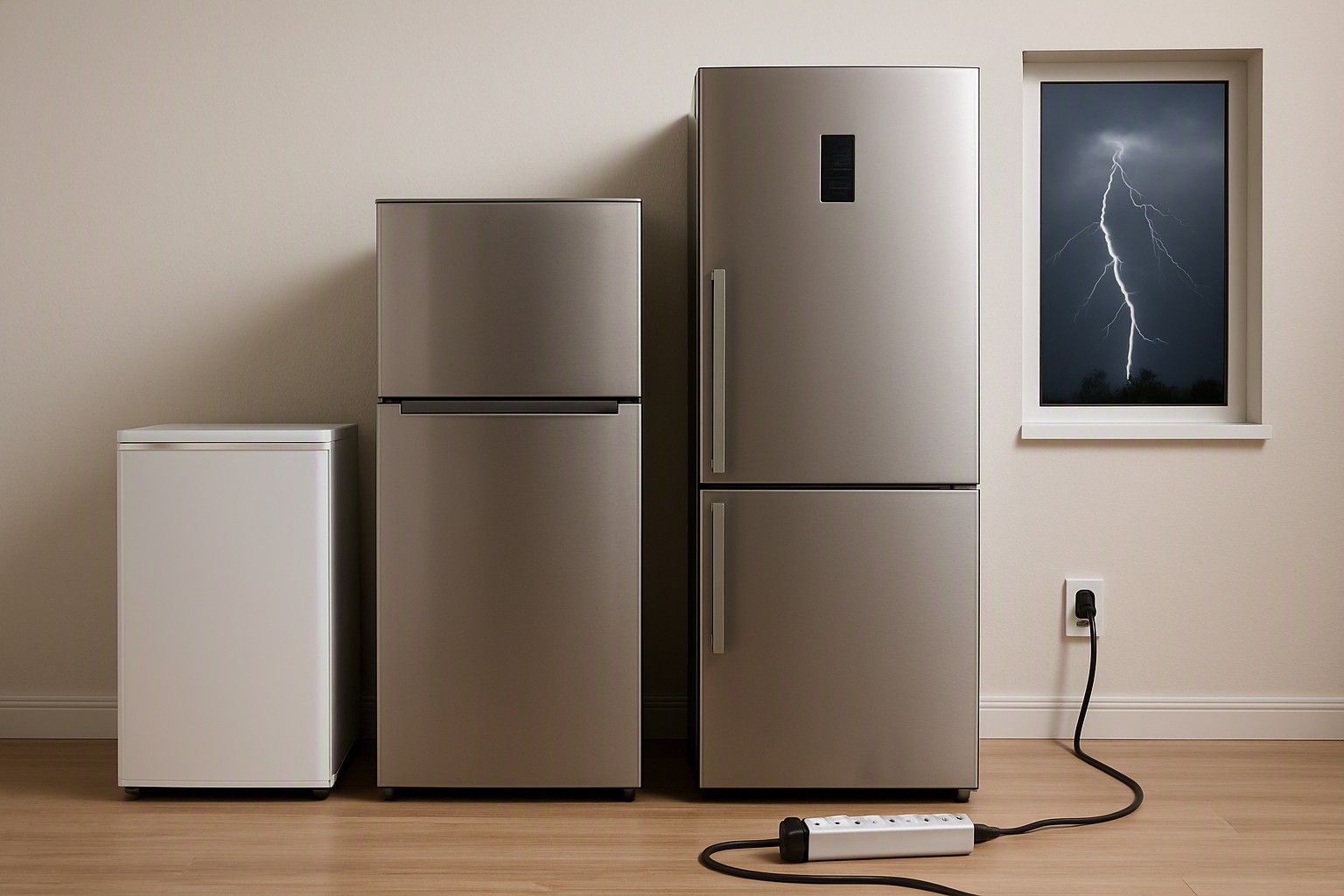
If your area sees long power cuts or your voltage swings enough to trip appliances, the refrigerator you buy needs to handle both — not just cool efficiently on paper. This isn't about star ratings alone; it's about how long the cabinet holds temperature once the power goes, and whether the compressor survives years of unstable current. That's the lens this guide uses to answer which fridge actually copes with India's power reality.
How Long a Fridge Stays Cold Without Power
A refrigerator is essentially a box of stored cold, and how long it stays usable during an outage depends on insulation quality, how full it is, and how often the door gets opened. A well-insulated fridge that's kept reasonably full — food and bottles act as thermal mass — can hold safe temperatures for several hours in the fridge compartment, while a freezer packed with frozen items can stay safe noticeably longer than a half-empty one. Cheaper models in the ₹10,000 range often use thinner insulation and cut corners on door sealing, so they lose cold faster once compressor cycling stops. Mid-range fridges in the ₹22,000 and ₹45,000 bands generally use better foam insulation and tighter gaskets, which buys real extra hours during a cut.
If outages in your area regularly run past two to three hours, don't rely on the fridge's base insulation alone — keep it fuller than you might otherwise, avoid opening the door during the cut, and treat insulation quality as a genuine buying criterion, not an afterthought. This matters more than brand reputation or finish, because it's the one factor that directly determines whether your food survives the next long cut without spoiling.
Inverter Compressors and Battery-Backed Cooling
Inverter compressors don't switch fully off and on the way older fixed-speed compressors do — they modulate speed to match cooling demand, which means the compressor is already running in short, efficient bursts rather than long stop-start cycles. This matters during voltage instability because inverter compressors typically have wider input voltage tolerance built into their control electronics, so brief dips or surges are less likely to trip the compressor or throw an error state compared to a basic fixed-speed unit reacting badly to the same fluctuation. That said, an inverter compressor still needs power to run — it doesn't store cooling capacity, it just uses power more intelligently while power is available.
Battery-backed or inverter-battery-compatible cooling is a separate consideration, relevant mainly if you already run a home inverter or plan to. Some fridges are explicitly rated to run off inverter backup power without drawing more than the backup system can handle, which is useful in areas with frequent, longer cuts. If you're deciding between a standard fixed-speed compressor and an inverter one purely for outage resilience, the inverter option holds a practical edge: it copes better with the voltage instability that often accompanies grid restoration after a cut, when supply is at its most unpredictable.
Built-In Stabiliser vs External Stabiliser
Many fridges sold in India today come with a built-in voltage stabiliser, which protects the compressor from voltage swings without needing a separate box wired in. This works well for moderate fluctuations and is genuinely convenient — one less component to install, wire, or maintain, and one less point of failure in the setup. Built-in protection is usually rated for a certain voltage band, and as long as your area's fluctuations stay within that band, it does the job quietly in the background.
An external stabiliser becomes the better call in areas with severe or frequent voltage swings — rural or semi-urban areas on long distribution lines, for instance, where voltage can dip or spike well outside what a built-in unit is rated to absorb. External stabilisers are also easier to service or replace on their own if they fail, without needing a technician inside the fridge's internals. The trade-off is upfront cost and a bit of extra wiring, but if you've already had a compressor damaged by voltage issues before, or you know your area's supply is genuinely erratic rather than just occasionally unstable, spending on a dedicated external stabiliser is the more defensive choice. For most buyers in areas with only mild fluctuation, though, a fridge with adequate built-in protection is sufficient and simpler.
Why Inverter Tech Also Saves Electricity
The same inverter compressor that handles voltage swings better also runs more efficiently day to day, because it avoids the energy spikes that come with a fixed-speed compressor's full stop-start cycling. Over months of use, that efficiency shows up directly on your electricity bill, not just in resilience during outages. If you're already leaning toward an inverter model for its power-cut behaviour, it's worth understanding exactly how inverter compressors cut your running cost too, since the same feature is doing double duty — protecting the compressor from bad power and lowering what you pay for good power. That combination is a large part of why inverter models, even at a higher upfront price within the ₹22,000 or ₹45,000 range, tend to work out cheaper to own over a few years than a similarly priced fixed-speed alternative.
Protecting Your Fridge Long-Term From Voltage Damage
Voltage damage rarely kills a compressor in one dramatic event — it's usually cumulative, small surges and dips stressing the windings and electronics over months or years until the compressor either seizes or starts drawing abnormal current. This is exactly why the stabiliser question isn't a one-time install decision; it's ongoing protection that determines whether your fridge's compressor lasts its expected lifespan or fails early. A compressor is also the single most expensive component to replace on a refrigerator, and in many cases the repair cost approaches what you'd pay for a new lower-tier unit, which changes the economics of the decision entirely.
Before you commit to skipping a stabiliser to save money upfront, it's worth knowing what a compressor failure costs to repair later, because that figure usually makes the case for spending on protection now rather than gambling on stable supply. Warranty terms also matter here — some manufacturers void or limit compressor warranty claims if damage is traced to voltage issues and no stabiliser was in use, so check the fine print rather than assuming the warranty covers every failure mode regardless of cause.
Factoring Power Reliability Into Your Choice
Power reliability in your specific area should sit alongside capacity, cooling type, and budget as a core filter, not a footnote you consider only after you've already picked a model. If you know outages are frequent or long, and voltage swings are a known issue where you live, that should push you toward better insulation, an inverter compressor, and either strong built-in or external stabiliser protection — even if it means spending slightly more within the ₹22,000 or ₹45,000 range rather than the cheapest option in ₹10,000. Given that prices across the category span ₹8,500 to ₹1,50,000 with an average around ₹26,000, there's enough range to find outage-resilient features without necessarily buying at the top end.
The smartest way to approach this is to add outage resilience to the rest of your checklist rather than treating it as a separate purchase decision — capacity, frost-free versus direct-cool, and star rating all still matter, but none of them help you if the unit you choose can't survive your area's actual power conditions. Decide with your local power reality in view, and you won't need to revisit this choice because of a cut or a surge you could have planned for.
The refrigerator that handles power cuts and voltage swings well isn't a single named model — it's one that pairs decent insulation with either an inverter compressor or adequate stabiliser protection matched to how unstable your local supply actually is. Match that combination to your area's real outage pattern, and you've answered the question that brought you here: not which fridge is popular, but which one keeps your food safe when the power doesn't.
Comments
Be the first to comment.