Refrigerator Capacity Guide: How Many Litres for Your Family Size
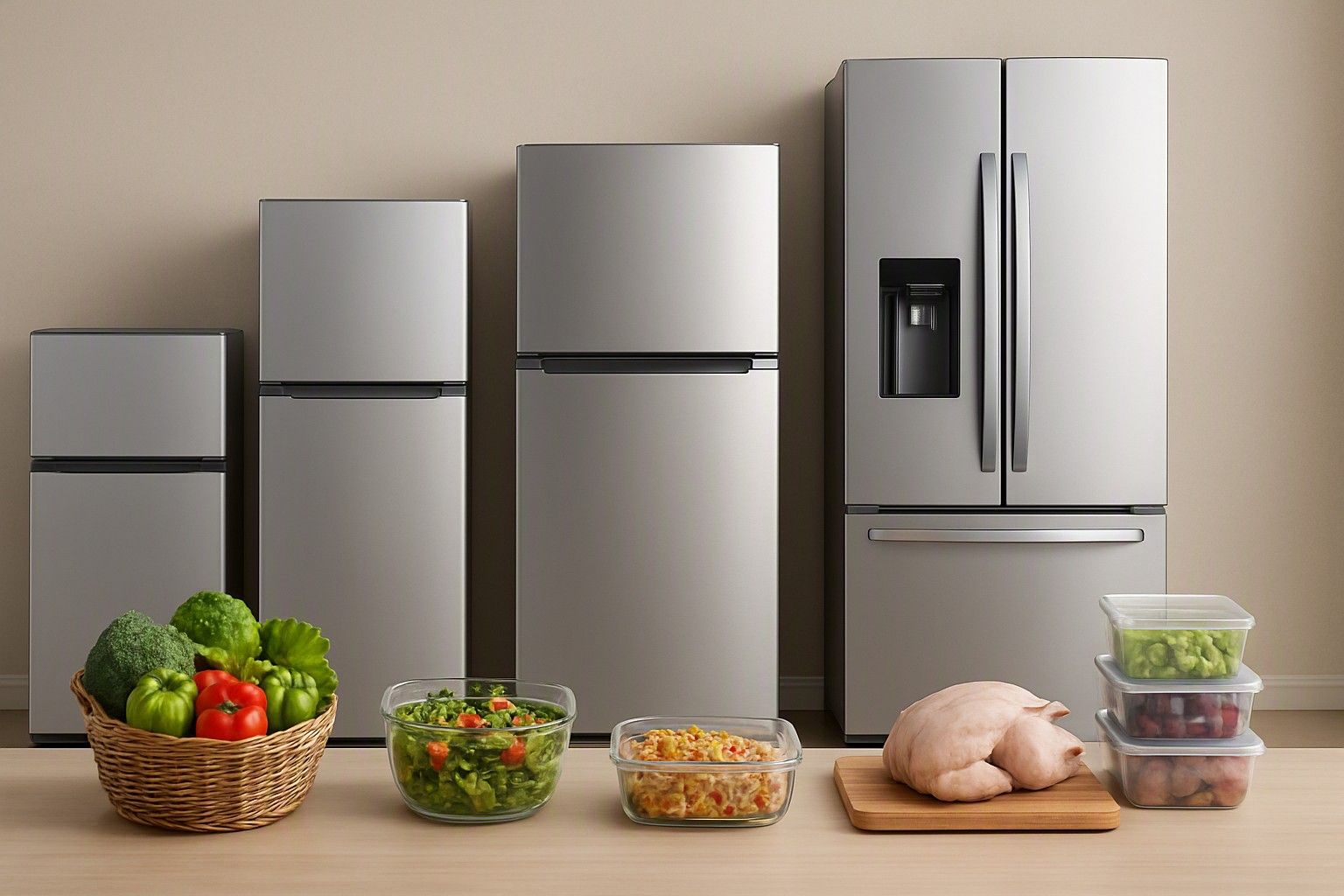
If you're standing in a showroom or scrolling listings wondering whether 190 litres is too small or 500 litres is overkill, this is the question this article answers: how many litres of refrigerator does your household actually need. The right number depends less on how many people live in your home and more on how you cook, shop and store food day to day.
Litres per Person: A Simple Indian Household Rule
A rough starting rule that works well for most Indian households is to budget between 50 and 80 litres per person living in the home. This isn't a scientific formula, but it accounts for the way Indian kitchens actually work: daily fresh vegetables, cooked dal and curries stored for the next meal, milk, curd set at home, and a freezer stocked with parathas, ice or the occasional non-vegetarian batch cooking. A single person living alone can usually get by on 150 to 200 litres, since the meals-per-week and grocery-run frequency stay low. Add a second adult and the number climbs toward 250 to 300 litres simply because two people generate more leftover storage, more dairy, and more condiments that live in the door racks.
Where this rule needs adjusting is diet and lifestyle. A household that eats out often, orders groceries every couple of days, or doesn't cook large batches can comfortably run a smaller fridge than the per-person math suggests. On the other hand, a home with growing children, frequent guests, or someone who cooks elaborate meals from scratch will find that the same headcount needs meaningfully more litres than a minimalist household of the same size. Use the per-person number as a floor, not a fixed answer, and adjust it against how your kitchen is actually used before you decide on a capacity.
Capacity for Couples, Nuclear and Joint Families
For a couple with no children, 250 to 300 litres is typically the sweet spot. It's enough for a proper vegetable drawer, dairy, some frozen items and party-time buffer, without paying for space that sits empty most of the month. Once a couple has one or two children, the practical range shifts up to 300 to 400 litres, mainly to accommodate milk in larger quantities, tiffin-friendly leftovers, fruit for kids, and the general unpredictability of a growing family's eating habits.
Joint families, or any household of five or more where cooking is centralised rather than split across smaller units, usually need 400 to 500 litres or more. The logic here isn't just headcount, it's that joint families tend to cook once for everyone rather than in small individual batches, which means bigger vessels of curry, rice and dal going into storage at once, along with higher volumes of vegetables, fruit and dairy bought in bulk to save on repeated shopping trips. A joint family trying to run on a 300-litre fridge will typically find themselves overstuffing shelves, blocking airflow, and running to the market far more often than they'd like.
Across all these household types, price tends to track capacity fairly closely, moving from the ₹10,000 range for compact single-door models from popular refrigerator brands up through ₹22,000 and into ₹45,000 as litres and features increase, with the broader market spanning ₹8,500 to ₹1,50,000 and averaging around ₹26,000. Buying close to your actual household need, rather than stretching for a number that sounds impressive, keeps you from overpaying for space you won't use.
Extra Space for Bulk Cooking and Festivals
Indian households often need to plan for volume spikes that a simple per-person calculation misses entirely. Festival cooking is the clearest example: Diwali sweets, Holi snacks, or a wedding season of guest meals can mean storing two or three times the normal volume of prepared food, dough, paneer, and fruit for a few weeks at a stretch. If your family regularly hosts relatives, cooks for community events, or preserves seasonal produce like mango pulp or pickles in bulk, it's worth adding 50 to 100 litres above what your day-to-day headcount suggests.
This is also where the buffer matters for practical reasons beyond just fitting things in. A fridge packed to capacity loses cooling efficiency because air can't circulate properly around stored items, which means food near the back or bottom may not chill as evenly as it should. Households that cook in bulk for the week, common in joint families and in homes where both parents work, benefit from having enough spare shelf space that a Sunday batch-cooking session doesn't mean playing shelf-tetris every time the door opens.
The smart approach is to size your fridge for a realistic "busy month" rather than an average one. If you only ever hit peak storage needs a few times a year, that's still worth planning for, because being consistently over capacity accelerates wear on the compressor and makes the fridge run less efficiently than its rating suggests, which matters more the longer you plan to keep the appliance.
How Freezer Size Changes Your Choice
Total litres only tells part of the story, because how that space is split between fridge and freezer compartments varies a lot depending on the fridge type you choose. A single-door fridge typically gives you a small top freezer section that's fine for ice trays and short-term frozen storage but not built for bulk freezing. A double-door or frost-free fridge usually offers a proper dedicated freezer compartment that can handle frozen vegetables, meat, or a few weeks of prepped food, which matters a great deal if your household freezes in bulk or buys meat and paneer in larger quantities to save on trips.
This is worth thinking through before you fixate on a single litre number, because the type you pick caps how much freezer room you get, regardless of the total capacity printed on the box. Two fridges with the same overall litres can behave very differently in daily use if one allocates generously to the freezer and the other keeps it minimal. If your family relies on the freezer for anything beyond ice and the occasional frozen paratha, check the specific freezer litres, not just the combined total, before deciding on a model.
Bigger Fridge, Bigger Electricity Bill?
It's natural to assume that a larger fridge automatically means a noticeably higher electricity bill, and there is some truth to that, but capacity is only one variable in the equation. A 500-litre fridge with a strong star rating can run more efficiently than a smaller, older, poorly-rated model, because compressor technology and insulation quality matter as much as sheer size. That said, all else being equal, moving up in litres does mean more space to cool and more surface area to insulate, so it's reasonable to expect somewhat higher running costs as capacity increases.
The practical way to think about this is to separate the decision into two questions: how many litres does your household genuinely need, and then, within that size bracket, how larger capacity affects running cost based on the star rating and compressor type you choose. Buying a bigger fridge than you need purely because it seemed like better value per litre often backfires, since you end up paying more upfront and more every month to run and cool space that never gets used. Right-sizing first, then optimising for efficiency within that size, tends to save more money over the fridge's life than chasing capacity for its own sake.
Fitting Capacity Into the Wider Buying Decision
Litre capacity is one of the clearest, most concrete numbers you'll compare while shopping, but it was never meant to be decided in isolation. The same household size can be served well by very different fridges depending on budget, kitchen layout, and how much you value features like frost-free convenience or a larger vegetable crisper. A family that has settled on needing 400 litres, for instance, still has real choices to make between models priced anywhere from the lower end of ₹22,000 to well into ₹45,000, and those price differences usually reflect cooling technology, energy efficiency and build quality rather than capacity alone.
Once you have a litre range in mind from this guide, the next useful step is to weigh litres against price, cooling and space together so the capacity number you've settled on actually fits your kitchen space, your budget, and the other features that matter for daily use. Capacity answers one part of the question; the rest of the decision still needs the fuller picture.
With a litre range matched to your family size, your cooking habits, and how much bulk or festival storage you realistically need, you're no longer guessing at a number off a showroom sticker, you know exactly what size fridge your household needs and why.

Comments
Be the first to comment.