Member 1 · You
7×
1×/wk14 · 2×/day
Typical program
Lower heat, longer cycle — best for daily lightly soiled loads.
See what your dishwasher really costs to run — electricity, water and per-wash consumables. Pick countertop, freestanding or built-in, your household's cycles and local rates for an instant India-first estimate.
~₹5,970/yr
avg yearly dishwasher electricity + water + consumables cost, Indian home
Pick the format closest to your machine. Check the spec sheet for place settings, energy per cycle and water use.
Add each person whose dishes the machine washes. Cycles per week and the program used can differ per person.
Typical program
Lower heat, longer cycle — best for daily lightly soiled loads.
India-first defaults: ₹6.5 per kWh, ₹0.02 per litre of water and ₹10 per wash for consumables. Edit all three to match your bill and shopping.
Typical: ₹6.5/kWh
Typical: ₹0.02/L · Tanker ~₹0.35/L
Covers detergent, softener salt and rinse aid · Typical ₹8–₹15/wash · Tablets ₹10–₹20 each
The price tag is only the start. A dishwasher's real monthly cost has three parts: electricity — mostly the inbuilt heater warming the wash and rinse water plus the drying phase — water, about 8–15 litres for a full cycle, and consumables: detergent, softener salt and rinse aid, which hand washing simply does not buy.
The machine's big win is water and time. A dishwasher fills once and recirculates 8–15 litres, while hand washing the same day's utensils under a running tap commonly uses several times that. What it does not do is cut your power or soap bill — so it pays to know the real per-wash number before you commit.
Defaults are India-first: ₹6.5 per kWh, ₹0.02 per litre for water (raise it to ~₹0.35 if you buy tankers) and ₹10 per wash for consumables. Everything updates live as you change your machine, programs and rates.
Each cycle is priced as (kWh × ₹/kWh) + (litres × ₹/L) + consumables ₹/wash, multiplied by cycles per week and by 4.33 weeks for the month. Eco is the baseline; Intensive adds 50% energy and 25% water; Quick uses 60% energy and 80% water. Cycles are summed across all members of your home.
| Assumption | Value |
|---|---|
| Countertop · Eco energy / cycle | 0.60 kWh |
| Freestanding · Eco energy / cycle | 0.95 kWh |
| Built-in · Eco energy / cycle | 0.90 kWh |
| Water per Eco cycle | 8 L countertop · 11–12 L full-size |
| Program multipliers | Intensive ×1.5 kWh · ×1.25 water · Quick ×0.6 · ×0.8 |
| Consumables default | ₹10 per wash (detergent + salt + rinse aid) |
| Weeks per month | 4.33 |
| Default tariffs | ₹6.5/kWh · ₹0.02/L · ₹10/wash |
Estimates only — real use varies with load size, inlet water temperature, soil level and drying type. See your electricity bill and water receipt for your exact tariffs.
Monthly cost below assumes 7 Eco cycles/week (roughly one a day) at ₹6.5/kWh, ₹0.02/L water and ₹10/wash consumables (detergent + salt + rinse aid).
| Type | Place settings | Eco cycle | Water / cycle | Monthly total |
|---|---|---|---|---|
| Countertop 6–8 | 6–8 place settings | 0.6 kWh | 8 L | ₹426 |
| Freestanding 12–14 · selected | 12–14 place settings | 0.95 kWh | 12 L | ₹498 |
| Built-In 12–14 | 12–14 place settings | 0.9 kWh | 11 L | ₹487 |
Run full loads
Wait for a full rack unless your machine has a genuine half-load program — a half-empty cycle uses nearly the same heat and water as a full one.
Eco for daily, Intensive for kadhai days
Heating the water is the biggest draw. Eco's lower temperature handles plates, cups and tiffins; save Intensive for greasy gravies and burnt vessels.
Scrape, don't pre-rinse
A quick scrape keeps the filter clean. Rinsing every plate under a running tap can waste more water than the whole cycle uses.
Powder + separate salt & rinse aid
Powder is the cheapest per wash and lets you dose to load size. All-in-one tablets are convenient but cost more per cycle.
Open the door after the cycle
Residual heat finishes the drying once the door is ajar, so you can skip hot-air drying and its extra units.
Set the softener to your water hardness
Too little salt leaves scale and spots; too much wastes money. Match the setting to your area's hardness and refill on the indicator.
A countertop 6–8 place machine uses about 0.6 kWh on an Eco cycle; a 12–14 place freestanding or built-in machine about 0.9–0.95 kWh. Intensive cycles run roughly 50% higher — about 1.4–1.5 kWh on a full-size machine — because they heat the water hotter and for longer.
Our defaults: about 8 L per Eco cycle for a countertop and 11–12 L for a 12–14 place machine, with Intensive adding about 25%. Efficient full-size models typically land in the 10–15 L range for a whole cycle. Hand washing the same utensils under a running tap commonly uses several times that.
With the defaults (freestanding, Eco, one cycle a day) it works out to about ₹16 per wash — roughly ₹6 electricity, ₹0.25 water and ₹10 for detergent, salt and rinse aid — around ₹500 a month or ₹5,970 a year. Intensive cycles and hard-water salt top-ups push it higher.
Not on power and detergent — hand washing uses almost no electricity, and dishwasher detergent, salt and rinse aid are new recurring costs. The dishwasher wins on water and time. If a maid stays on for other chores anyway, the machine won't pay back in money; justify it on hygiene, water and evenings saved.
Yes. Heating the wash water is the largest part of a cycle's energy, and Eco runs at a lower temperature (the cycle is longer, but cheaper). Save Intensive for greasy kadhai, tawa and gravy loads; Quick suits lightly soiled items, not oil and masala.
Powder is usually the cheapest per wash (roughly ₹3–₹6) and lets you dose to load size, but you add rinse aid and softener salt separately. Tablets are pre-measured and cost ₹10–₹20 each; all-in-one tablets still don't replace softener salt in hard water.
Salt regenerates the built-in softener and matters only where water is hard — in soft-water areas you can often skip it. Rinse aid helps water sheet off so steel and glass dry without spots. Both are optional, and both are included in the consumables figure this calculator uses.
It is the biggest single draw. A 1.2–2 kW heater warms the wash and rinse water, and that heat is what cleans Indian oily cooking — which is why Eco vs Intensive changes the bill so much. A hot-water inlet line (solar or geyser) would reduce it, but most Indian installs use a cold inlet, as assumed here.
Run full loads, use Eco for daily dishes and Intensive only for greasy vessels, scrape instead of pre-rinsing, dose powder to load size, set the softener to your water hardness, and open the door after the cycle so residual heat does the drying.
No — scrape food scraps into the bin and load. A pre-rinse under a running tap can use more water than the cycle itself, and modern detergent plus the heater handles the rest. Soaking only the burnt-on bases of cookware is still worth it.
Capacity, hard water, installation and price guides to help you pick the right dishwasher — with specs and real prices.
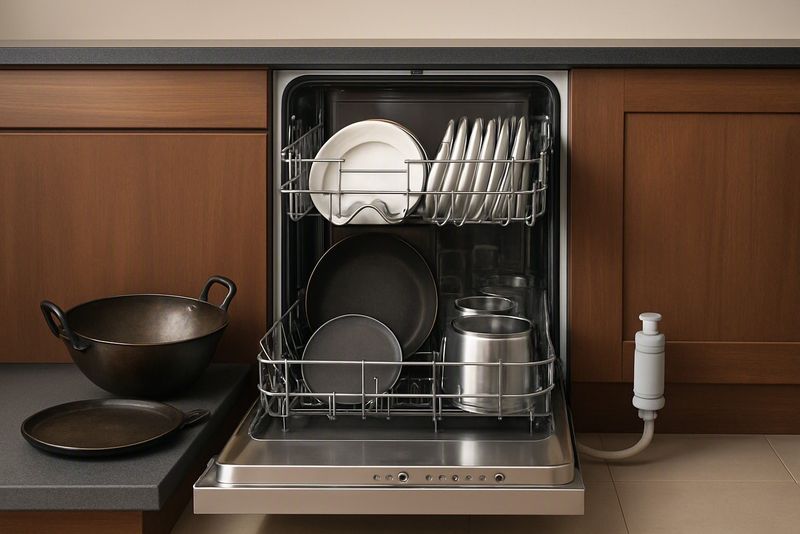
Choose a dishwasher for Indian kitchens: cleaning on kadai and tawa, capacity, hard water, features, installation, price bands and upkeep, all in one guide.
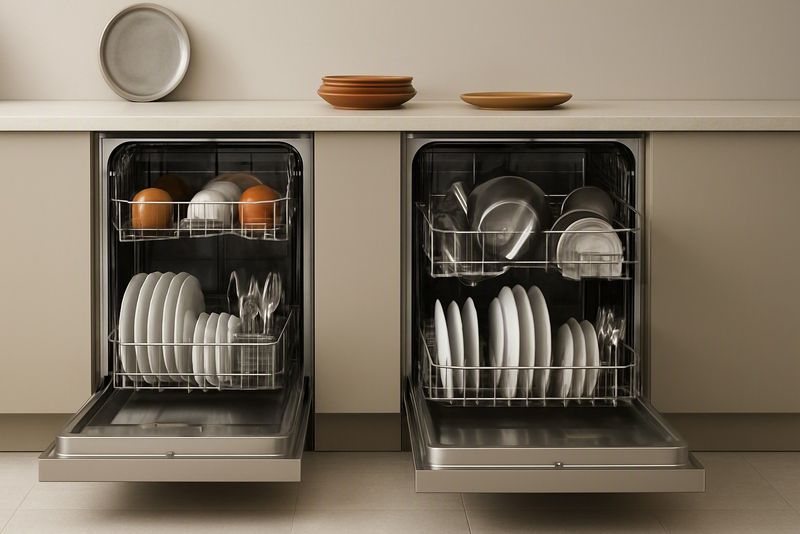
Is a 12 or 14 place setting dishwasher enough for a family of four? See how Indian meals and vessels change capacity needs, from couples to joint families.
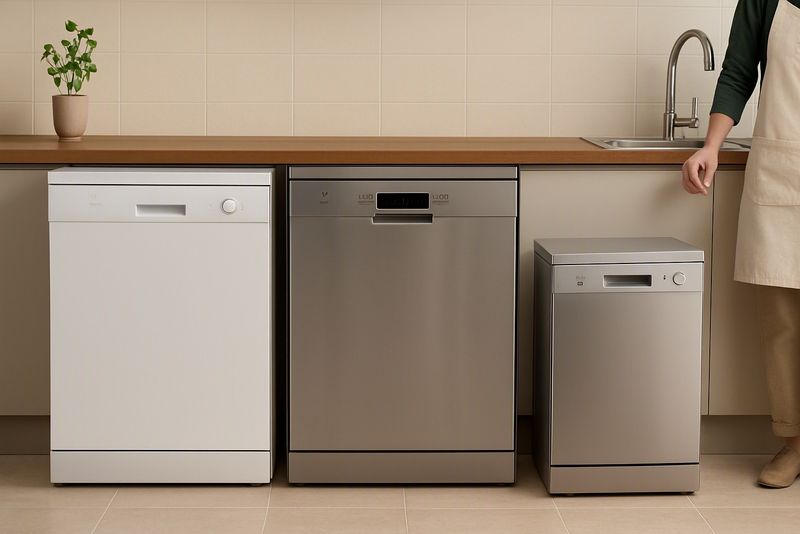
Compare freestanding, built-in and countertop dishwashers on size, installation, cost and service to pick the right type for your Indian kitchen.