How Many Place Settings Do You Need? Dishwasher Capacity for Indian Families
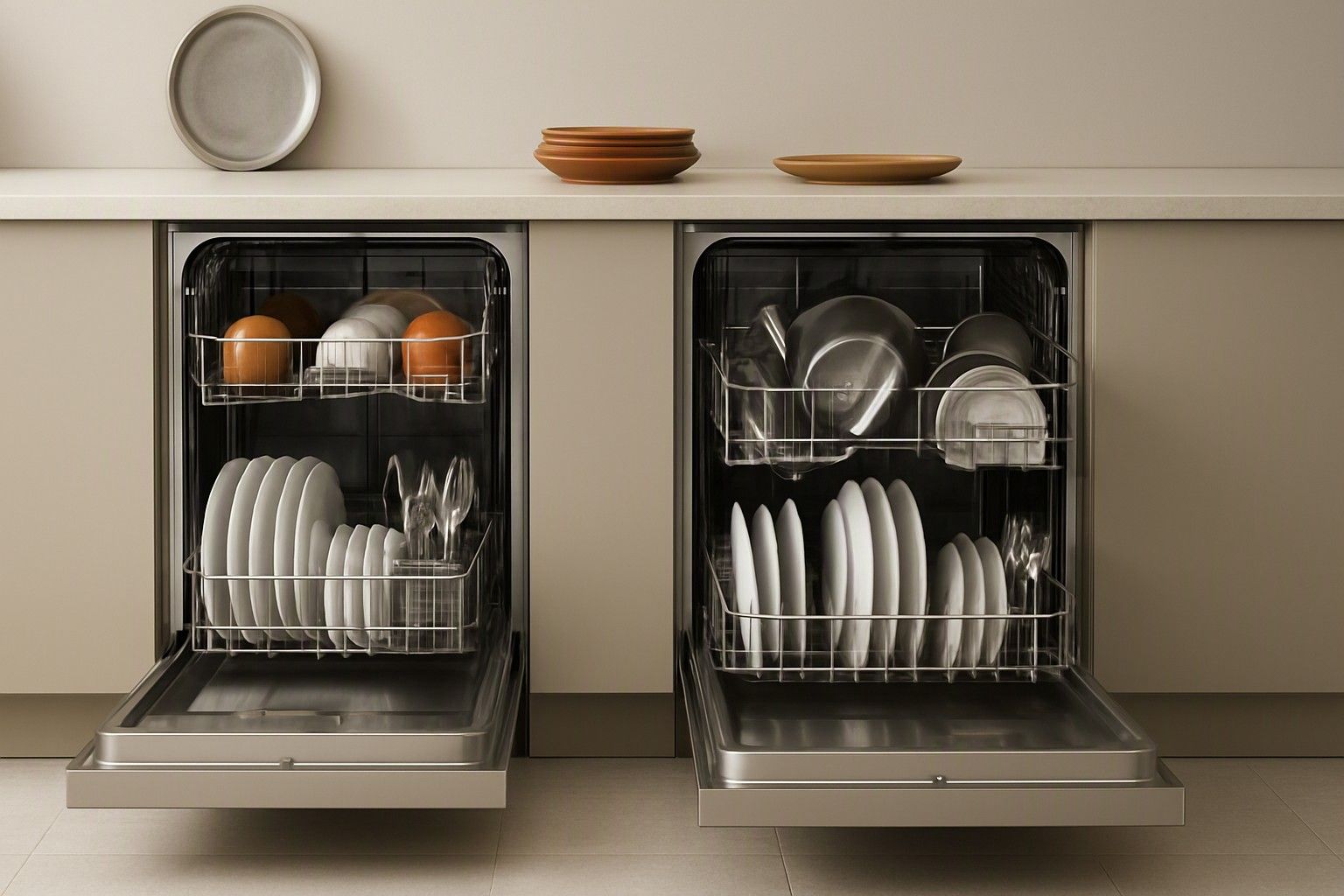
For a family of four, a 12 or 14 place setting dishwasher is usually enough if you load it twice a day, and 14 is the safer pick if you want to run it once. The catch is that place-setting ratings assume a Western meal, so a rating that looks generous on paper shrinks quickly once cookers, kadais and thalis go in. This guide shows how to translate the number on the box into what your own kitchen produces.
What a Place Setting Means and Why It Undercounts Indian Meals
A place setting is a fixed set of crockery and cutlery for one person: a dinner plate, a smaller plate, a soup bowl, a glass, a cup and saucer, and a few pieces of cutlery. A 12 place setting machine is rated on how many of those sets fit in its racks. The rating comes from Western table habits, where each person eats from a few flat plates and the pots stay small.
An Indian meal looks different. One person may use a large thali, three or four katoris, a steel glass and a spoon. Cooking leaves behind a pressure cooker, a kadai, a tawa, ladles, a steamer and lids, none of which are counted in the rating. Tiffin boxes, water bottles and mixer jars add to the pile.
So a place setting is a measure of plates, not of your kitchen. Treat the stated number as the capacity for dining ware alone, and expect cooking vessels to take a large share of the space. That is why a machine that seems oversized for a family of four can feel just right once you load it the way you actually cook.
Capacity by Family Size: Couples, Nuclear Families and Joint Families
These are rules of thumb, not guarantees. Your cooking style moves the numbers.
Couples (2 people): A compact machine in the 8 to 10 place setting range handles daily dining ware well. If you cook full meals at home and use big vessels often, a standard 12 place setting gives you room without wasting much space.
Nuclear families (3 to 4 people): This is where the 12 versus 14 question sits. A 12 place setting machine works if you are happy to run it twice a day, after lunch and after dinner. A 14 place setting machine is the better fit if you want to run it once a day, since one day's thalis, katoris and cooking vessels can overflow a 12.
Larger nuclear families (5 to 6 people, or with regular guests): Go for 14 at minimum, and consider the largest capacities available. Running two cycles a day is still the realistic pattern here.
Joint families (6 or more people): Even the biggest household machine will usually need two loads a day, and more on festival days. Buy for the daily routine, not the festival peak. For occasional feasts, washing the largest vessels by hand is a reasonable compromise.
Fitting Cookers, Kadais and Large Thalis: Why Rack Design Matters
Two machines with the same place-setting rating can behave very differently with Indian vessels, because rack design decides what actually fits. Start with the lower rack. Look for tines that fold down or lie flat, so a kadai or a pressure cooker base can sit upright or tilted instead of being forced between fixed prongs. Check the height between the lower and upper racks, since a tall cooker needs clearance, and a low upper rack can block it.
The upper rack matters just as much. An adjustable-height upper rack lets you raise it for tall items on the bottom or lower it to fit large glasses on top. A separate cutlery tray, rather than a basket, frees space on the lower rack for big vessels. Large thalis need slots wide enough to stand upright without touching, otherwise water cannot reach every surface.
Before you buy, measure your biggest regular vessels, such as the cooker, the widest kadai and your standard thali, and compare them to the rack dimensions in the specification sheet. Size is only half the question, because material and build decide cleaning results too, so read up on which heavy vessels clean well in a machine before deciding how much of your cookware you plan to load.
Once-a-Day vs Twice-a-Day Loading
Your loading habit changes the capacity you need more than family size does.
If you run the machine once a day, usually after dinner, it must hold the whole day: breakfast plates, tiffin boxes, lunch thalis, evening chai cups, dinner vessels and all the cooking pots. A family of four can easily cross 12 settings' worth of space this way, which is why 14 is the more comfortable choice. The advantage is a single cycle, one unloading session and lower running effort.
If you run it twice a day, after lunch and after dinner, each load is smaller and a 12 place setting machine is usually enough for four people. The trade-off is that the machine runs more cycles, and you must be disciplined about loading it right after meals, since dirty vessels sitting in the rack for hours can leave dried food that is harder to clean.
There is also a hybrid pattern: run the machine once on regular days and add a second cycle when guests are over. If that sounds like your home, buying one size up gives you breathing room and avoids paying the cost of a mismatch every time the household grows.
Half-Load Options for Lighter Days
Not every day produces a full load. A weekday when only two of you eat at home, or a day of light cooking, can leave the racks half empty. Running a full cycle on a half load wastes water, power and time, and a larger machine makes this more likely.
Some models offer a half-load option that concentrates washing on one rack, usually the lower or the upper, using less water for the smaller batch. Quick programs help too, since they handle lightly soiled dining ware in much less time. These features matter more if you are leaning towards a bigger capacity, because they let you own the larger machine without paying for its full appetite every day.
Before choosing, check whether the machine you are considering actually has these options, and how they work on the rack you would use. To see what each setting does and how drying fits in, read about half-load and quick programs for smaller batches. If your household swings between light and heavy days, a 14 place setting machine with a good half-load mode is often more practical than a 12 that overflows on busy days.
Picking a Size That Fits Both Kitchen and Family
Capacity is only useful if the machine fits your kitchen and your budget. Standard full-size machines need a fixed width, height and depth, plus space to open the door and pull out the racks fully. Measure the spot you have in mind, including the clearance for the door swing, and confirm where the water inlet, drain and power point sit.
On price, models across the category run from ₹25,000 to ₹80,000, with an average of ₹42,000. Smaller capacities generally sit toward the lower end, and larger ones with more flexible racks tend to move up. As a guide, the ₹28,000 tier suits couples and small households, the ₹45,000 tier is where most 12 to 14 place setting machines for families of four are found, and the ₹65,000 tier opens up larger capacities and more rack flexibility. Treat these as pointers, not promises, and check each model's specifications.
If you are deciding today, match capacity to your real loading habit first, then check rack design, then budget. For the bigger picture of how capacity fits with type, budget and installation, the buying guide covers the rest of the decision.
So, is 12 or 14 enough for a family of four? Twelve works if you load twice a day, fourteen works if you load once, and a joint family should plan for two loads regardless of size. Check the rack layout against your own cooker, kadai and thalis, and you can settle on a capacity with confidence.

Comments
Be the first to comment.