Freestanding vs Built-In vs Countertop Dishwashers: Which Suits Your Kitchen?
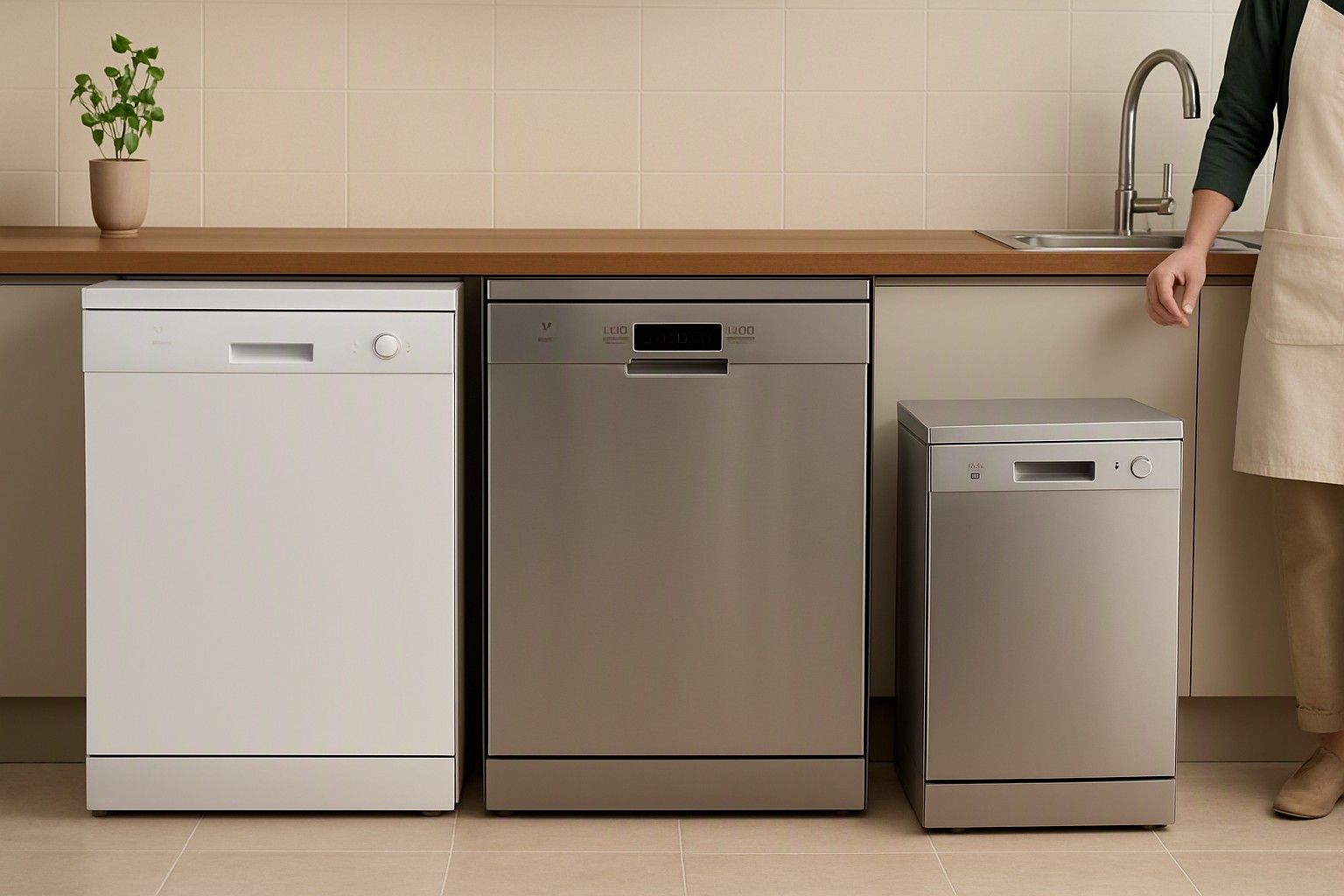
If your kitchen is rented, modular or short on counter space, the right dishwasher format will be different in each case, and this article helps you work out which one is yours. Freestanding, built-in and countertop units all wash dishes the same basic way. What separates them is where they sit, what they demand from your kitchen, and how easy they are to service. Settle the format first, and the feature comparison that follows gets much simpler.
How the Three Types Differ in Size and Placement
The three formats are best understood by where each one physically lives in your kitchen.
Freestanding units are full-size machines, usually around 60 cm wide, with finished sides and a top. They can stand alone against a wall or slide under a counter with some clearance. Slimmer versions exist for narrower spaces.
Built-in units are the same sort of full-size machine, but designed to disappear into a cabinet run. They sit in a dedicated niche between other cabinets, often with a front panel that matches your modular shutters, so the dishwasher is not visible as an appliance at all.
Countertop units are compact machines that sit on your platform or a sturdy table. They are much smaller in both footprint and internal space, and they take up counter area you may already be short of.
All three need the same three things: a water inlet, a drain outlet and a power point. The difference is how much planning those connections take. A freestanding or countertop unit can usually borrow what is near the sink. A built-in needs those connections routed to a fixed spot before the cabinetry is finished.
Freestanding: The Flexible Choice for Rented Homes
A freestanding dishwasher is the format that moves with you. Because it is not fixed into cabinetry, you can disconnect it, load it into a vehicle and reinstall it in your next flat. For anyone on a lease, that portability is the main argument, since you are not spending money on a fixture that stays behind with the landlord.
Installation is usually light. The machine needs to stand near the sink so the inlet hose can reach a tap connection and the drain hose can reach the sink outlet or a nearby drain point. It also needs a power socket within reach and a level floor. No carpentry is involved, and most landlords have no objection to a machine that leaves no permanent mark.
Capacity is the other strength. A full-size freestanding unit has room for the large, awkward items that pile up after Indian cooking, such as kadhais, big vessels and tiffin sets, and it suits a family that cooks daily.
The trade-off is floor space. You need roughly 60 cm of width, plus gaps at the back and sides for hoses, and in a narrow galley kitchen that can be hard to find. It will also look like an appliance, because it is one, which may bother you in a carefully designed kitchen.
Built-In: Planning It Into a Modular Kitchen
A built-in dishwasher makes sense when you own the home and the kitchen is being designed or renovated. Done well, it gives the cleanest look: the front panel matches your shutters, nothing sticks out, and the work triangle stays tidy.
The catch is sequencing. The machine has to be chosen before the carpenter finalises the carcass, because the niche dimensions, the clearance for the door to open, and the routing of the water and drain lines all depend on the exact unit. Reading up on the plumbing and cabinet cut-out needs for integrated units before you sign off the kitchen layout can save you an expensive rework later.
It is also a long-term commitment. Once it is fitted, replacing it with a different model means the new unit must match the niche, and moving house means leaving it behind. That makes it a poor fit for tenants and a sensible one for owners who expect to stay put.
If your modular kitchen is already complete and no space was left for a dishwasher, retrofitting a built-in is usually more trouble than it is worth. In that situation a freestanding or countertop unit is the more realistic route.
Countertop: For Compact Kitchens and Small Families
A countertop dishwasher is the answer when the kitchen has no floor space to give but does have a clear stretch of platform. It plugs in, connects to the tap or sink, and sits beside the basin, so it needs no cabinet changes at all. That makes it the easiest of the three to try in a small rented flat.
The limit is how much it holds. These machines are sized for a small household, and the interior is shallow. Before buying, look closely at how much a tabletop model can actually hold, because a rated number of place settings is measured with standard plates and bowls, not with a pressure cooker lid or a wide kadhai. Large cookware often has to be washed by hand anyway.
Check two practical things too. The platform must be strong enough to carry the machine's weight when it is full of water and crockery, and you need enough free counter that you are not giving up your main prep area. Some compact units also run noticeably louder in a small room, since there is no cabinetry around them to absorb sound.
For a couple or a small family with light cooking, it works well. For a joint family with heavy daily cooking, it will probably feel undersized within weeks.
Cost and Service Differences Between Types
Across the dishwasher category, prices run from ₹25,000 to ₹80,000, with an average of ₹42,000. Three tiers help you place a purchase: under ₹28,000, ₹45,000, and ₹65,000. Compact countertop models tend to sit toward the lower end of that spread, while larger freestanding and built-in machines make up more of the middle and upper tiers. Treat that as a pattern, not a rule, since capacity and features move the price as much as format does.
The machine price is only part of the cost of the format. A built-in adds cabinetry work, panel matching and coordinated plumbing, so the total spend is higher than the sticker price suggests. Freestanding and countertop units usually need only a basic installation visit.
Service is where the formats differ most day to day. A freestanding or countertop unit can be pulled out and reached from the sides and back, so a technician can work on it quickly. A built-in sits inside fixed cabinetry, and servicing may involve removing panels or the unit itself, which takes longer and needs your carpenter's cooperation if anything was fixed tightly.
If a format fits your kitchen and your budget tier today, buy it now. The category's pricing is already settled enough to commit to a decision, and every month without a dishwasher is a month of washing by hand.
Which Type to Shortlist
Match the format to your living situation first, and your preferences second.
- Rented home: shortlist freestanding. If counter space is your only free space and the household is small, a countertop unit is the alternative.
- Owned home with a kitchen being designed or renovated: shortlist built-in, and lock the model choice in before the carpentry is finalised.
- Owned home with a finished kitchen and no gap: shortlist freestanding, or countertop if floor space is the issue.
- Small household with light cooking and limited space: countertop is a sensible, low-commitment fit.
- Large family or heavy daily cooking: lean towards a full-size freestanding or built-in, because capacity will matter more than anything else.
Once you have picked a format, you can compare models on capacity, wash programmes, water use and service coverage. The buying guide lays out the first steps, and it also covers the other checks that narrow your shortlist further. If you want that second layer of filtering, the other checks that narrow your shortlist further are all in one place there.
The format question comes down to your home, not the machine. Rented or short of space points to freestanding or countertop, an owned and modular kitchen points to built-in, and a large family points to full-size capacity. With the format settled, you can move on to comparing models within your budget tier.

Comments
Be the first to comment.