Inbuilt Heater, Drying Systems and Wash Programs: Which Dishwasher Features Matter
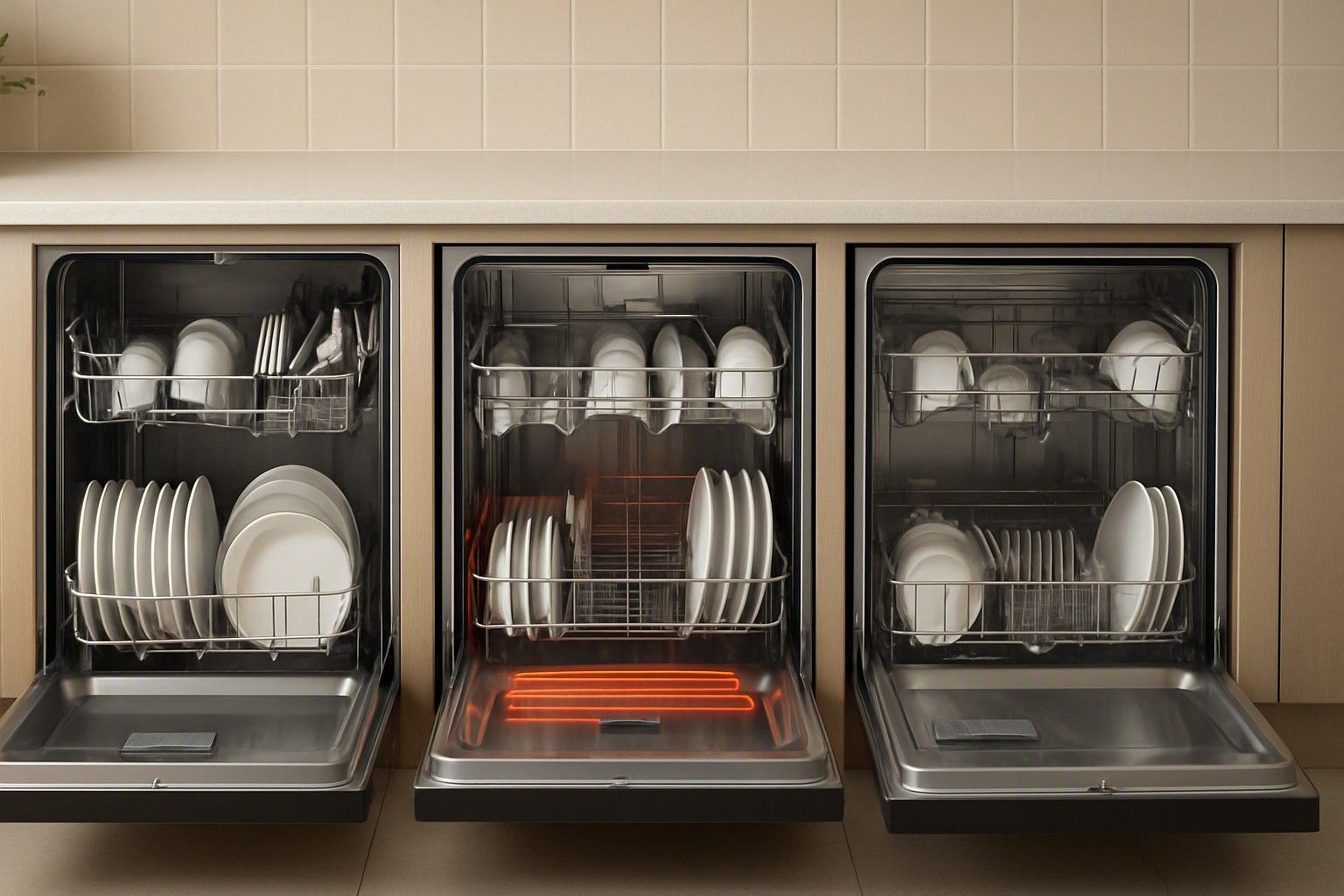
If you are comparing dishwashers for a kitchen that cooks with oil, ghee and masala every day, most of the spec sheet will not decide how clean your utensils come out. Three things do: the inbuilt heater, the drying type and the intensive wash program. This article explains what each one does, what it costs you in time and power, and which of the remaining features are marketing extras.
Why an Inbuilt Heater Matters for Greasy Indian Cooking
Fat is the main problem in an Indian kitchen's dirty dishes. Tadka oil, ghee, paneer gravies and fried residue cling to steel and glass, and cold or lukewarm water simply smears them around. An inbuilt heater warms the water inside the machine during the wash and rinse, so grease softens and the detergent can lift it off properly.
Many Indian homes connect a dishwasher to a single cold-water tap, and even where a geyser line is available, the temperature reaching the machine is unpredictable. A heater makes the result consistent no matter what comes out of the inlet. It also supports the drying stage, because a hot final rinse leaves utensils warm enough to dry on their own.
The trade-off is a longer cycle and higher electricity use than a cold-fill machine would need. For daily cooking with oil and masala, that trade is worth making, and it is the one feature we would treat as non-negotiable. For a closer look at how oily masala residue responds to hot washes, including turmeric stains and burnt-on bases, see our utensil-cleaning guide.
Intensive, Eco, Quick and Half-Load Programs Explained
Most dishwashers list four or five programs, and each one trades heat, time and water differently.
Intensive runs hotter and longer, with stronger spray. This is the program for kadhais, pressure-cooker pots, tawas and plates with dried gravy. If your household cooks oily food daily, this will be your most used setting.
Eco uses lower temperatures and runs for a long time to save water and power. It cleans lightly soiled loads well, such as tea cups, glasses and plates that carried dry food, but it is not built to handle curry residue.
Quick shortens the cycle sharply. It suits lightly soiled items you need back soon, and it is a poor choice for anything greasy because the shorter wash gives the detergent less time to work.
Half-load lets you run a partly filled machine while using less water and energy. It helps small households that would otherwise wait a day or two to fill the racks.
When reading a spec sheet, look for a genuine intensive option and a half-load option. Eco and quick are common and rarely decide anything on their own.
Drying Types: Residual Heat, Hot Air and Zeolite
Drying is where machines differ most, and it is often described vaguely in brochures.
Residual heat (condensation) drying relies on the hot final rinse. The utensils stay warm, the moisture evaporates and then condenses on the cooler tub walls and drains away. It uses little extra power and keeps cost down, but it is slow and leaves droplets on items that do not hold heat.
Hot air drying adds a fan and sometimes a heating element to push warm air through the tub. It dries faster and more evenly, at the cost of more electricity and a slightly longer total cycle.
Zeolite drying uses a mineral that absorbs moisture and releases heat as it does. It dries well without a large energy penalty, but it is generally found on costlier machines.
If your kitchen is mostly steel, residue heat drying is usually acceptable, because steel holds heat and dries quickly. If you use a lot of plastic containers and tiffins, hot air or zeolite is worth the extra spend. Opening the door slightly once the cycle ends helps with any type.
Why Plastic Containers Often Stay Wet
Plastic is the most common complaint in Indian dishwasher use, and it is mostly physics rather than a fault. Steel and glass absorb heat during the hot rinse and release it afterwards, which evaporates the water. Plastic absorbs very little heat, so water stays on it as beads, and the concave bases of containers and lids collect small pools that never evaporate.
A few habits reduce the problem. Place plastic on the top rack, away from the heating element, and angle containers so the bases face down and sideways rather than upwards. Keep lids separate and secured so they do not flip and trap water. Check that each container is marked dishwasher-safe, because cheaper plastic can warp under a hot wash.
Drying type changes how much of this you will see. A residual-heat machine will leave most plastics damp, while hot air and zeolite models cope better. Even then, expect to wipe a few small pools. If plastic tiffins and storage boxes are a big part of your load, factor that into the drying choice instead of assuming any machine will handle them.
Noise Levels for Open Kitchens and Small Flats
In a compact flat, the dishwasher may sit a few steps from the sofa or the bed, and in an open kitchen there is no door to shut. Noise then matters far more than it does in a closed kitchen with a utility area.
The spec sheet lists a decibel rating, and a lower number means a quieter machine. Treat it as a guide, because it is measured in controlled conditions and your cabinet, floor and wall all change what you hear. Quieter models generally have better insulation and motors, and that usually shows up in the price.
Cycle length matters as well. Eco programs run for a long time, so a moderate noise level lasts longer, while an intensive wash is louder but shorter. A delayed-start option lets you load in the evening and run the machine at a time that suits you, such as when you are out or after the household has settled in.
If the machine will sit in a living space or a studio-style home, give the decibel rating real weight. In a separate kitchen with a door, you can relax this criterion.
Wi-Fi, Sensors and Other Extras You Can Skip
Wi-Fi control and app notifications let you start a cycle or check progress from your phone. In practice, you still have to load the machine, add detergent and unload it by hand, so the remote start saves very little effort. It is a nice extra, not one that changes how clean your dishes get.
Sensors that adjust the wash to how dirty the water is can be useful in principle. Results vary, and for oily Indian loads a reliable intensive program with a proper heater does the main job. Do not pay a premium for sensors alone. Other additions, such as projected floor lights, extra cosmetic displays and a large number of rarely used program names, add to the price without helping with greasy utensils.
Prices in this category run from ₹25,000 to ₹80,000, with an average of ₹42,000. Spend your budget first on the heater, the drying type and the noise level, and treat the extras as a tie-breaker between otherwise similar models. Our guide on which features show up at higher price bands shows where each of these tends to appear, so you can choose a tier with confidence today.
Building Your Feature Checklist
Turn what you have read into a short list before you open any listing.
- Inbuilt heater: treat as essential for daily oily cooking.
- Intensive program: confirm it exists and is not just a renamed normal wash.
- Half-load option: useful for small households that cannot fill the racks daily.
- Drying type: residual heat is fine for steel-heavy loads; choose hot air or zeolite if plastic containers are a big share.
- Noise rating: weigh it heavily for open kitchens and small flats, lightly for a closed kitchen.
- Extras: Wi-Fi, sensors and lights only as a tie-breaker.
Hold every model up against this list, whether it sits in the ₹28,000 tier, the ₹45,000 tier or the ₹65,000 tier. A machine that meets the first five points does the job, and a machine that skips one of them should have a clear reason for doing so. To see how these features fit alongside capacity and water quality, the buying guide covers the other two big decisions.
For Indian cooking, the features that earn their place are a proper inbuilt heater, an intensive program, a drying type matched to how much plastic you use, and a noise level that suits your layout. Wi-Fi and similar extras can be skipped without losing cleaning performance, so you can shortlist models against that checklist and decide now.
Comments
Be the first to comment.