Dishwasher vs Hand Washing and House Help: Is It Worth It in India?
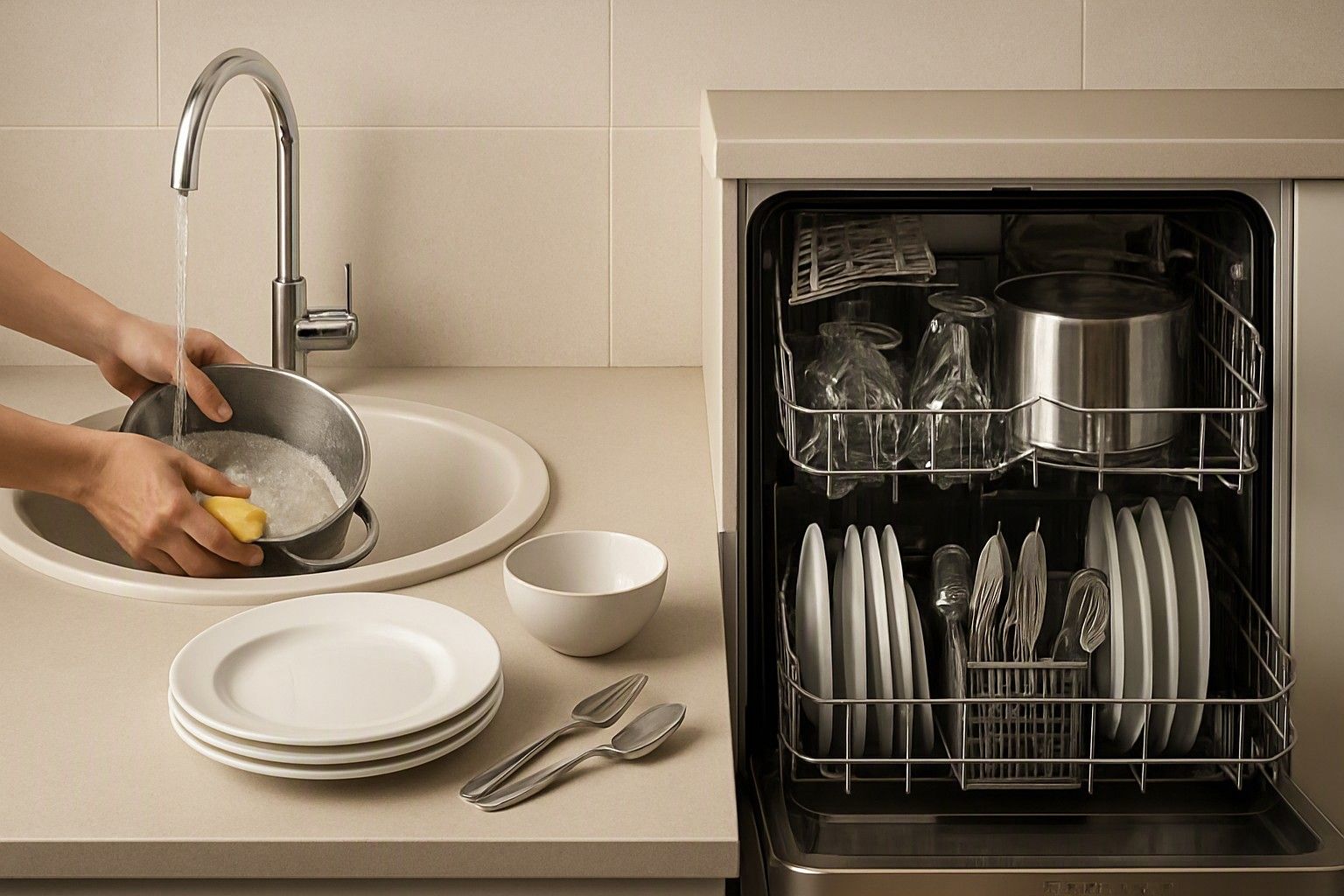
If a maid already washes your utensils every day, a dishwasher is worth buying only in specific situations: when help is irregular, when you want hot-water hygiene, or when daily washing-up is eating into your evenings. This article sets a dishwasher against hand washing by family or domestic help on water, running cost, hygiene, time and upfront spend, so you can see which side your household falls on.
Water Use: A Dishwasher Cycle vs a Running Tap
The biggest water saving comes from changing how water is used. Hand washing in most Indian kitchens means rinsing each utensil under a flowing tap, often twice, and that adds up quickly across a day of plates, katoris, tiffins and cooking vessels. A dishwasher fills once, recirculates that water through the spray arms and drains it. Efficient models typically use somewhere in the range of 10 to 15 litres for a full cycle, and the rating label on a model will tell you its exact figure. A day's worth of hand washing under an open tap commonly uses several times that.
The gap narrows if your help washes in a tub or bucket and rinses sparingly, so the saving depends on how the washing is actually done in your home. Two practical points matter in India. Dishwashers need a scrape, not a pre-rinse, so oily gravies should be wiped off the plate first. And if your supply comes from a borewell or overhead tank, check inlet pressure and water hardness before you rely on the machine, because hard water changes how well it cleans and what it needs to keep running.
Electricity and Detergent Cost Per Month
Hand washing has almost no electricity cost, unless your household heats water in a geyser for greasy vessels. A dishwasher adds a real power draw, mostly from heating the water and from the drying phase. For a small family running one cycle a day, this is a modest addition to the bill rather than a dramatic one, but it is a new recurring cost that hand washing does not have. Running full loads and using the eco programme where your utensils allow keeps it down.
Detergent is the other line. Hand washing uses liquid soap and scrubbers. A dishwasher uses dedicated tablets or powder, plus rinse aid and, in hard-water homes, regular salt for the softener. Most of that is consumable spend that does not exist with a bucket and scrubber. For a clear picture of what salt, rinse aid and tablets add to the monthly bill, read that breakdown before you finalise a budget. The honest takeaway is that a dishwasher does not save you money on power and detergent. Its savings come from water and time, and from whatever it lets you change about paid help.
Hygiene and Hot-Water Sanitising Compared to Hand Washing
Hand washing is limited by what hands can tolerate, so water is rarely hot enough to break down oil or reduce bacteria properly. The weak point is often the scrubber or cloth, which stays damp, is reused across vessels and can spread residue from one item to the next. A dishwasher runs much hotter water, uses detergent formulated for that temperature and dries with heat, which is why it tends to handle oily steel tiffins, milk vessels, glasses and baby bottles more consistently than a quick manual scrub.
The advantage is real but conditional. Results depend on loading properly, not blocking the spray arms and cleaning the filter regularly. Burnt-on residue in a kadhai or heavily caked cookware will still need soaking or a manual scrub first. Treat the machine as a very consistent cleaner for everyday crockery and steelware, not as something that makes every vessel in the kitchen spotless without any input from you.
Time Saved for Working Couples and Homes Without Regular Help
Here the case is strongest. For a working couple, dishes tend to pile up overnight or get washed at the end of a long day. Loading a dishwasher takes a few minutes after each meal, and the machine finishes while you sleep or are at work. There is no waiting for someone to arrive and no scramble when help takes a leave, which is common and difficult to predict in Indian cities.
Homes without regular help, such as nuclear families, people living away from relatives, or households where a maid is hard to find, are effectively comparing a dishwasher with their own time. In that case the question is simple: do you want to spend part of every evening on washing-up? The benefit also shows during festivals, guest visits and large gatherings, when the volume of vessels is far beyond what one person can clear quickly. If you already have a punctual maid and a lot of free time, this advantage shrinks considerably.
When Keeping House Help Still Makes More Sense
A dishwasher is not the right answer for every kitchen. If your maid does sweeping, mopping and other chores anyway, a dishwasher will not remove her cost. You would be adding a machine on top of existing help rather than replacing it. Small households with few utensils may also never fill a load, and running half-empty cycles wastes the water and power you were trying to save.
Cooking style matters too. If most of your cooking involves large kadhais, heavy pressure cookers, tawas and big steel vessels, a good share of the washing will still be manual. Practical limits count as well: no plumbing point or drain near the counter, low water pressure, frequent power cuts, or a rented flat where you cannot make changes. In these homes, keeping house help, or reducing the load on it with a smaller machine later, is the more sensible choice today.
Upfront Cost vs Long-Term Savings
Dishwashers in this category range from ₹25,000 to ₹80,000, with an average of ₹42,000. The entry tier sits at ₹28,000, the middle tier at ₹45,000 and the upper tier at ₹65,000. If you want to see how much the machine itself costs across budgets, that guide goes through what each band typically offers. Installation and consumables come on top of the machine price.
Whether it pays back depends on what changes in your household. If a dishwasher lets you cut paid help hours or avoid hiring altogether, the saving builds up over the machine's years of use. If your maid stays on for other work, the machine will not pay for itself in money, and you should justify it on time, hygiene and water instead. Either way, you can weigh this against the typical price range now, using your own help costs and usage, and make a confident decision without waiting for a better moment.
Making the Call for Your Household
Use these checks to decide:
- Buy a dishwasher if help is irregular or absent, evenings are tight, hygiene matters (infants, elders, oily cooking) and you have a plumbing point and decent water pressure.
- Keep hand washing or house help if your maid does other work anyway, the household is small, most cooking uses bulky vessels, or the kitchen cannot support the installation.
- Consider a mix: a dishwasher for daily plates, glasses and tiffins, with large cookware washed by hand or by your help.
If you land on the first or third option, the full set of factors to check once you commit to buying covers capacity, installation and features in detail.
So, is a dishwasher worth it if you already have a maid? Only if it changes something real: fewer paid hours, less water, more dependable hygiene or evenings you get back. If none of those apply, hand washing with help remains a perfectly sound choice. If one or more do, you now have what you need to decide today.
Comments
Be the first to comment.