Kitchen Chimney Electricity + Filter Cost Calculator
Find out what your kitchen chimney really costs to run — electricity plus filters — based on your chimney size, daily cooking hours and your local tariff. India-first, instant and editable.
~₹3,600/yr
avg yearly kitchen chimney cost (electricity + filters), Indian home
1. Your kitchen chimney
Pick the size closest to your chimney. Check the label on the side or the spec sheet for watts and suction.
2. Daily use
How long does the chimney run on a typical cooking day? Count both burners-on time and the 10–15 min you leave it on afterwards to clear smoke.
Typical Indian home: 1.5–3 hr/day · Heavy cooking / joint family: 4–6 hr/day
3. Your running costs
India-first defaults: ₹6.5 per kWh and ₹3,000/year for filters (baffle wash + carbon/mesh replacement). Edit both to match your bill and service cycle.
Typical: ₹6.5/kWh
Typical: ₹1,800–₹4,500/yr · Ductless carbon higher
Ducted baffle filters are washable; ductless carbon / charcoal filters need replacement every 6–12 months.
Why your kitchen chimney's running cost matters
A kitchen chimney's sticker price is only half the story. The real cost is the monthly running — electricity for the motor and lights, plus the filters that keep suction strong. Two homes with the same chimney can pay very different yearly amounts depending on size and daily hours.
Three things decide the bill: the chimney class (a 60 cm wall chimney at 150 W sips power, a 90 cm at 200 W or an island at 180 W with ductless carbon pulls more and needs pricier filters), how many hours you run it each day, and filter type — washable baffle/mesh for ducted chimneys versus replaceable carbon/charcoal for ductless. This calculator adds electricity and amortised filter cost together and prices them at your editable rates.
Defaults are India-first: ₹6.5 per kWh and ₹3,000 per year for filters. Raise the filter figure to ~₹4,500 if you run ductless carbon, lower it to ~₹1,500 if you are fully ducted with washable baffles. Suction ratings and wattages are averages, not your exact model's lab figure.
How your estimate is worked out
We take the chimney's rated watts, multiply by your daily hours to get daily kWh, then scale to weekly, monthly and annual. Electricity cost is kWh × your ₹/kWh rate. Filter cost is spread evenly: annual ÷ 12 per month (÷ 365 per day). Total is the sum — electricity dominates at high hours, filters dominate at low hours or with ductless carbon.
| Assumption | Value |
|---|---|
| Wall 60 cm · energy / day | 150 W × 2 hr ≈ 0.30 kWh |
| Wall 90 cm · energy / day | 200 W × 2 hr ≈ 0.40 kWh |
| Island · energy / day | 180 W × 2 hr ≈ 0.36 kWh |
| Suction vs size | 60 cm ~900 m³/h · 90 cm ~1,300 m³/h · Island ~1,400 m³/h |
| Daily → monthly / annual | Monthly ×30.44 · Annual ×365 |
| Filter amortisation | Monthly = annual ÷ 12 · Daily = annual ÷ 365 |
| Default tariffs | ₹6.5/kWh · ₹3,000/yr filters (editable) |
| Formula | kWh = watts/1000 × hrs · Cost = kWh×rate + filters/period |
Estimates only — real draw varies with fan speed, suction setting, light use and duct length/bends. See your chimney's rating plate and filter service card for exact figures.
How does your chimney compare?
Monthly cost below assumes 2 hours/day, ₹6.5/kWh and type-typical filter cost (60 cm ducted ₹2,000/yr, 90 cm ₹2,800/yr, island ductless ₹4,200/yr).
| Type | Size | Power | Suction | Monthly kWh | Filter / mo | Monthly total |
|---|---|---|---|---|---|---|
| Wall 60 cm | 60 cm | 150 W | 900 m³/h | 9.13 | ₹167 | ₹226 |
| Wall 90 cm · selected | 90 cm | 200 W | 1,300 m³/h | 12.2 | ₹233 | ₹312 |
| Island | 90 cm | 180 W | 1,400 m³/h | 11.0 | ₹350 | ₹421 |
Cut the cost of running your chimney
Use the right speed
Low/medium handles most everyday tadka and simmering. Reserve max suction for deep-frying — it can draw 20–30% more power.
Clean baffles monthly
Greasy baffles choke airflow, forcing the motor to run longer at higher speed. A monthly warm-water wash restores suction.
Don't run longer than needed
10–15 min after cooking is enough to clear smoke. Leaving it on for an hour wastes ~0.15–0.20 kWh each day.
Switch off lights separately
LED lamps on the chimney are 1–3 W each. Turn them off when not plating or cooking at night — small but daily.
Prefer ducted where possible
Ducted baffle chimneys are washable and avoid carbon replacement (₹2,000–₹3,000 saved per year vs ductless).
Frequently asked questions
How much electricity does a kitchen chimney use per hour?
A 60 cm wall chimney (~150 W) uses ~0.15 kWh per hour, a 90 cm (~200 W) ~0.20 kWh per hour, and an island (~180 W) ~0.18 kWh. At ₹6.5/kWh that is roughly ₹1–₹1.30 per hour on suction alone.
What is the average monthly cost of a kitchen chimney in India?
At 2 hours a day, expect ~₹60–₹80 electricity plus ~₹165–₹350 filters per month (ducted lower, ductless carbon higher). All-in is typically ₹250–₹450/month, or ~₹3,000–₹5,000 a year.
Do I need to replace filters, or can I wash them?
Ducted baffle/mesh filters are washable (soapy warm water monthly). Ductless chimneys use carbon/charcoal filters that cannot be washed and need replacement every 6–12 months, usually ₹1,000–₹2,500 per set.
Does suction size affect electricity use?
Yes, but modestly. A 90 cm chimney rated at 200 W vs a 60 cm at 150 W uses about 33% more per hour on max. Running either on low speed can halve the draw versus max.
Does a kitchen chimney use a lot of power compared to other appliances?
No — it is light. Even 3 hr/day at 200 W is only ~18 kWh a month, less than a 1.5-ton AC in a single day. Filters, not electricity, dominate the annual bill.
How do I find my chimney's actual wattage and suction?
Check the rating plate on the side or the manual — it lists motor watts (e.g. 150–260 W) and suction in m³/h (e.g. 1,000–1,500). Add ~5 W if LED lamps are on.
Is ductless more expensive to maintain?
Usually yes. Ductless carbon filters cost ~₹4,000–₹5,000 a year versus ~₹1,800–₹2,800 for ducted baffle cleaning and occasional mesh. Choose ducted if your kitchen allows an outlet.
Does chimney size depend on stove size?
Generally match them: 60 cm for 2–3 burner (60 cm hob), 90 cm for 4–5 burner (90 cm hob). Too small a chimney leaves smoke at the edges; too large wastes power and space.
Can I reduce chimney costs without cooking less?
Yes — use correct speed, clean baffles monthly, limit after-run to ~15 min, turn off lights separately, and prefer ducted baffle over ductless carbon if you can vent outside.
Do chimneys use electricity on standby?
Very little — most draw under 1 W for touch controls when off. No need to unplug daily, unlike appliances with clocks/displays.
More kitchen chimney buying guides
Size, suction and installation guides to help you pick the right kitchen chimney — with specs and real prices.
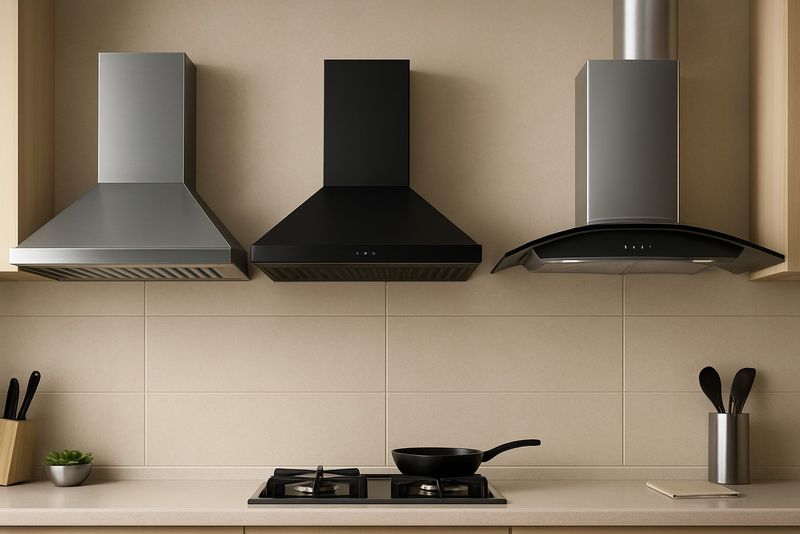
How to Choose the Right Kitchen Chimney for an Indian Kitchen
Choosing a kitchen chimney in India: ducted vs ductless, size and suction, filters, noise, installation, upkeep and price from ₹2,999 to ₹45,990.
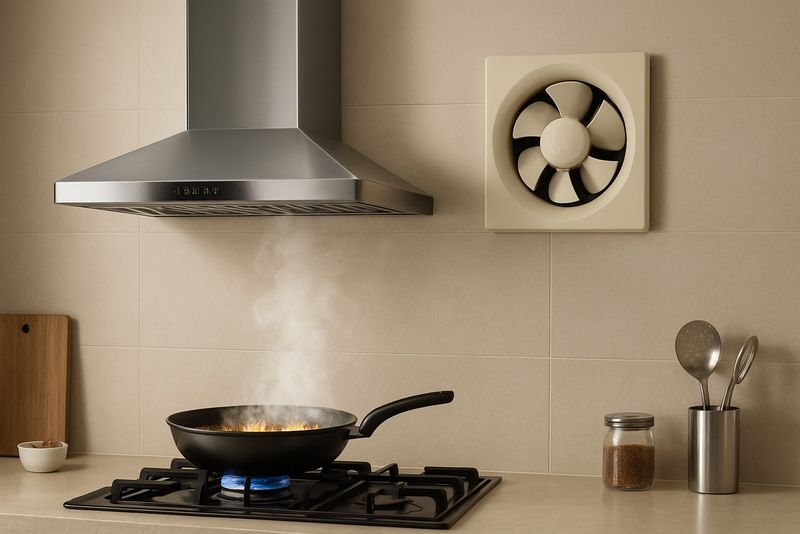
Kitchen Chimney vs Exhaust Fan: What Indian Kitchens Actually Need
Chimney or exhaust fan for your Indian kitchen? A clear look at smoke, grease and tadka handling to help you decide without overspending or underbuying.
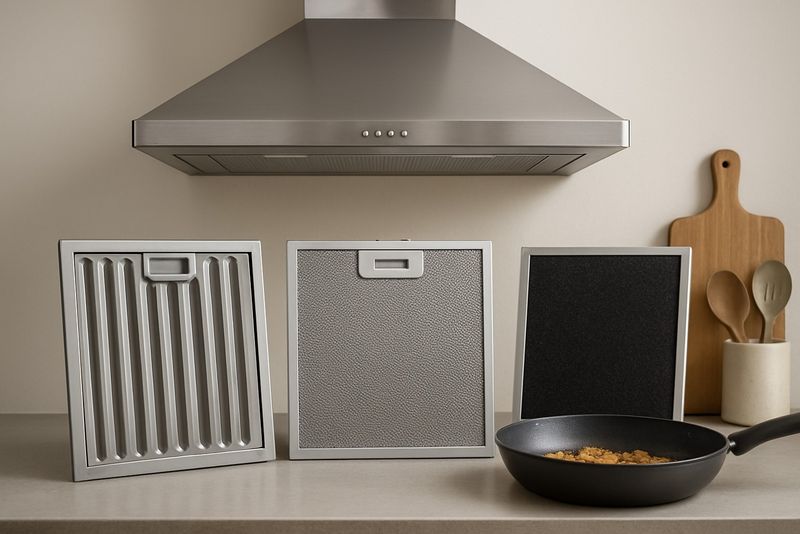
Kitchen Chimney Filter Types Explained for Oily Indian Cooking
Baffle, mesh or filterless: see which kitchen chimney filter handles heavy Indian frying and tadka best, and which one you'll actually keep cleaning.