Kitchen Chimney Filter Types Explained for Oily Indian Cooking
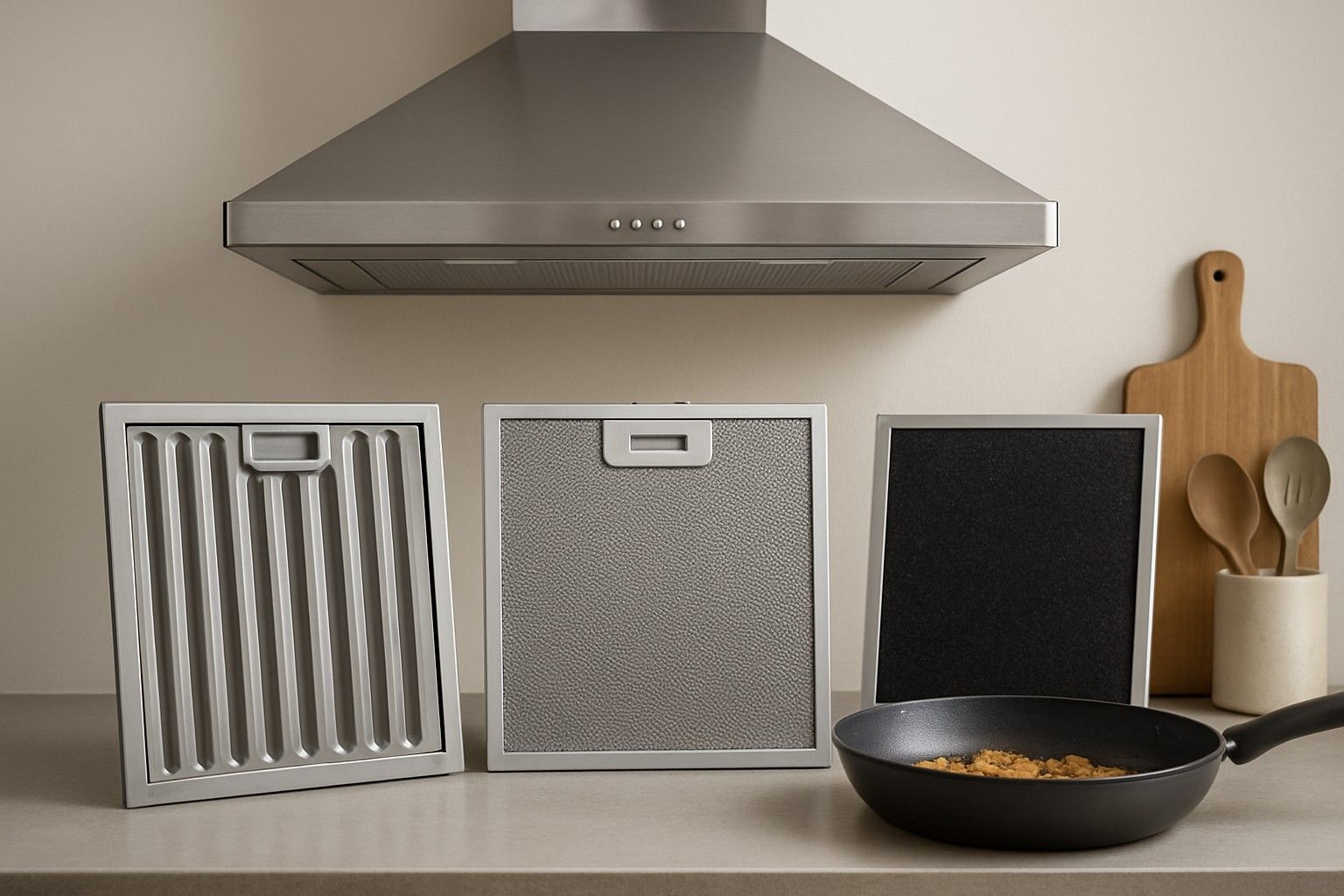
If your cooking involves daily tadka, deep frying or a lot of masala-heavy gravies, the filter type matters more than almost any other chimney spec. Baffle, mesh and filterless designs deal with airborne grease very differently, and picking the wrong one means either constant cleaning or a chimney that quietly loses suction within months. This article breaks down exactly which filter type suits heavy Indian cooking and why, so you can match the design to how your kitchen actually operates.
Baffle, Mesh and Filterless: What's the Difference
A baffle filter is a series of curved metal panels arranged so that greasy air is forced to change direction sharply as it moves through them. The oil is heavier than the air carrying it, so it can't turn as fast, and it slams into the panels and drips down instead of travelling further into the duct. There's no fine mesh to block, just solid metal baffles, which is why this design has become the default on most mid-range and premium chimneys sold in India.
A mesh filter works on a completely different principle. It's usually made of layered aluminium mesh, and it physically traps grease particles the way a sieve catches solids, by making the air pass through very fine gaps. It's an older design, cheaper to manufacture, and still common on entry-level chimneys because it works reasonably well at low cooking intensity.
A filterless chimney skips a physical grease barrier entirely. Instead, it relies on suction pulling air past a smooth, often coated internal surface into the motor housing, with grease collected in a removable cup or channel rather than caught mid-flow. There's nothing to scrub in the airflow path itself, only the collection cup to empty. Each design exists because Indian kitchens vary hugely in how much oil, spice and steam they generate, and the right filter genuinely depends on your specific cooking style rather than one design being universally superior.
Which Handles Oily and Spicy Cooking Best
For kitchens that fry often, whether that's daily pakoras, puris, or tempering dals and sabzis with a generous hand, baffle filters cope noticeably better. The zig-zag airflow path is built specifically to separate heavy grease from air at the point of highest oil content, which is exactly what deep frying and tadka produce. Because the panels are solid metal rather than fine mesh, they don't lose efficiency as grease builds up the way a mesh filter does, so suction stays more consistent meal after meal.
Mesh filters struggle in this exact scenario. The fine gaps that trap grease are also the first thing to clog when oil load is high, and once they're coated, air simply can't pass through as freely, which means the motor has to work harder for the same suction. In a kitchen that fries occasionally or cooks lighter, less oily food, this isn't a major issue. In a kitchen frying daily, it becomes a real bottleneck within weeks.
Filterless designs sit in an interesting middle position. Without a physical filter to clog, they maintain airflow more consistently than a neglected mesh filter, but they depend heavily on strong, sustained suction to actually pull grease-laden air away before it settles on nearby surfaces. In a very oily, high-frequency Indian kitchen, that puts more load on the motor and the exhaust ducting to do the separation work that a baffle would otherwise share. For most homes cooking rich, oil-heavy food regularly, a baffle filter remains the more dependable choice for keeping suction strong through heavy use.
Cleaning Effort for Each Filter Type
Baffle filters are removable and dishwasher-safe on most models, and because grease collects on solid panels rather than fine gaps, a periodic soak and wipe is usually enough to keep them working well. Many households manage with cleaning every few weeks depending on cooking frequency, since the panels don't demand the meticulous scrubbing that trapped mesh grease requires.
Mesh filters are the opposite experience. Grease gets lodged deep in the layered mesh, and a quick rinse rarely clears it fully. It typically needs hot water, degreasing detergent and manual scrubbing, and if it's skipped for even a couple of weeks in an oil-heavy kitchen, the buildup becomes visibly harder to shift. This is the main reason mesh filters have a reputation for being high-maintenance despite costing less upfront.
Filterless chimneys shift the maintenance question elsewhere. There's no filter panel to wash, but the internal grease collection cup or tray needs regular emptying and wiping, and the smooth internal surfaces still need occasional cleaning to stop residue from accumulating. Some models pair this design with auto-clean functions that use hot oil and steam to flush the chamber, cutting down manual effort considerably. If long-term upkeep is a deciding factor for you, it's worth understanding how much cleaning each design demands over time before settling on one, since the difference in weekly effort between these designs is significant enough to change daily kitchen habits.
How Filter Choice Affects Suction Over Time
Filter type and suction longevity are directly linked, because every filter design is really a trade-off between how much grease it captures and how much airflow it lets through as it gets dirty. A baffle filter loses relatively little efficiency as it collects grease, since the panels have open space around them even when coated, so suction stays closer to its rated performance for longer stretches between cleanings.
A mesh filter behaves very differently once it starts clogging. Airflow through the fine mesh drops noticeably as grease accumulates, and the motor has to pull harder to compensate, which over months of neglect in an oily kitchen can mean visibly weaker extraction, more escaped smoke and odour lingering in the kitchen, and lingering grease film on nearby cabinets. This is less about the chimney's rated suction power and more about how quickly that rating becomes theoretical once the filter is dirty.
Filterless models avoid this specific decline since there's no mesh to clog, but they depend more on the ducting staying clear and the motor maintaining strong output, since there's less physical grease separation happening before the exhaust. Whichever type you're evaluating, it helps to understand why clogging reduces suction power in the first place, because the same underlying airflow principles determine whether a chimney rated for your kitchen size will actually perform that way in daily, oil-heavy use rather than only on paper.
Choosing the Right Filter for Your Cooking Style
If you fry often, use a lot of oil, and want a chimney that keeps performing without weekly deep-cleaning, a baffle filter is the more forgiving choice for genuinely heavy Indian cooking. If your cooking is lighter, less frequent, or more occasional frying with mostly steaming or light sautéing, a mesh filter can still work adequately, and it tends to sit at the lower end of the price range, closer to the ₹4,999 band than the mid-range. Filterless designs suit kitchens that prioritise minimal manual filter-scrubbing and are willing to rely on strong suction and, often, auto-clean features to do the grease-handling work instead, and these tend to appear more often as you move into the ₹11,999 and ₹24,999 price bands.
Across the market, prices for chimneys with these different filter types range from ₹2,999 to ₹45,990, with the average sitting around ₹12,999, so filter type alone doesn't dictate budget as much as motor quality, size and additional features do. What matters more is matching the filter to your actual kitchen habits rather than assuming a higher price automatically means less maintenance. Since filter type is just one piece of the decision alongside size, suction rating and mounting style, it's worth stepping back to fit the filter choice into your overall decision so the final choice works as a complete package rather than in isolation.
For heavy, oil-heavy Indian cooking, baffle filters generally hold up best with the least ongoing effort, mesh filters suit lighter or occasional frying at a lower price, and filterless designs trade filter-cleaning for stronger reliance on suction and auto-clean. Match that trade-off to how often you actually fry and temper, and the filter type stops being a guessing game and becomes a straightforward fit to your kitchen.

Comments
Be the first to comment.