How Loud Are Kitchen Chimneys? Noise Levels for Small and Open Kitchens
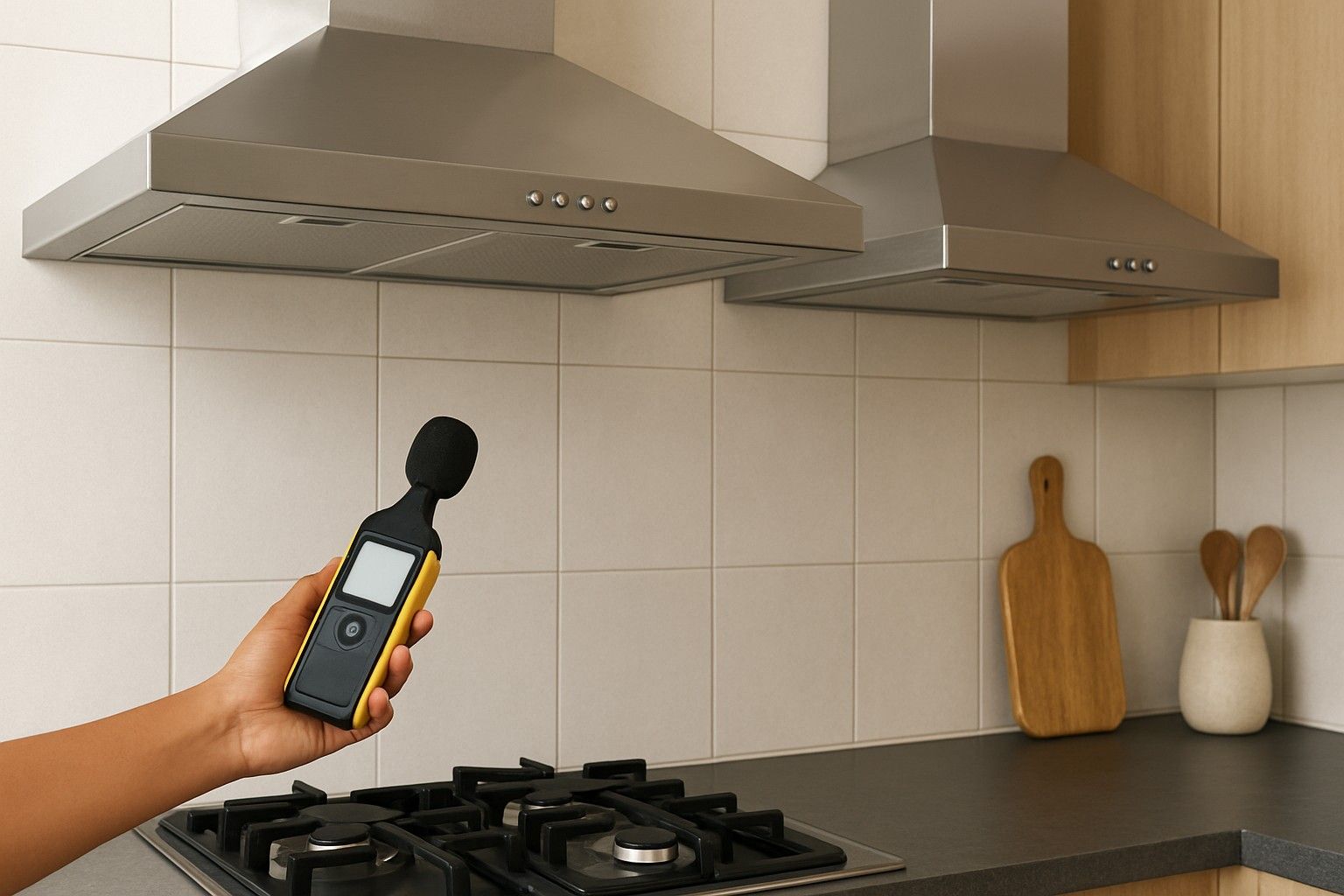
If your kitchen opens into the living room, or your flat simply doesn't have the space to absorb sound, a chimney's noise rating matters as much as how well it clears smoke. This article breaks down what decibel numbers on a spec sheet actually mean in a real Indian kitchen, and how to judge whether a particular chimney will be too loud for the way your home is laid out.
How Chimney Noise Is Measured in Decibels
Every chimney sold in India carries a noise rating in decibels (dB), usually listed at the highest fan speed since that is when the motor works hardest and produces the most sound. This number is measured under standard test conditions, typically at a fixed distance from the unit, so it gives you a consistent way to compare one chimney against another on paper. What it does not capture is how that sound will actually feel in your kitchen, because a decibel scale is logarithmic, not linear. A jump from 55 dB to 65 dB is not a small increase, it is roughly a doubling in perceived loudness, so a difference that looks like ten points on a spec sheet can be the gap between a background hum and something that interrupts conversation. Most chimneys on the market report noise somewhere between the high 50s and low 70s dB at top speed, and this figure usually drops by several points when you run the unit on a lower or medium setting. When you're comparing two chimneys, always check whether the dB figure quoted is at maximum suction or at a normal cooking speed, because brands don't always specify this consistently, and comparing a low-speed rating on one model against a high-speed rating on another will give you a misleading sense of which is actually quieter.
Why Noise Matters More in Open and Small Kitchens
In a closed, separate kitchen, chimney noise stays contained behind a door and rarely becomes a household issue. That changes the moment your kitchen opens into a dining or living area, which is now common in newer flats and open-plan layouts across Indian cities. Sound from the chimney motor travels freely into shared space, and at higher fan speeds it can compete with conversation, a television, or a phone call in the next room, especially during long cooking sessions like frying or tempering that need sustained high suction. Small kitchens face a related but distinct problem: hard surfaces like tiled walls, granite counters, and steel modular units reflect sound rather than absorb it, so the same decibel rating can feel louder in a compact, boxed-in kitchen than in a larger one with more soft furnishings nearby. This is why the primary buyer question behind noise isn't really about the number itself, it's about whether that number will be intrusive in your specific layout. If you live in a studio-style flat or a home where the kitchen and living room share air space, it's worth treating the noise rating as a hard filter during shortlisting, not an afterthought you check once you've already decided on suction power and size.
The Trade-off Between Suction Power and Noise
Suction power and noise are connected because both come from the same source: motor speed. A more powerful motor pulling more air through the same size duct or filter generally has to spin faster, and that extra speed is what generates additional sound. This means chasing the highest suction rating on a spec sheet without checking the accompanying noise figure often backfires, particularly if your kitchen doesn't actually need that much pulling power in the first place. A small, well-ventilated kitchen with limited Indian-style deep frying may do perfectly well with a lower-suction, quieter unit, while a larger or heavily used kitchen might genuinely need the extra draw and will have to accept a higher noise ceiling as the cost of that performance. The two specs should be weighed together rather than in isolation, because a chimney that's technically more powerful but unbearable to run at full speed defeats its own purpose if you end up avoiding the top setting altogether. Some models manage this trade-off better than others through motor and blade design rather than sheer power, which is why two chimneys with similar suction ratings can still land at noticeably different noise levels. Before fixating on decibels alone, it's worth working out how much suction you actually need, since matching suction to your actual cooking load is what determines whether you'll ever need to run the unit loud enough for noise to be a problem in daily use.
What Counts as an Acceptable Noise Level
There's no single universal cutoff, but a few reference points help make the number on a spec sheet meaningful. Sound in the high 50s to low 60s dB range is roughly comparable to normal conversation or a running refrigerator, and most people find this tolerable even in an open kitchen, since it blends into ordinary household background noise. Once a chimney crosses into the mid-60s and beyond at top speed, it starts to resemble a loud conversation or a running vacuum cleaner, which is noticeably more disruptive if the kitchen opens directly into a living or dining space. For a closed kitchen used mainly at low or medium fan speed, this higher figure matters less, since you'll rarely run the unit at the setting where that peak noise applies. For an open-plan or small kitchen, though, it's worth treating anything comfortably under 60 dB at the speed you'll actually use most as the more realistic target, rather than judging the chimney by its quietest low-speed number or its loudest top-speed number alone. Chimneys across the price spread, from the ₹4,999 entry range up through the ₹24,999 bracket, vary in noise performance independent of price, so a higher budget doesn't automatically buy you a quieter unit. It's a spec worth checking on its own terms rather than assuming it tracks with cost.
Reducing Noise in Everyday Use
Even a well-chosen chimney will feel louder than it needs to if it's used or installed carelessly, and a few habits make a real difference. Running the chimney on medium speed for routine cooking and reserving the top setting only for heavy frying or tempering keeps average noise well below the peak figure quoted on the box. Installation height matters too: a chimney mounted too close to the hob has to work harder against heat and smoke turbulence, which can push the motor to run louder than it would at the recommended clearance. Keeping filters clean is another overlooked factor, since a clogged mesh or baffle filter restricts airflow and forces the motor to compensate with higher speed, effectively adding to the noise you hear over time even though the unit's rated dB hasn't changed. Loose ducting or a poorly sealed connection to the outside vent can also introduce rattling or vibration noise that has nothing to do with the motor itself and everything to do with fitting quality. None of this replaces choosing a chimney with a genuinely acceptable base noise level for your kitchen type, but it does mean two identical models can feel quite different in daily use depending on how they're installed and maintained. Once noise is sorted, it's worth stepping back to revisit the other factors that shape your pick, since suction, filter type, and size all interact with how loud a chimney feels day to day.
Noise on a spec sheet isn't just a number to skim past, it's one of the more practical filters for anyone buying a chimney for an open-plan or compact Indian kitchen. Match the decibel rating to your layout and your usual cooking speed, rather than to the highest suction figure on offer, and you'll land on a chimney that does its job without turning every fry-up into background noise for the rest of the house.
Comments
Be the first to comment.