60cm or 90cm Chimney? Size & Suction Power Explained
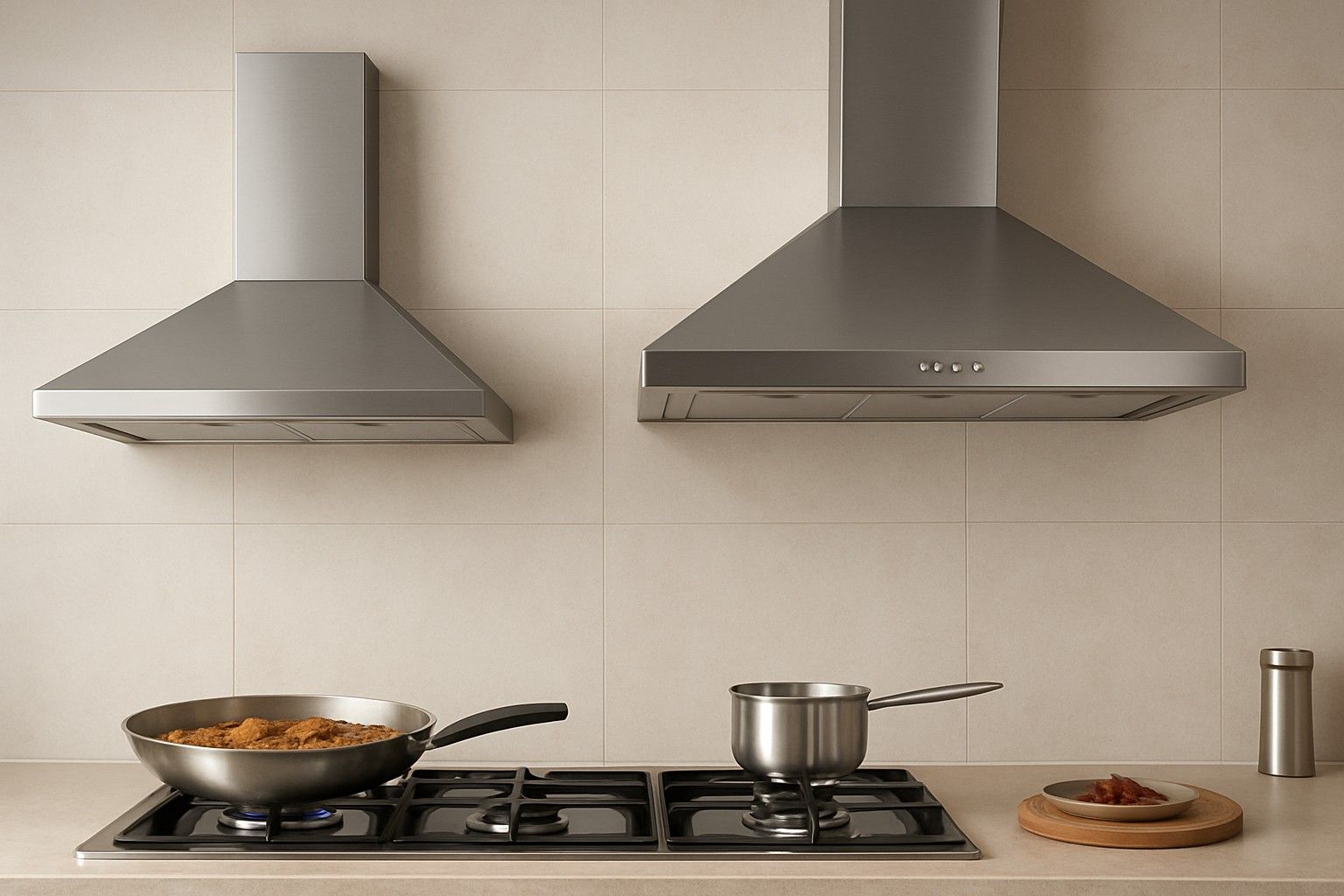
If you're stuck between a 60 cm and a 90 cm chimney, or unsure whether 1000 m³/hr suction is enough for your kitchen, this is the decision itself, not a side note. Size and suction are the two specs that actually determine whether a chimney keeps up with Indian cooking, and getting them wrong is the most common reason people end up disappointed with an otherwise decent-looking unit. This guide walks through both, using your hob width and your cooking style as the starting point rather than what various kitchen chimney brands claims.
60 cm vs 90 cm: Matching Width to Your Hob
The first rule is mechanical, not aesthetic: a chimney should be at least as wide as the hob underneath it, and ideally a little wider. If you run a standard 60 cm, 2-3 burner hob, a 60 cm chimney sits directly above the cooking zone and can capture steam and oil particles as they rise. If you have a 90 cm, 4-burner hob, or even a 60 cm hob where the outer burners are used constantly, a 60 cm chimney leaves the edges exposed, and smoke simply drifts past the baffle plates untouched. This is why width mismatch, not a weak motor, is often the real reason a chimney seems to underperform.
A 90 cm chimney also gives you room to grow. Indian kitchens tend to add a second hob burner cluster, a grill plate, or an additional cooktop over time, and a wider chimney handles that expansion without needing replacement. The trade-off is upfront cost and installed footprint: a 90 cm unit needs more wall space and, in compact kitchens, can visually overwhelm the room if the platform itself is narrow. For a genuinely small kitchen with a 60 cm hob and no plan to expand it, a well-specified 60 cm chimney is not a compromise, it is the correctly sized choice. Width should follow your hob and your cooking layout, not the other way around.
How Much Suction Power Indian Cooking Really Needs
Suction power, measured in m³/hr (cubic metres per hour), tells you how much air the chimney can pull through the hood in an hour, and it is the single number that separates a chimney that clears smoke from one that just hums along uselessly. For occasional, light cooking, a modest suction rating can keep a kitchen tolerable. But Indian cooking, with its recurring oil-based frying, tempering, and roasting, produces oily aerosols that stay airborne unless removed with real force, not gently drawn away.
As a working reference, kitchens with routine deep frying, multiple daily curries, or a joint-family cooking volume are usually better served by chimneys towards the upper end of the suction range you'll find on the market, rather than entry-level ratings meant for lighter cooking. This holds regardless of what tier you're shopping in: chimneys across the ₹4,999, ₹11,999, and ₹24,999 price bands all offer a spread of suction ratings, so a higher price does not automatically mean higher suction, and a budget unit is not automatically underpowered. What matters is checking the m³/hr figure directly against your cooking habits rather than assuming it scales with what you paid. Ducting length and the number of bends between the chimney and the outside vent also eat into effective suction, so a kitchen with a long or bent duct run benefits from rating on the higher side to compensate for that loss.
Why High Suction Matters for Frying and Tadka
Tadka and deep frying are the two cooking moments that separate chimneys that feel adequate from ones that feel essential. When mustard seeds, dried chillies, or hing hit hot oil, they release a sudden, concentrated burst of pungent, oily smoke, and a chimney needs enough suction to catch that burst before it spreads to curtains, cabinets, and clothes. A chimney with modest suction will eventually clear the room, but modest and eventually are the problem: by the time it catches up, the smell has already settled into soft furnishings.
Deep frying compounds this because it runs longer and releases oil in finer, more persistent particles than a quick tempering does. Kitchens that fry regularly, think pakoras, puris, or snacks made in batches, need a chimney that can sustain strong extraction for extended stretches without the airflow tapering off. This is also where auto-clean and filter design intersect with suction: a chimney whose filters clog with grease over time will lose real-world suction even if its rated m³/hr number stays impressive on paper. So the honest answer to "how much suction for frying" is that it should be rated well above what feels sufficient for boiling or light sautéing, because frying is the stress test your chimney has to pass every single day, not the occasional one.
Sizing for Small Flats vs Joint-Family Kitchens
A single person or couple cooking in a compact flat, with a 60 cm hob and mostly light to moderate cooking, is well served by a 60 cm chimney at a moderate suction rating, and does not need to pay for capacity they'll never use. Overbuying here mostly costs more without solving a problem that doesn't exist, since a smaller kitchen also has a shorter, simpler duct run that lets even a modest suction rating perform close to its rated figure.
A joint-family kitchen tells a different story. More people cooking through the day, larger vessels, back-to-back meals, and heavier frying all add up to a kitchen that runs its chimney far more hours per day than a single-person household does. Here, a 90 cm chimney with suction on the higher end of the range is less about luxury and more about keeping pace with volume: the chimney simply has more air to move, more often, for longer stretches. It's also worth factoring in whether the kitchen is enclosed or open to a living or dining area, since an open-plan joint-family kitchen needs stronger suction to stop cooking smoke from drifting into shared living spaces, something a closed single-person kitchen doesn't have to fight against. Matching the chimney to household size, not just hob size, avoids both overspending and under-capacity.
Does Higher Suction Mean More Noise?
It's a fair worry: a stronger motor pulling more air can sound like it should be louder, and in a general sense, higher suction ratings do correlate with higher noise potential. But the relationship isn't fixed, because build quality, motor design, and baffle or filter type all influence how much of that suction translates into audible sound. Two chimneys with an identical m³/hr rating can differ meaningfully in how loud they feel in daily use, which is why suction alone shouldn't be the only spec you weigh before buying.
The practical way to think about it is that you shouldn't avoid a high-suction chimney purely out of noise concerns, since the frying and tadka performance it delivers is usually worth more than a few extra decibels, especially if you check how suction relates to how loud the chimney gets before deciding. That comparison matters more once you've already settled on the suction level your kitchen needs, because it lets you choose between two similarly powerful options based on which one is actually quieter to live with day to day.
Putting Size and Suction Into Your Overall Choice
Size and suction are the two specs that do the most work in determining whether a chimney actually solves your kitchen's smoke and grease problem, but they sit alongside other decisions, chimney type, filter style, price tier, that shape the final purchase. Prices for chimneys in the Indian market span from ₹2,999 to ₹45,990, with the average sitting around ₹12,999, and that range reflects genuine differences in size, suction, and build rather than arbitrary pricing, so there's no reason to wait for a better number to show up before deciding. Once you know whether you need 60 cm or 90 cm, and roughly what suction band your cooking demands, you're equipped to filter listings by spec instead of guessing from photos.
If you haven't already mapped out the rest of the decision, ducted versus ductless, filter type, installation needs, it helps to see how this fits the full buying decision so size and suction sit correctly within everything else you're weighing before you commit.
Between hob width and cooking volume, you now have a straightforward way to settle the 60 cm versus 90 cm question and to read a suction rating as something that maps to your actual frying habits rather than an abstract number on a spec sheet. Buy against those two answers with confidence, the current price spread already reflects real differences in size and power, not a reason to second-guess the decision.

Comments
Be the first to comment.