Kitchen Chimney vs Exhaust Fan: What Indian Kitchens Actually Need
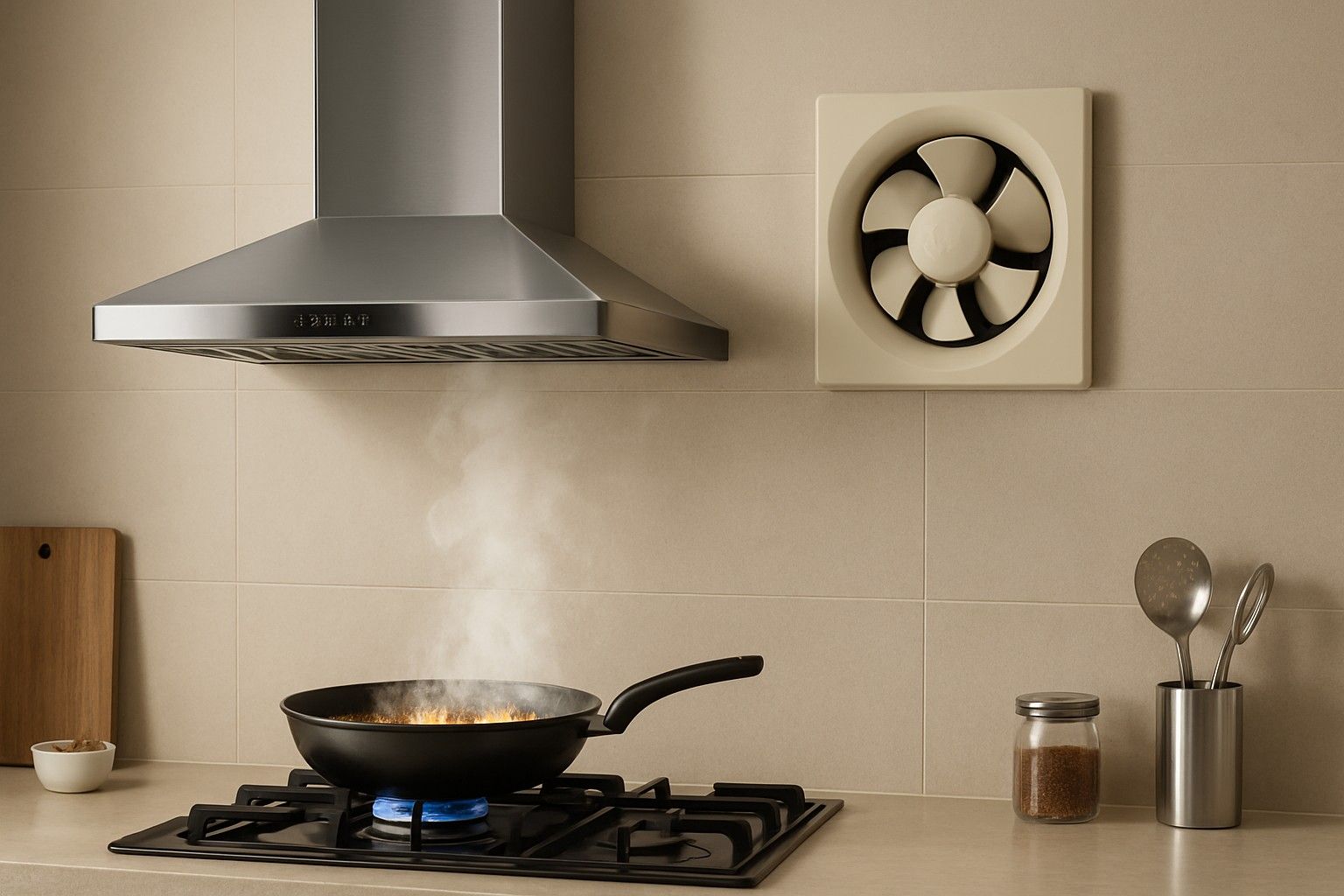
If you're standing in a hardware shop or scrolling online wondering whether you actually need a chimney, or if the exhaust fan already in your kitchen wall is doing enough, this is the question we're answering. The honest answer depends less on what's trendy and more on how your kitchen cooks — how much oil, how much masala, how often the tawa is on high flame. Read this before you spend on either, so the decision is based on your cooking, not on what a salesperson pushes.
What Each One Actually Does With Smoke and Grease
An exhaust fan is a simple mechanical fan set into a wall or window that pushes kitchen air outside. It moves air, full stop. It doesn't filter that air, doesn't trap grease, and doesn't distinguish between steam, smoke, and the fine oily particles that Indian cooking throws off in large quantities. Whatever leaves through the fan takes a share of grease with it, but a good amount of that grease still settles on your walls, cabinet tops and ceiling near the stove, because the fan is pulling air from the general room rather than capturing it right at the source.
A kitchen chimney works differently because it sits directly above the cooktop and captures smoke and steam before it spreads into the room. Inside, it runs that captured air through filters — mesh, baffle or a combination — that catch grease particles before the air is either pushed outside through ducting or recirculated through a carbon filter. This is the core functional difference: an exhaust fan removes air, a chimney removes air after cleaning it. For a kitchen that fries, tempers spices, and runs the stove for extended periods daily, that filtering step is what keeps grease off your walls and out of your lungs, and it's the reason this comparison exists in the first place.
How They Compare on Heavy Frying and Tadka Fumes
This is where the difference between the two stops being theoretical and becomes something you notice every single day. Tadka fumes and deep frying release oil vapour at high speed, right above the pan, and an exhaust fan positioned across the room or even on an adjacent wall simply isn't placed to catch that plume before it disperses. You'll smell mustard seeds and hing in your curtains an hour later, and the film on your kitchen tiles builds up faster than you'd expect for the effort you put into cleaning.
A chimney mounted directly over the burner is built for exactly this moment. Its suction is concentrated in a small area right where the fumes rise, so it pulls oil vapour and smoke up and away before it spreads sideways into the room. Most chimneys are also rated in cubic metres per hour of suction, and for kitchens that do daily heavy frying, tempering, or slow-cooked non-vegetarian dishes with a lot of oil, that suction strength matters more than any other spec. An exhaust fan has no suction rating in this sense — it just moves whatever volume of air the blade size allows, regardless of where the smoke is actually concentrated. If your cooking involves regular tadka, pakoras, or oil-heavy gravies, this is the section that should settle the debate for you.
Cost, Installation and Wall Space Compared
An exhaust fan wins comfortably on upfront cost and simplicity. It's a small unit that fits into an existing wall or window cutout, needs minimal wiring, and can often be installed in under an hour without any structural change to the kitchen. There's no ducting to plan, no cabinet space to sacrifice, and no ongoing filter replacement to budget for.
A chimney asks for more commitment on every one of these fronts. Prices across the category run from ₹2,999 to ₹45,990, with the average sitting around ₹12,999, and the range breaks into rough tiers of ₹4,999, ₹11,999 and ₹24,999 depending on suction power, filter type and features like auto-clean. Beyond the unit cost, a ducted chimney needs a route for a duct pipe to an outside wall, which isn't always straightforward in every kitchen layout, especially in apartments where the outer wall isn't close to the cooktop. A ductless or recirculating model skips that requirement but needs regular carbon filter changes to keep working properly. There's also the matter of overhead cabinet space, since the chimney body needs to be mounted above the hob, which can affect where you place your existing kitchen cabinets. If you're weighing this against a full renovation or a new kitchen layout, it's worth understanding what fitting a chimney into your kitchen involves before you commit to a model, since the installation reality varies more than the price tag suggests.
When an Exhaust Fan Is Genuinely Enough
There are kitchens where a chimney is genuine overkill, and it's worth saying so plainly rather than pushing everyone toward the pricier option. If your cooking is light — mostly boiling, steaming, roti-making, and occasional shallow frying with minimal oil — an exhaust fan combined with an open window or good cross-ventilation can keep the room comfortable and grease buildup manageable. Small households where the kitchen is used briefly a couple of times a day, rather than running for hours during festival cooking or joint-family meals, often don't generate enough sustained smoke and oil vapour to justify the extra cost and installation effort of a chimney.
Rental homes are another honest case for sticking with an exhaust fan, since landlords are often reluctant to allow duct holes or structural changes, and a chimney's value is hard to recover if you're moving in a year or two. If your kitchen already has a working exhaust fan and your cooking style is genuinely light on oil and spice-heavy tempering, spending on a chimney mainly because it feels like the modern default isn't necessary. The question isn't whether a chimney is better in absolute terms — it usually is at capturing grease — it's whether your kitchen's actual cooking load needs that capability enough to justify the cost and disruption.
Which One Suits Your Kitchen and Budget
By now the decision should be less about which product is objectively better and more about matching the choice to your kitchen's real cooking habits. If you fry often, cook for a large family, use a lot of oil and masala, or you've noticed a sticky grease film settling on surfaces despite an existing exhaust fan, that's a strong signal your kitchen has outgrown what a fan alone can manage. If your cooking is lighter and your kitchen is well-ventilated, an exhaust fan can keep serving you fine without the added cost and installation involved in a chimney.
Once you're leaning toward a chimney, the decision doesn't end at yes or no — suction capacity, filter type, duct versus ductless, and size relative to your hob all shape which model actually works for your kitchen. It helps to start with the core factors of choosing a chimney so you're comparing models against your kitchen's actual needs rather than a generic spec sheet, especially given how much the price range across this category can vary based on those choices.
The exhaust-fan-versus-chimney question isn't really about which appliance is more advanced — it's about matching the tool to how much smoke, oil and tadka fume your kitchen produces on a normal week. Heavy frying and daily tempering point toward a chimney's source-capture filtering; light, well-ventilated cooking can stay comfortably served by a fan. Whichever side of that line your kitchen falls on, you now have the actual basis to decide, rather than guessing based on what's trending.

Comments
Be the first to comment.