Smart TV Panel, Resolution & Internet Calculator
Which panel suits your room, is 4K worth it at your sofa distance, and can your broadband actually feed what you buy? Get four linked verdicts — panel, resolution, Mbps needed and GB per month — grounded in India-first room, DTH and data-plan realities.
~1,260 GB/mo
4K streaming data at defaults — bright hall · 8 ft · 55″ · 2 screens · 3 h/day
1. Your room
Daylight and viewing habits decide the panel more than the price tag does.
Daylight on the screen
Bright means windows or sun land on the screen through the day.
When does the TV actually run?
Fixed logos, ticker bars and scoreboards are what makes OLED burn-in a real risk over years.
Budget band
Panel technology is where the price tiers separate: LED under ₹30,000, QLED by ₹65,000, Mini LED and OLED above it.
2. Your seat & screen
Seating distance against the screen diagonal decides whether 4K is visible or just future-proofing.
Size you're considering
What will you mostly watch?
DTH and cable arrive at 720p/1080i — 4K lives on OTT.
3. Your internet & data
The same 4K picture needs ~15 Mbps per screen and eats ~7 GB an hour — check both before you buy.
Typical fiber: 100 Mbps · 4G: 10–30 Mbps
Screens streaming at once
Monthly data plan
What to check on the spec sheet
QLED · 4K
- Real refresh rate — not the “MEMC 120Hz” badge
- HDR brightness in nits — what decides a sunlit hall
- RAM and storage, for OS updates five years in
- HDMI ports — and an Ethernet port or 5 GHz Wi-Fi for 4K streaming
- BIS mark and the BEE star label on the carton
- Panel warranty length — the screen is the costliest part to fix
- A top-tier OTT plan — 4K titles need the premium tier
Will your home actually get the picture you're buying?
Showrooms answer the wrong question. What decides how good a smart TV looks at home is the light in your room (which panel survives daylight), the distance from your sofa (whether 4K is visible at all), and the internet feeding it — a 4K stream needs roughly 15 Mbps per screen and eats up to 7 GB an hour, which decides whether your plan can carry the TV you're considering.
In a bright Indian hall, LCD-based panels with strong backlights — QLED and Mini LED — keep their punch through the day, and standard LED copes in moderate light. OLED wins after dark but gives up daytime punch and carries a burn-in caution for homes that run news channels with fixed logos for hours. Your budget band decides which of these is actually in reach: LED dominates under ₹30,000, QLED becomes common by ₹65,000, and Mini LED and OLED sit above it.
Resolution is a distance question, not a price question. 4K's extra detail shows when you sit within about 1.5× the screen diagonal; Full HD stays comfortable to 2×, and DTH channels arrive at 720p/1080i whatever panel you buy. The defaults here describe a typical setup — bright hall, 8 ft sofa, 55″, 100 Mbps fiber — and the four verdicts update as you change them.
How the four verdicts are worked out
The panel pick scores each technology for bright-room punch and night-time blacks, weights them by how you actually watch, and removes anything your budget band can't reach — with a burn-in penalty when ticker content runs 3+ hours a day. The resolution check divides your seating distance by the screen diagonal: within 1.5× 4K's detail is visible, to 2× Full HD is enough, and beyond that even HD Ready looks the same. DTH-only homes cap at "4K optional" whatever the distance, because the broadcast itself is 720p/1080i.
The speed verdict multiplies the per-stream requirement of your resolution by the screens streaming at once, and compares it against your entered speed with a 25% headroom buffer. The data estimate multiplies GB-per-hour by screens, hours and 30 days, then checks the total against your fiber FUP, capped plan or daily mobile pack.
| What | Rule / value | Source |
|---|---|---|
| Panel scoring | Bright/black scores weighted 0.7 / 0.45 / 0.3 for bright-mixed-dim viewing; ticker content 3+ h/day penalises OLED burn-in risk. | Panel guide |
| Budget tiers | LED from the ₹12,000 tier · QLED from ₹30,000 (common by ₹65,000) · Mini LED and OLED from ₹65,000+. | Price tiers |
| 4K distance rule | 4K 1–1.5× the diagonal · Full HD 1.5–2× · HD 2× and beyond; DTH-only viewing caps the verdict at "4K optional". | Size guide |
| Streaming speed | 720p 3 Mbps · 1080p 5 Mbps · 4K 15 Mbps per stream (Netflix-recommended). | Netflix |
| Streaming data | Netflix "High" setting: HD up to 3 GB/h · 4K up to 7 GB/h; 720p and 1080p split at typical values (~2 / ~3 GB/h). | Netflix |
Estimates only. Actual speeds and usage vary by app, scene complexity, Wi-Fi conditions and quality settings — the numbers above are the official ceilings Netflix publishes, verified Oct 2026.
Every panel, at your room
Live verdicts for bright hall · evening viewing · 2 h/day of tickers · ₹30,000–65,000.
| Panel | Bright-room punch | Night blacks | Burn-in risk | Appears from | Your verdict |
|---|---|---|---|---|---|
| LED | Modest | Weak | None | ₹12,000 tier | Runner-up |
| QLED | Strong | Modest | None | ₹30,000 tier | Best fit |
| Mini LED | Excellent | Fair | None | ₹65,000 tier | Above your band |
| OLED | Weak | Excellent | Caution — static logos | ₹65,000+ tier | Above your band |
Resolution, speed and data at a glance
Data figures are Netflix's published per-hour ceilings (4K up to 7 GB) with 720p/1080p split at typical values — current pick highlighted.
| Resolution | Speed per stream | Data per hour | Comfortable seat at 55″ | Your fit |
|---|---|---|---|---|
| HD Ready 720p | 3 Mbps | ~2 GB/hr | 9.2+ ft | Lighter on data |
| Full HD 1080p | 5 Mbps | ~3 GB/hr | 6.9–9.2 ft | Lighter on data |
| 4K Ultra HD | 15 Mbps | ~7 GB/hr | 4.6–6.9 ft | Your streaming pick |
Five things that decide what you'll actually see
Wire it if you can
An Ethernet port — or 5 GHz Wi-Fi close to the router — removes buffering before you blame the broadband. 2.4 GHz often can't hold a stable 15–25 Mbps.
Buy headroom, not just enough
Plan for 25%+ above the per-stream sum. Phones, laptops and updates share the same pipe as your 4K stream.
Download instead of streaming on packs
On a daily mobile pack, an overnight Wi-Fi download beats a 7 GB/hour 4K stream. Set data-saver quality on capped plans.
Respect the ticker rule
Four or more hours a day of fixed logos and score bars is the one pattern where OLED is not worth the risk — let the panel table guide you.
Seat before you spend
Distance decides 4K vs Full HD more than the price tag does. Measure the sofa, not the showroom wall.
Frequently asked questions
Is 4K worth it in an Indian living room?
It depends on how far you sit. 4K's extra detail shows when your eyes are within about 1.5× the screen diagonal — a 55-inch set is roughly 4.6 ft, so 4K pays off under about 7 ft. From 8–9 ft, Full HD looks just as sharp. If you mostly watch DTH, which broadcasts at 720p/1080i, 4K mainly buys future-proofing and better upscaling.
How much internet speed do I need for 4K streaming?
Netflix recommends 15 Mbps per 4K stream, 5 Mbps for 1080p and 3 Mbps for 720p. Multiply by the screens streaming at once and add ~25% headroom: two 4K screens need about 30 Mbps, and around 40 Mbps to stay comfortable.
How much data does 4K streaming use per hour?
Netflix's own figures: 4K uses up to 7 GB per hour and HD up to 3 GB per hour. One 4K screen at 3 hours a day works out to roughly 630 GB a month — trivial on unlimited fiber, but a 1.5 GB/day mobile pack gives you only about 13 minutes of 4K a day.
Which TV panel is best for a bright living room?
QLED or Mini LED. Their stronger backlights keep colour and contrast alive when sun lands on the screen, and they carry no burn-in risk. A standard LED copes in moderately lit rooms but washes out in direct sun, and OLED can look dim under bright daytime light.
Is OLED a problem with news channels and cricket?
Fixed logos, ticker bars and scoreboards shown for hours are the burn-in risk OLED owners should respect. Modern sets include pixel-shifting protections and mixed viewing carries little risk — but if the TV runs a news channel with a fixed logo 3–4 hours a day, a QLED or Mini LED is the safer buy.
Do I need a premium OTT plan for 4K?
Yes. The TV and the internet can be ready and you still won't get 4K unless your streaming plan unlocks it — 4K titles sit on the top tier of Netflix and similar services, while standard HD plans cap at 1080p.
How far should I sit from a 55-inch 4K TV?
For 4K detail to be visible, about 4.6–6.9 ft (1–1.5× the diagonal). Full HD stays comfortable to roughly 9 ft, and beyond that even HD Ready looks the same. Comfort is personal — treat the bands as guidance, not rules.
Will 4G or a mobile hotspot handle 4K?
Real-world 4G in India delivers roughly 10–30 Mbps, so a single 4K stream is marginal and two won't fly. The data side is worse: 4K eats up to 7 GB an hour, so a 1.5 GB/day pack is exhausted in about 13 minutes of 4K. Keep 4K for fiber, and stream 1080p on 4G.
Ethernet or Wi-Fi for 4K streaming?
Wire the TV if it has an Ethernet port — it's the most stable way to hold 15–25 Mbps. Otherwise use 5 GHz Wi-Fi with the router in the same room; 2.4 GHz often can't sustain 4K and will quietly drop you to 1080p.
At what price do QLED, Mini LED and OLED start in India?
QLED starts appearing in the ₹30,000 band and is common by ₹65,000. Mini LED shows up towards the upper end of the ₹65,000 band and above, and OLED sits at the premium end. Under ₹30,000, standard LED dominates — which is fine for bedrooms and moderately lit rooms.
More smart TV buying guides
Panels, 4K vs Full HD, screen sizes, software and Indian prices — with specs and real prices.
How to Choose a Smart TV for an Indian Home: Size, Panel, Software and Service Decoded
Choose a smart TV for your Indian home with confidence: screen size, 4K or Full HD, panel type, software, DTH setup, budget and after-sales service explained.
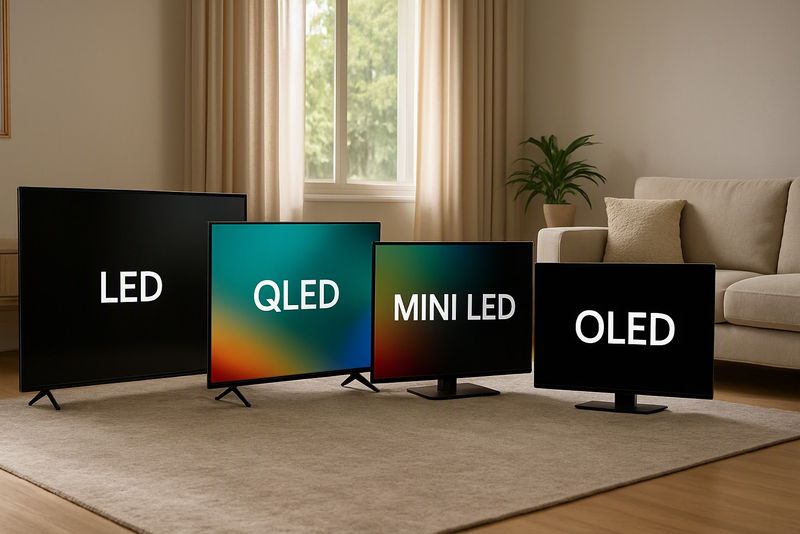
OLED vs QLED vs Mini LED vs LED: Which Wins in Bright Rooms?
Compare LED, QLED, Mini LED and OLED TVs for bright Indian living rooms: glare, black levels, burn-in risk and which panel suits your budget today.
Smart TV Price Tiers in India: What ₹12,000, ₹30,000 and ₹65,000 Actually Get You
How much should a smart TV cost in India? Compare size, panel and features at every budget band, and check if your quoted price is fair.