OLED vs QLED vs Mini LED vs LED: Which Wins in Bright Rooms?
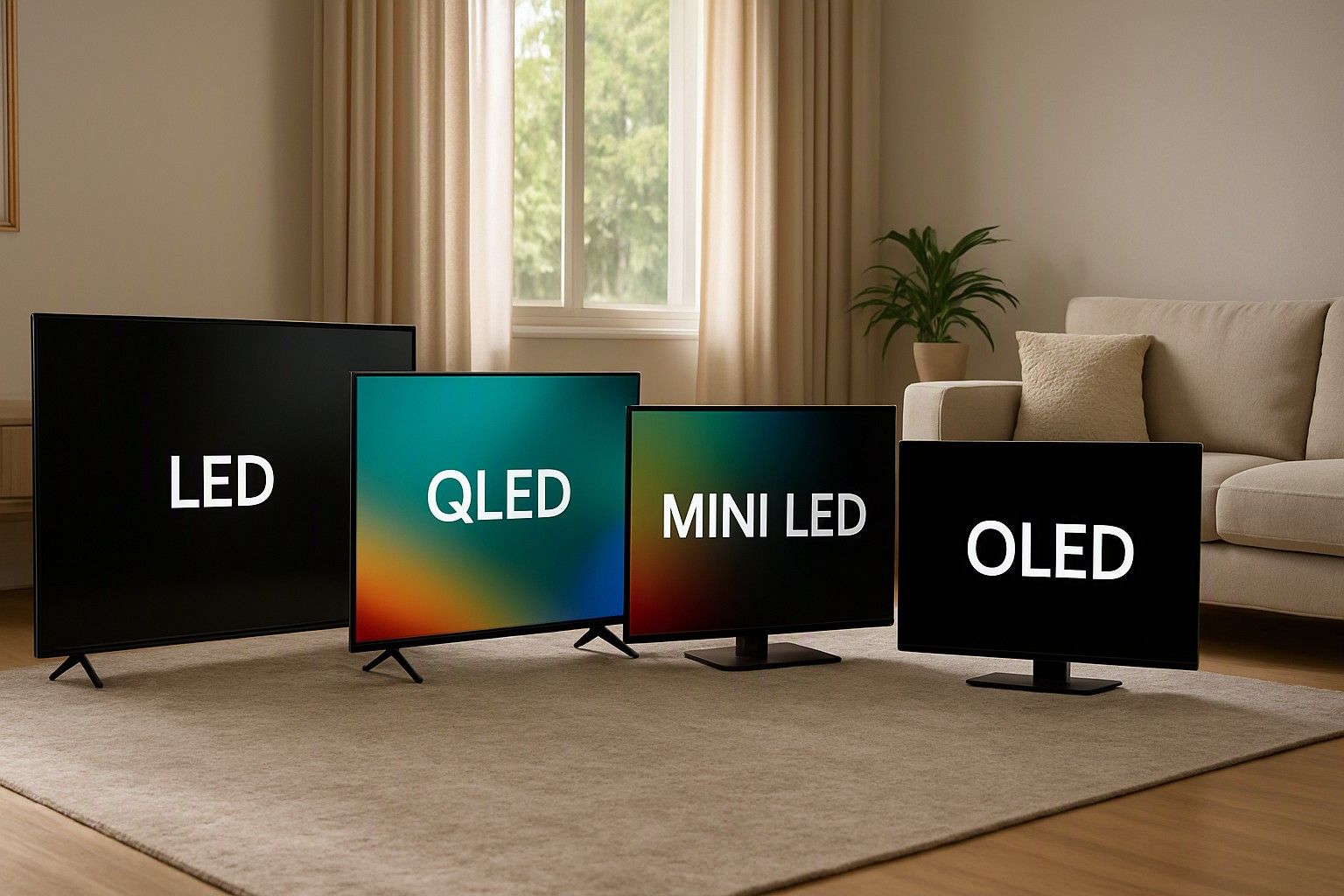
If your living room gets strong daylight and your TV runs news, cricket and serials for hours, a normal LED is often good enough, and QLED or Mini LED is the sensible step up. OLED is the one that needs a closer look, because it wins in dim rooms and carries trade-offs in bright ones. This article walks through how each panel behaves in an Indian home so you can decide which one fits your room and your viewing habits.
How Each Panel Type Creates the Picture
The four names describe two different ideas, and mixing them up is where most confusion starts.
LED is a liquid crystal (LCD) panel lit from behind by LED lights. The liquid crystal layer shapes the picture, and the backlight supplies the brightness. Almost every affordable TV in India works this way. The backlight can sit along the edges or directly behind the screen.
QLED is still an LED-backlit LCD. The difference is a layer of quantum dots between the backlight and the liquid crystals, which improves colour range and lets the screen look more vivid. It is a refinement of LED, not a separate technology.
Mini LED is also LCD, but the backlight is built from a much larger number of tiny LEDs grouped into dimming zones. The TV can switch off or dim zones behind dark parts of the picture, which gives better contrast than a standard backlight. Many Mini LED sets also use quantum dots.
OLED works differently. Each pixel produces its own light, with no backlight at all. A pixel that is switched off is truly black. That one design choice explains both OLED's biggest strength and its biggest caution, which the next sections cover.
Brightness and Glare in Sunlit Halls
Daylight is the hardest test for any TV, and this is where LCD-based panels have the clear advantage. A backlit panel can push a lot of light, so a bright scene stays visible even when sun comes through a window or balcony door. QLED and Mini LED usually lead here, because a stronger backlight and better light control keep the picture from looking washed out at noon.
A standard LED can handle a moderately lit room, but colours and contrast fade faster when sunlight hits the screen, especially on edge-lit models with weaker backlights.
OLED has a trade-off. Its peak brightness is generally lower than a good Mini LED or QLED, and in a hall with large uncovered windows the picture can look dimmer and less punchy during the day. Good OLED screens handle reflections reasonably well, but they cannot match the raw brightness of the best LCD sets.
The screen finish also matters. A glossy panel acts like a mirror when a window or a light sits opposite it, whatever the technology. If your TV faces a window, think about curtains and placement as much as panel type. For a room that is bright most of the day, Mini LED or QLED is the safer fit. OLED suits rooms where you can control the light.
Black Levels and Night Viewing
Switch the lights off for a late film and the ranking flips. OLED produces the deepest blacks, because dark pixels turn off completely. Starfields, night scenes and dark corners of a frame stay properly black, and bright objects next to them look sharp and separate.
Mini LED comes closest among LCD panels. With many dimming zones, it can darken the areas behind black parts of the picture. The compromise is blooming, a faint halo around a bright object, such as subtitles or a logo, on a dark background. How visible it is depends on how many zones the TV has and how well it controls them.
QLED and standard LED sets, especially edge-lit ones, show blacks as dark grey in a dark room, because the backlight is always partly on. Contrast looks flatter, and you notice it most in films and streaming dramas with many night scenes.
So the question is when you watch. If most of your viewing is evening and night with the lights dimmed, OLED or a strong Mini LED will give you a noticeable improvement. If you watch mainly in daytime or with lights on, deep blacks matter less, and brightness matters more.
Burn-In, Lifespan and Static News Tickers
Burn-in is the main reason Indian buyers hesitate over OLED. Because each pixel makes its own light, pixels that show the same bright image for many hours can age faster than their neighbours, and that can leave a faint permanent ghost. A news channel with a fixed logo, a scrolling ticker bar and a cricket scoreboard is exactly the kind of content that creates this risk if it runs for hours every day.
Modern OLED sets include protections such as pixel shifting and screen-saver routines, and mixed viewing carries little risk. Heavy daily use of one static-heavy channel is where caution is justified.
LCD-based panels (LED, QLED, Mini LED) do not suffer burn-in in the same way. Their long-term wear shows up as the backlight dimming or developing uneven patches after many years, rather than as a permanent image.
Lifespan also ties into cost. If a panel fails after the warranty ends, the screen is usually the most expensive part of the TV, and repair can approach the price of a new set. Before choosing a panel, check what panel failure costs to fix outside warranty, so you know what you are protected against and for how long.
Which Panel Appears at Which Price Point
Smart Tv prices in India across this category run from ₹6,999 to ₹3,00,000, with an average of ₹35,000, and panel technology is one of the main reasons for that spread.
In the ₹12,000 tier, you will mostly find standard LED panels, which is a sensible choice for a bedroom or a modestly lit room. In the ₹30,000 tier, standard LED still dominates, though QLED begins to appear, usually on specific models and sizes. In the ₹65,000 tier, QLED becomes much more common, Mini LED starts to show up, and some entry-level OLED options may appear depending on screen size.
Above that, the premium end of the range is where larger Mini LED sets and OLED screens are concentrated, along with the extra processing and brightness that come with them.
To see the price band where QLED and Mini LED start showing up in more detail, along with what else each tier includes, use the price tier breakdown. The practical point is to choose the panel your room needs first, then look at the tier that holds it, instead of paying for a technology that your lighting will not let you see.
Choosing a Panel and Moving Forward
Match the panel to the room you actually have.
- Bright hall, daytime viewing, a lot of news and sport: QLED or Mini LED. You get the brightness to beat glare, and there is no burn-in concern.
- Dim room or mostly night viewing, films and streaming: OLED gives the best picture, provided you are not running a single static channel all day. A good Mini LED is the alternative if you want more brightness.
- Tight budget or a secondary room: a standard LED is good enough. It will not match the others for contrast, but it does the everyday job well.
Panel type is one decision among several. Screen size, sound, smart platform and warranty all affect what you will be happy with, so fit your panel choice into the rest of the TV decision before you settle on a model. Today's prices already show what each panel type typically costs to own, so you can decide with confidence now.
So, QLED, OLED or a normal LED? For a bright Indian living room used for news, cricket and family viewing, QLED or Mini LED is usually the safest upgrade. OLED is worth it if your room is dim and your viewing is varied, and a standard LED is enough when the budget or the room does not need more.

Comments
Be the first to comment.