Smart TV Warranty, Wall Mounting and Service: What to Confirm Before and After Delivery
A smart TV's panel is the one part you cannot cheaply replace, and a panel repair can come close to the price of a new set. This article is for anyone deciding whether to pay for extended warranty, what installation and wall mounting really cost, and whether the brand will actually send someone to your city. By the end you will know what to confirm before delivery, what to check on the day, and when extra cover is worth paying for.
Standard Warranty vs Separate Panel Warranty
Most smart TVs brands in India carry a standard warranty that covers the set as a whole, usually for a fixed period from the date of purchase. Many brands treat the display panel as a separate line item, with its own term, its own conditions, or its own exclusions. That split matters because the panel is the costliest component, and it is the part most likely to be disputed.
Before buying, ask for the warranty terms in writing and look for three things. First, whether the panel is covered for the same period as the rest of the TV or for a different one. Second, whether the warranty includes parts only or parts plus labour and visit charges. Third, what the brand treats as physical damage. Cracked screens are almost never covered, but some brands also classify pressure marks, line defects after a fall in transit, or damage from a faulty power supply as outside cover.
Keep the invoice, the serial number and the warranty card together, and photograph the sticker on the back of the set when it is unpacked. If a panel issue appears, a clean paper trail is what separates a free replacement from an argument about whose fault it was. A shorter, clearly worded panel cover is often more useful than a long one full of exceptions.
Is an Extended Warranty Worth Buying?
It depends on how much of the TV's price a panel failure would wipe out, and on how reliable local service is where you live. Across the category, sets run from ₹6,999 to ₹3,00,000, with an average of ₹35,000. On a set near the bottom of that range, a plan that costs a noticeable slice of the TV price is hard to justify, because replacing the TV later may be no more expensive than repairing it. On sets in the ₹30,000 and ₹65,000 bands, a panel repair is a far bigger financial hit, so cover starts to make real sense. If you want to see how extended cover changes the real cost in each budget band, that comparison puts the numbers side by side.
When you evaluate a plan, check what it adds beyond the standard warranty. Good plans cover the panel explicitly, include labour and visits, and say who services the claim: the brand or a third party. Plans that exclude the panel or cap the claim at a fraction of the TV price are close to worthless on the one component you are worried about.
A practical rule: buy extended cover if the TV is in the higher bands, if your area has a reliable authorised service centre, and if the plan names the panel in writing. Skip it if the plan is vague, if the claim process runs through a call centre with no local technician, or if the TV sits in the ₹12,000 band and the plan costs a large share of its price.
Free Installation, Wall-Mount Brackets and Hidden Charges
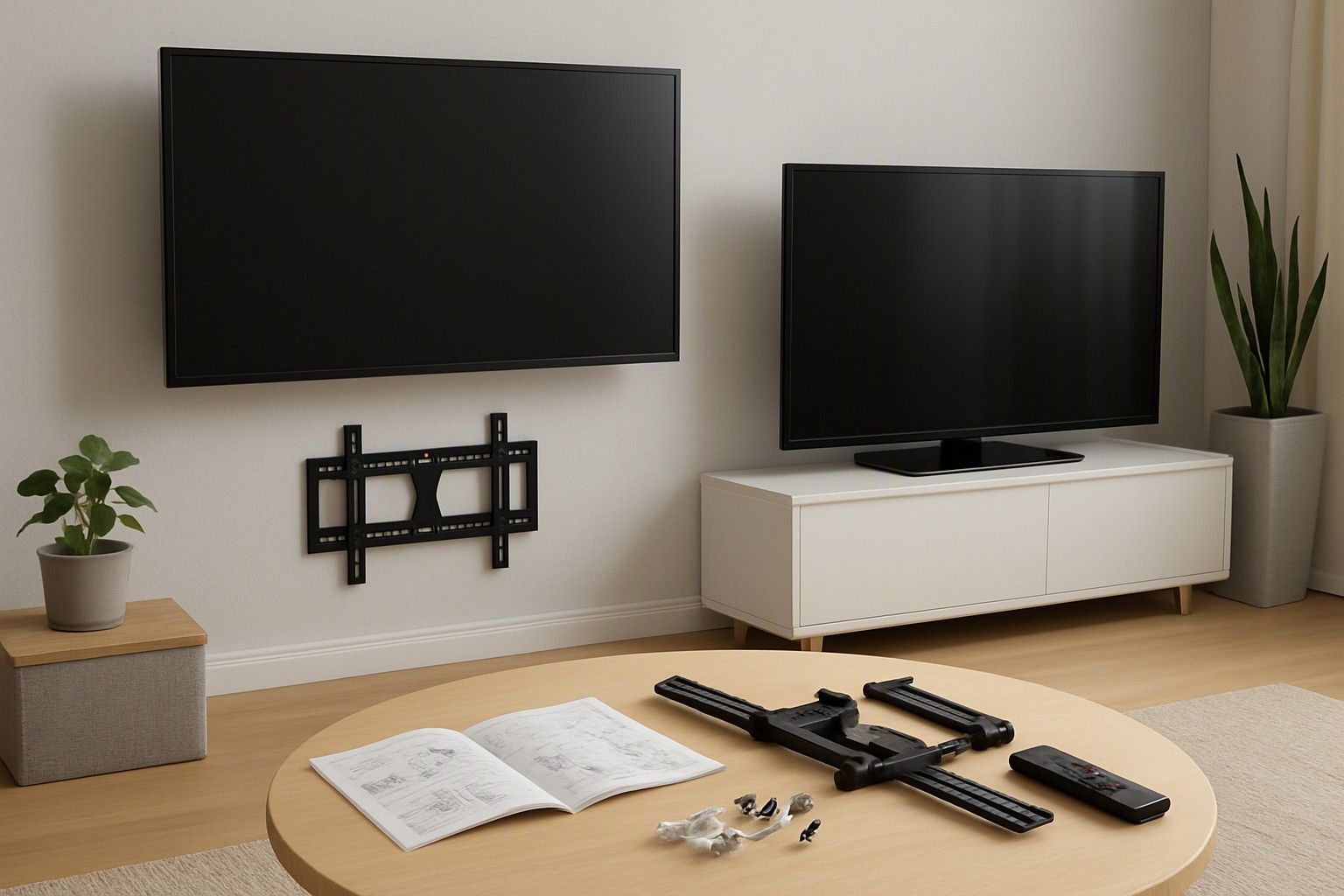
Free installation usually means a technician visits, unboxes the TV, places it on a stand or fixes it to a bracket, and runs the first-time setup. What it often does not mean is wall mounting. Many sellers include a basic stand but charge separately for drilling, for the bracket, or for both, and the visit itself may be booked days after delivery.
Ask these questions before you pay:
- Is the installation visit free, and is it handled by the brand or by the seller's own technician?
- Does the box include a wall-mount bracket, or only table-stand feet?
- If I want wall mounting, what is charged for the bracket and what for the labour?
- Are drilling, extra cable work and concealed wiring included or extra?
- Does the technician carry the right fasteners for my wall type, such as brick, concrete or hollow partition?
Check the bracket's rated weight and size range against your TV before it goes on the wall, and make sure the wall can take the load. Partition and plaster walls need proper anchors, not just screws. Watch the technician fit it and confirm the TV is level and does not flex when you push the bottom edge.
Also inspect the TV for screen damage before the delivery person leaves, and have the installer record that the set powered on normally. Disputes about transit damage are far easier to win if they are raised at the door.
Voltage Fluctuations, Stabilisers and Surge Protection
Power quality in many Indian homes is uneven. Voltage dips, spikes after an outage and lightning-related surges are common causes of power-board failures in televisions, and they are exactly the kind of fault warranty teams may argue is external. Read the warranty card for any clause about operating voltage range or damage from power supply problems.
A smart TV's built-in power circuit has some tolerance, but it is not unlimited. If your area sees frequent fluctuations, a voltage stabiliser or a surge-protected power strip placed between the wall socket and the TV is cheap insurance relative to the cost of a panel or board repair. Choose one rated for the TV's power draw, not just any adapter, and avoid chaining multiple cheap extension boards.
Habits matter too. Unplug the TV, the set-top box and the router during thunderstorms if you can, and do not switch the TV back on the instant power returns after a cut. Giving it a minute lets the supply settle. Make sure the socket has a working earth connection, as poor earthing is a common contributor to surge damage.
If you do claim, a visible protection setup shows you took reasonable care, which can help if the service centre questions the cause of failure.
Service Network Reach in Smaller Cities and Towns
A warranty is only as good as the nearest technician. In metros, most brands have authorised centres and home-visit options. In smaller cities and towns, coverage can thin out quickly, and some brands that sell mainly online rely on a handful of partner centres or on courier pickups that leave you without a TV for weeks. For a deeper look at spotting online-only brands with thin service coverage, the spec and seller details on a listing often give early clues.
Before buying, check the brand's own service locator using your pin code, not just the city name. Call the listed number and ask three things: whether a technician visits the home for panel and board issues, what the usual response time is, and whether parts are stocked locally or shipped from a central warehouse. Local shop owners and neighbours who own the same brand are often more honest than a website.
If the nearest centre is far away, factor that in. A well-priced TV from a brand with no service nearby can cost more in the end than a slightly pricier one with a technician in your town. In such cases, a seller who handles warranty returns directly can be a better safety net than a distant brand centre.
Factoring After-Sales Into the Brand You Choose
After-sales support should carry real weight in the decision, not sit as a tie-breaker after picture quality and price. Two TVs with similar screens and similar prices can be very different ownership experiences if one brand answers service calls in two days and the other in two weeks.
A simple way to compare is to score each shortlisted brand on a handful of points: how clearly the warranty and panel terms are written, whether a service centre exists in your pin code, how long repairs reportedly take, whether extended cover names the panel, and how installation and wall-mount charges are handled. Then weigh these alongside display quality and budget. For a framework that lets you rank brands by service reliability alongside picture and price, the main buying guide shows how the factors fit together.
If two models are close, pick the one with the stronger local service and clearer paperwork, even if it costs a little more. Where service is weak but the price is appealing, treat that as a real cost: the saving may disappear the first time something goes wrong. Choosing with after-sales in mind means you can buy now with confidence rather than hope nothing breaks.
So, is extended warranty worth it, and what does installation cost? Extended cover pays off on higher-priced sets, in areas with real service reach, and only when the plan names the panel in writing. Installation is often free for the basic setup but not for wall mounting, so confirm the bracket, drilling and visit charges before you pay. Settle those points, add a stabiliser or surge protector, and you can place the order knowing what happens after delivery.
Comments
Be the first to comment.