Ink Tank vs Cartridge Printers: What Indian Buyers Should Know
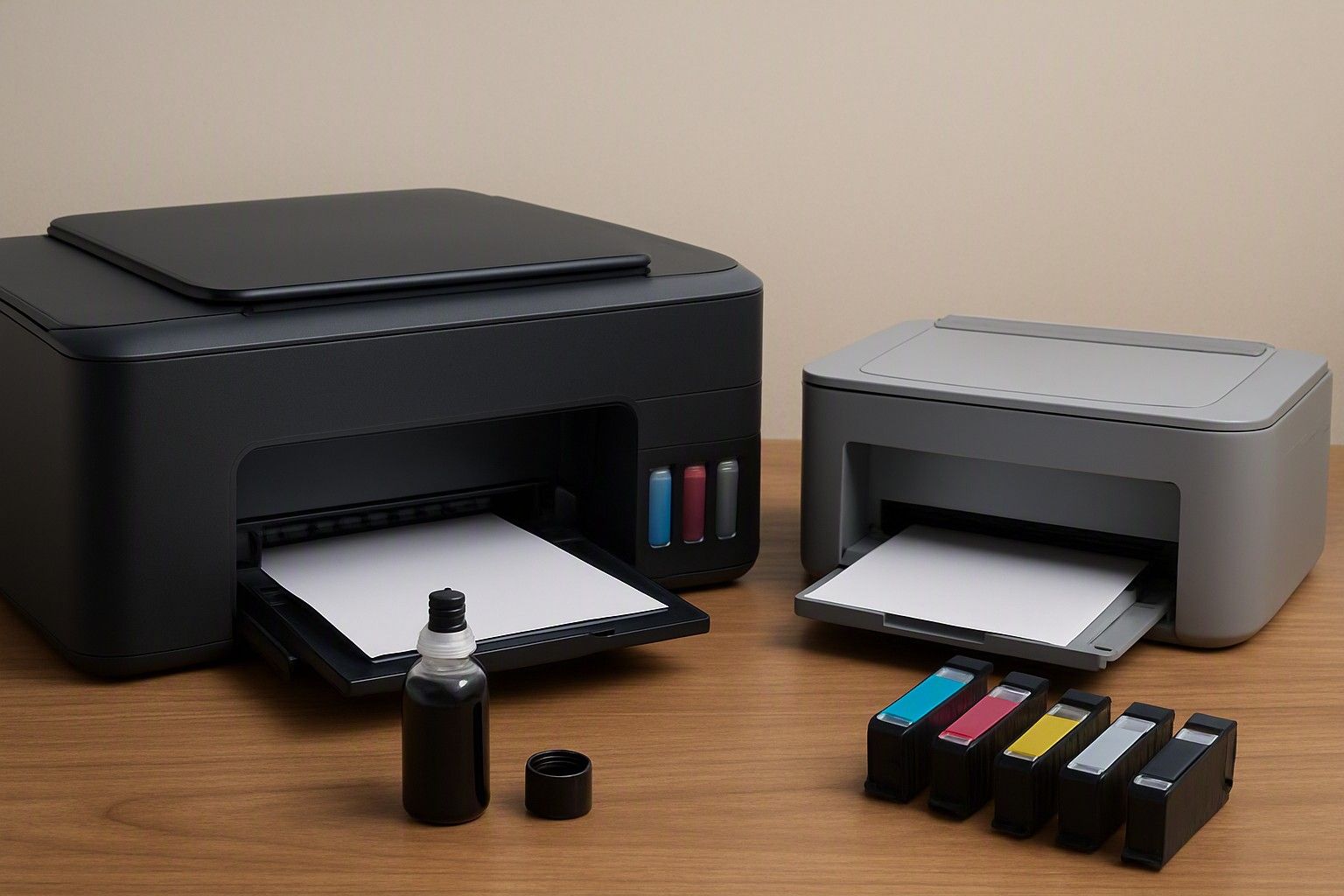
If you print more than a few pages a week and dread the cost of replacing cartridges, you've probably already heard people push you toward ink tank printers. Whether that's actually the right call depends on how much you print, what you print, and how you use the printer between print jobs — not just the sticker price at the store. This article walks through both systems so you can answer that question for your own household or desk, not just follow a trend.
How Ink Tank and Cartridge Systems Differ
A cartridge printer uses small, sealed ink or toner cartridges that snap into the print head or feed it via a tube, and you replace the whole cartridge once it runs dry. An ink tank printer instead has large refillable reservoirs, usually sitting alongside or in front of the printer, that you top up from ink bottles using a nozzle or dropper. The print mechanism itself works similarly in both — nozzles push ink onto paper — but the ink delivery and refill process are built completely differently.
This difference shows up the moment you run low on ink. With a cartridge printer, you buy a new cartridge, snap out the old one, and you're done in under a minute. With an ink tank printer, you buy an ink bottle separately, open the tank, and pour in ink carefully enough to avoid spills or air bubbles. Ink tank models also tend to be physically larger and heavier because they need room for the tanks, so if desk space or portability matters to you, that's worth factoring in alongside the running cost question. Neither system is inherently better at print quality — that comes down to the print head technology, not whether the ink sits in a cartridge or a tank.
Why Ink Tank Printers Took Off in India
Ink tank printers found a genuinely enthusiastic audience in India for reasons that are specific to how Indian households and small offices actually print. Cartridge costs here have historically been high relative to the price of the printer itself, and buyers routinely found that replacing cartridges a few times over a printer's life cost more than the printer did originally. That math frustrated anyone printing school assignments, exam material, business documents, or photos regularly, and it pushed demand toward a system where the ongoing cost per page was dramatically lower.
Joint family homes, coaching centres, small shops and home-based businesses in India also tend to print in bursts rather than a steady trickle — a stack of documents one week, nothing for the next fortnight. Ink tanks handle this pattern well because a full tank holds enough ink to cover months of moderate use without a refill, which matters when the nearest cartridge or ink bottle stockist isn't always around the corner. Manufacturers responded by pricing ink tank printers more aggressively for the Indian market specifically, narrowing the upfront cost gap with cartridge printers to the point where the refill savings became the clear deciding factor for most buyers rather than a distant, theoretical benefit.
Upfront Price vs Refill Economics
Printers sold in India span ₹2,900 to ₹35,000, averaging around ₹11,000, and both cartridge and ink tank models show up across that range. Broadly, cartridge printers dominate the ₹5,000 bracket, ink tank printers become common from ₹12,000 upward, and the ₹25,000 bracket includes higher-capacity ink tank models built for heavier office use. So the upfront price gap between the two systems is real but no longer huge — you're not paying double for an ink tank printer the way buyers once did.
Where the two diverge sharply is after purchase. A cartridge printer's low entry price is offset by cartridges that need frequent replacing, and those costs add up fast if you print regularly. An ink tank printer costs a bit more to bring home but each bottle of ink covers a far larger number of pages, so the cost of every single page you print drops substantially over the printer's life. If you want the actual rupee-per-page numbers rather than a general sense of the trend, it's worth taking the time to see how refill savings show up in cost per page — that's where this trade-off becomes concrete rather than directional. The short version: judge these two systems by total cost over a year or two of realistic use, not by the number on the box.
Print Volume Where Each One Makes Sense
Print volume is the single clearest way to decide between these two systems, more than budget or brand preference. If you print occasionally — the odd form, a boarding pass, a handful of pages a month — a cartridge printer is arguably the more sensible choice. You avoid the higher upfront cost of an ink tank printer, and since cartridge ink can dry out or degrade over long idle periods anyway, low-volume use doesn't let an ink tank printer's cost advantage play out fully.
Once you're printing regularly — school or college work through the year, a home business generating invoices and labels, or a small office churning out documents daily — the equation flips firmly toward ink tank printers. The more pages you print, the more the lower cost per page compounds, and the gap between what you'd have spent on cartridges versus ink bottles widens every month. Households with multiple students or a shared home office setup tend to see the clearest payoff, since combined print volume across users adds up faster than any one person printing alone. As a rough guide, if you find yourself replacing a cartridge more than a couple of times a year, you're already in ink tank territory, and continuing with cartridges at that point is generally the more expensive habit to keep.
Reliability, Clogging and Maintenance Concerns
Both systems can develop clogging issues, but the cause and the fix differ. Cartridge printers rarely clog badly because each cartridge is sealed and replaced before ink has a chance to dry out inside it, though print heads can still dry up if the printer sits unused for long stretches. Ink tank printers are more prone to clogging precisely because the ink sits in open tanks and tubing for extended periods, and if the printer is left idle for weeks, the ink nearest the print head can dry and block the nozzles.
The good news is that ink tank printers are largely self-correcting if you use them somewhat regularly — printing even a single page every week or two keeps ink moving through the system and prevents most clogging. Most models also include a built-in cleaning cycle you can run from the printer's control panel or software when you notice faded or streaky output, though running this too often wastes ink. Refilling itself is straightforward once you've done it a couple of times, but it does require a steady hand and a clean workspace, since spilled ink is harder to deal with than a dropped cartridge. If your printer is genuinely likely to sit unused for a month or more at a stretch, a cartridge printer is the lower-maintenance choice; if it gets used at least occasionally, an ink tank printer's maintenance needs are manageable and shouldn't be a reason to avoid it.
Which System Is Right for Your Household
Bring the decision back to how you actually print, not how you'd like to print in theory. Light, occasional use with long idle gaps favours a cartridge printer — lower upfront cost, no risk of dried-up tanks, and a system that tolerates being ignored for weeks. Regular or heavy printing, especially shared across a household or used for a home business, clearly favours an ink tank printer, where the higher upfront price pays for itself in refill savings within the first year or so for most active users.
If you're still weighing this against other printer decisions — inkjet versus laser, single-function versus all-in-one, or which features actually matter for your use case — it's worth taking a step back and checking the overall printer buying guide before deciding, since the ink tank versus cartridge question is only one piece of that larger decision. But on this specific question, the answer usually comes down cleanly once you're honest about your monthly print volume and how patient you are with occasional maintenance.
Whether an ink tank or cartridge printer suits you isn't a matter of one being objectively superior — it's a matter of matching the system to how much you actually print and how you'll treat the printer between uses. Weigh your realistic monthly volume against the refill economics above, and you'll know which one earns back its price rather than costing you more down the line.

Comments
Be the first to comment.