Do You Really Need a Baby Monitor in an Indian Home?
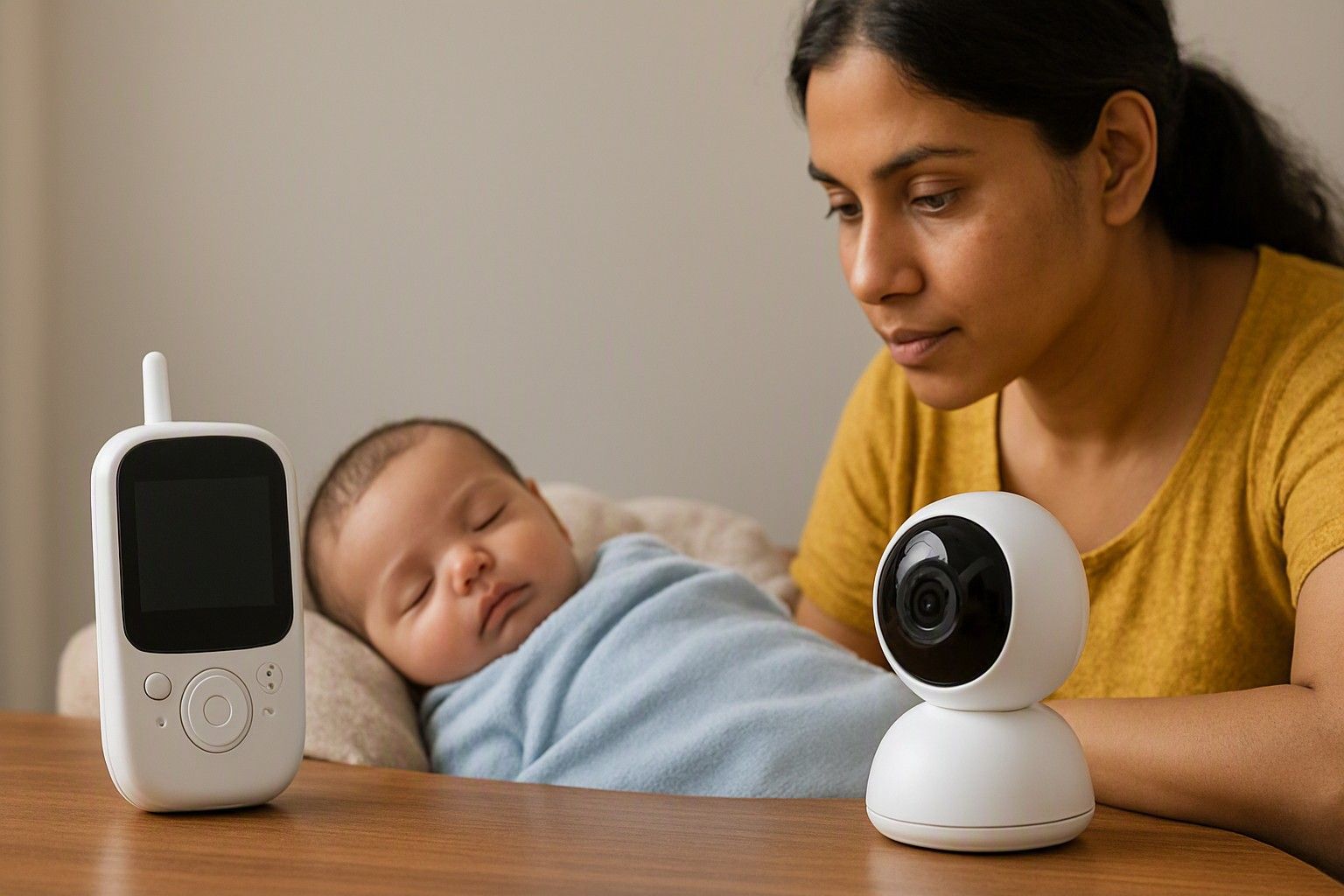
If your baby's cot is a few feet from your bed, or grandparents are almost always home, you may be wondering if a baby monitor is solving a problem you don't actually have. It's a fair question — plenty of Indian households run on shared rooms and constant adult presence, which is exactly the situation a monitor was designed to compensate for elsewhere. This article walks through when a monitor earns its place in a home like yours, and when your existing setup already does the job.
What a Baby Monitor Does and How It Works
A baby monitor is, at its core, a way of extending your ears and sometimes your eyes into a room you're not physically in. The simplest versions are audio-only: a transmitter near the baby picks up crying or stirring and sends it to a receiver you carry with you. Video monitors add a camera feed, usually to a handheld screen or a phone app, so you can see the baby without walking over or opening a door. Some models add extras like temperature readouts, lullabies, two-way talk, or motion sensing under the mattress, but the underlying job is always the same — letting you know what's happening in another room without being physically present in it.
The reason this matters for the question at hand is simple: a monitor's entire value proposition depends on distance and separation. It exists to bridge the gap between where the baby sleeps and where the caregiver is working, resting, or attending to other things. If that gap is already small or already covered by another adult sitting in the same room, the monitor isn't adding a new capability — it's duplicating one you already have. Understanding this mechanism is what makes the rest of this decision straightforward rather than something you have to guess at.
When It Genuinely Helps in Indian Households
There are specific, common situations in Indian homes where a monitor stops being a nice-to-have and starts solving a real problem. The most obvious is a home with more than one floor, where the baby naps upstairs while the rest of the household — including the kitchen, the washing machine, or a home office — is downstairs. Climbing up every fifteen minutes to check isn't practical, and a monitor removes that friction entirely.
It also helps when a parent is the sole caregiver for stretches of the day, such as when one partner travels for work or extended family lives separately rather than under the same roof. In that case, there's no second adult to keep half an ear out while you cook, shower, or step onto a balcony call, and the monitor fills that specific gap.
A third situation is a baby who's a light or unpredictable sleeper, where you want visual confirmation of breathing or position rather than just sound — this is where video monitors particularly earn their keep over audio-only ones. Finally, homes with domestic help or a nanny watching the baby while a parent works from a different room often use a monitor as a shared check-in tool rather than a replacement for supervision. In each of these cases, the monitor is addressing an actual distance or attention gap, not just being bought because it's available.
Single-Room Homes vs Separate Nursery Situations
This is where the calculation changes most sharply, and it's worth being honest about it. In a single-room or studio setup, where the baby's cot sits within arm's reach or clear line of sight of the adults, a monitor is largely redundant for its primary purpose. You'll hear a cry before any transmitter does, and you can see the baby without a screen. Buying a monitor here isn't wrong, but it isn't solving the problem it was built for either — you'd mostly be paying for convenience features like a night-light or lullaby, not for the core function of remote awareness.
The picture flips once you move into a 2BHK or larger home with a separate nursery or a spare room used for the baby's daytime naps, especially if that room isn't visible from the kitchen, living room, or wherever the rest of the household spends the day. Distance and closed doors are exactly the conditions a monitor is meant to handle, and the further the baby's room is from where you naturally are, the more a monitor earns its cost. If you're in a larger or multi-floor home, it's worth reading how range needs change in larger or multi-room homes, since the distance a monitor needs to reliably cover — through walls, floors, or across a courtyard — varies a lot more than most first-time buyers expect, and getting this wrong is the most common reason people end up disappointed with a monitor they've already bought.
When You Can Safely Skip Buying One
There's no safety requirement that says every household must own a baby monitor, and several genuinely common Indian living arrangements make one unnecessary rather than merely optional. If you live in a joint family where a grandparent, spouse, or other adult is almost always within earshot of the baby's sleeping area, you already have a human monitor with better judgment than any device. If your home is small enough that every room is close to every other room, the physical distance a monitor is meant to cover simply doesn't exist in your case.
It's also fine to skip one if your baby currently co-sleeps or naps in the same room as an adult for most of the day, which is standard practice in many Indian households in the first several months. In these situations, spending anywhere from ₹1,800 to ₹16,000 on a monitor doesn't buy you anything you don't already have — the money is better held onto or redirected elsewhere in the baby's setup. This isn't a compromise or a corner being cut; it's simply recognizing that the tool matches a problem, and if the problem — distance, closed doors, sole caregiving — doesn't exist in your home, there's nothing missing by not owning one.
If You Decide to Buy: What to Look At Next
If you've gone through the situations above and recognise your own home in the ones where a monitor genuinely helps — a separate nursery, a multi-floor layout, solo caregiving stretches, or a baby whose sleep you want to watch more closely — the next step is figuring out which type and features actually matter for your space, rather than picking based on price alone. Monitors across the market span ₹3,000, ₹8,000, and ₹18,000, with an average around ₹7,500, and the right tier depends far more on your home's layout and how you plan to use it than on chasing the highest-spec option available.
Rather than repeating that groundwork here, it's worth going straight to start with the core decisions in the full buying guide, which walks through audio versus video, range, and the features worth paying for in the order they actually affect your decision. Buying with that framework in hand, once you know a monitor fits your situation, is a far more useful next step than browsing listings first and working backward.
So — do you need a baby monitor if family is usually around? If your home is compact and someone's almost always within earshot, the honest answer is no, and that's a perfectly sound way to run things. If your layout puts distance, closed doors, or solo stretches between you and the baby, a monitor is solving a real gap, not just adding a gadget. Either way, you now have a clear-eyed answer for your own house, not a generic one.

Comments
Be the first to comment.