Does Your Child Really Need a Car Seat in India?
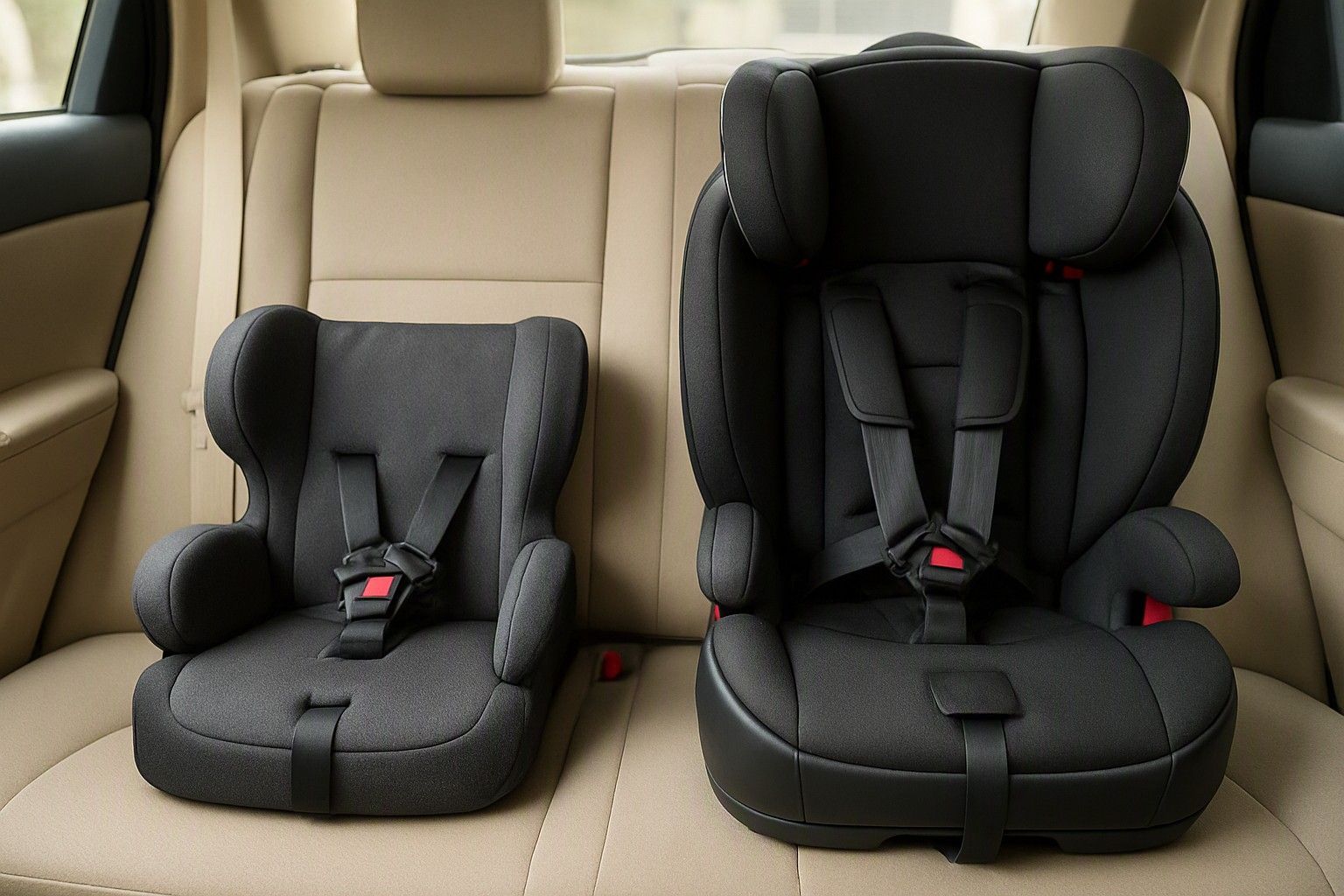
If you're driving around with your child on your lap or buckled next to you on the back seat, and wondering whether a car seat is genuinely necessary or just another item on the new-parent shopping list, this is worth reading before you decide either way. The honest answer depends on how you drive, where you drive, and what "safe enough" really means once you look past habit and convenience. Let's go through what actually matters.
The Real Risk of Carrying a Child on Your Lap in a Car
Holding a child on your lap in a moving car feels protective, but it works against you the moment there's a sudden stop or impact. At even a modest speed, a collision multiplies a child's effective weight several times over, meaning your arms cannot hold on to them no matter how tightly you're gripping. Worse, an adult's body becomes a crushing force against the child in a frontal impact, since the adult's own momentum carries forward into the child sandwiched against the dashboard, seatbelt, or airbag. This isn't a rare freak scenario either — Indian roads see frequent hard braking, potholed swerves, and two-wheeler cut-ins that force sudden stops even at city speeds well under the highway limit.
A rear-facing or forward-facing car seat, by contrast, is engineered to spread crash force across the shoulders and pelvis rather than the soft abdomen and neck, and it keeps the child anchored to the vehicle structure instead of to a person who is also being thrown forward. This is the single biggest reason the question "do I actually need one" has a fairly clear answer for anyone who drives with a child regularly: an adult's lap, no matter how careful the driving, cannot replicate what a properly secured seat does in the first fraction of a second of a crash. The risk isn't about reckless driving on your part — it's about what happens when someone else on the road forces your hand.
What Indian Law Says About Child Restraints
India's motor vehicle safety rules have been catching up with global norms, and child safety restraints for young passengers are increasingly part of that framework, alongside long-standing requirements like seatbelts for front-seat occupants and helmets for two-wheeler riders. Enforcement on car seats specifically has been inconsistent across states compared to something like helmet checks, and many parents correctly sense that the immediate legal risk of skipping one is lower than the immediate legal risk of, say, not wearing a seatbelt yourself. That gap in enforcement is exactly why so many families end up asking whether a car seat is genuinely necessary rather than just legally mandated — and it's worth separating those two questions clearly.
Legal requirement and actual safety need are not the same thing, and treating the current patchwork enforcement as a signal that car seats are optional in practice is a mistake. Rules tend to tighten over time, not loosen, and India's road safety policy has been moving steadily toward global standards on this front. Relying on the fact that a traffic officer is unlikely to stop you today isn't a safety strategy — it's a bet that nothing goes wrong before the law catches up to where crash data already points. If you're deciding based on what you can get away with versus what actually protects your child, those are two very different decisions, and only one of them should influence what you do this week.
At What Age Can a Child Skip the Car Seat?
There's no age at which a child truly "outgrows" the need for some form of restraint appropriate to their size — what changes is the type of restraint, not whether one is needed at all. Infants need rear-facing support because their neck and spine can't yet handle forward-facing crash forces, toddlers need harnessed forward-facing seats once they're walking and heavier, and older children who've outgrown a full car seat still need a booster to sit correctly under an adult seatbelt rather than have the belt cut across their neck or stomach. It's usually somewhere in the pre-teen years, once a child is tall enough that the adult seatbelt sits properly across the collarbone and hips on its own, that the need for any additional restraint device finally ends.
Parents often assume this transition happens earlier than it actually does, especially with a child who's tall for their age but still years away from adult-sized proportions. Skipping a step in this progression — moving a toddler straight to an adult seatbelt, for instance — leaves a real gap in protection even though it feels like a natural next stage. If you're trying to work out exactly where your child currently falls in this progression, it helps to see which seat matches your child's current age and weight rather than guessing based on how old they seem for their years.
Do You Need One If You Rarely Drive Long Distances?
A lot of Indian parents reason that car seats matter mainly for highway trips, and that short city runs to school, the clinic, or a relative's house down the road don't carry the same risk. This logic doesn't hold up against how and where crashes actually happen. Most collisions occur at lower speeds and closer to home, precisely because that's where the bulk of driving happens — dense traffic, sudden braking for pedestrians or two-wheelers, and tight intersections are a daily feature of short city drives, not highway journeys. The risk isn't proportional to distance travelled; it's proportional to how often you're in a moving vehicle at all, however briefly.
There's also a practical angle worth being honest about: a car seat that only comes out for occasional long trips tends to get installed poorly, since infrequent use means less familiarity with the buckles and anchor points, and inconsistent use means the child is unrestrained on all the short trips in between anyway. The stronger approach for most families is to install a seat once, correctly, and use it for every drive regardless of length, rather than treating it as special equipment reserved for road trips. If your driving is genuinely occasional — you don't own a car and rarely travel in one — the calculus shifts, but for anyone who drives their child around town even a few times a week, distance isn't the deciding factor here; frequency is.
Common Myths Indian Parents Believe About Car Seats
A few beliefs come up repeatedly among Indian parents deciding against a car seat, and most don't survive scrutiny. One is that a careful driver doesn't need one — but a car seat protects against other people's mistakes on the road, not your own driving skill, and India's mixed traffic means you're sharing the road with a lot of unpredictable behaviour you can't control. Another is that holding a child tightly or having someone experienced sit with them in the back is a workable substitute — covered earlier, this simply isn't physically possible to do reliably in a real collision. A third is that car seats are only necessary for very young infants, when in fact toddlers and young children need a different kind of restraint, not none at all, right through the booster stage.
There's also a belief that a car seat is unnecessary if the car has airbags, but airbags are designed and calibrated for adult bodies and can actually injure a small child if they aren't properly restrained in a seat first. And some parents assume that because their own parents drove them around without any restraint decades ago and everyone turned out fine, the same reasoning applies today — this ignores both the survivorship bias in that logic and the fact that Indian traffic density and vehicle speeds have both increased substantially since then. Buying a seat is only half the job, though; even a well-chosen seat fails to protect if it's installed loosely or used inconsistently, so it's worth learning to know the installation and safety mistakes that undo any car seat's protection before you assume the seat alone is doing the work.
Deciding If It's Worth Buying for Your Family
Bringing this back to the original question: if you drive your child anywhere with any regularity — school runs, weekend outings, visits to family — a car seat is worth having, not as an occasional-use accessory but as standard equipment for every trip. Prices for car seats sold in India span a wide range, from ₹1,800 at the very low end up to ₹35,000 for more feature-rich options, with the market averaging around ₹7,000. That spread exists because seats differ in the age range they cover, the materials used, and how many years of use you'll get from one seat versus needing to replace it as your child grows — not because higher prices signal safety on their own.
Families working with a tighter budget can still get a genuinely protective seat in the ₹2,000 or ₹6,000 range, while the ₹15,000 band tends to bring extra convenience features and multi-stage designs that adapt as your child grows rather than needing replacement. None of these price points should be treated as a reason to wait for a better deal — the cost of delaying is measured in unprotected trips, not rupees saved, and the price history on these products doesn't suggest waiting brings meaningfully better value. Once you've accepted that a seat is worth having, the more useful next step is figuring out which type and which features actually fit your child, your car, and your budget, and that's exactly where you should move on to how each seat type and buying factor fits your situation.
The question of whether your child actually needs a car seat in India isn't really about strict driving or short distances or what the law currently enforces — it's about physics that doesn't change based on how careful you are or how far you're going. Once that's clear, the remaining decisions are practical ones: which seat type, which price range, and how to install it correctly, all of which are far easier questions to answer than the one you started with.

Comments
Be the first to comment.