ISOFIX vs Seatbelt Car Seats: Will It Fit Your Car?
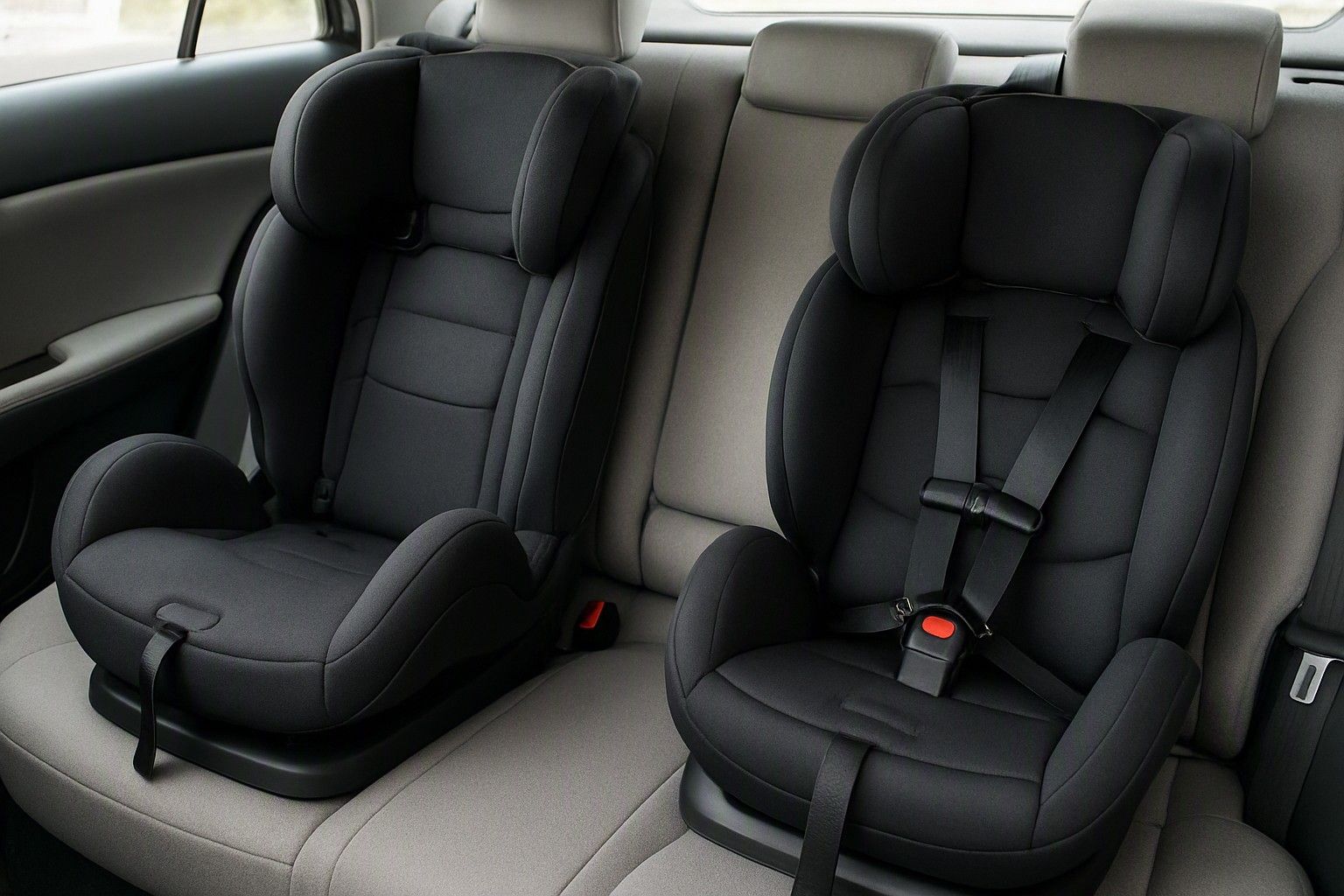
If you've been comparing car seats and keep running into the word "ISOFIX" without knowing whether your own car even supports it, you're not alone — a large number of cars on Indian roads, especially older ones, were never built with ISOFIX anchors. This article walks through what ISOFIX actually does, how to check your specific car, and what your options are if it turns out you don't have it. By the end you'll know exactly which installation type to buy, not just which one sounds more advanced.
What ISOFIX Actually Is and Why It's Safer
ISOFIX is a standardised anchoring system — two metal bars fixed into the car's body, usually tucked into the seat bight where the backrest meets the base of the rear seat. A car seat with ISOFIX connectors clicks directly onto these bars, creating a rigid, near-permanent link between the seat and the car's structural frame rather than relying on the car's seatbelt to hold it in place. This matters because seatbelts were engineered to restrain adults, not to lock a child seat into a fixed position, and a belt-installed seat can shift a few centimetres during hard braking or a crash even when tightened correctly.
That rigidity is the whole point. A properly clicked-in ISOFIX seat has far less forward and lateral movement on impact, which translates to less strain on a child's neck and torso. It also removes human error from the equation — there's no belt routing to get wrong, no risk of a loose loop you didn't notice. For a country where installation is almost always done by the parent rather than a trained technician, that consistency counts for a lot. It doesn't make the seat itself safer in isolation, but it makes the installation far more reliably safe, which in real-world use is often the bigger risk factor than the seat's build quality alone.
How to Check If Your Car Has ISOFIX Anchor Points
Before you fall in love with an ISOFIX seat, spend five minutes confirming your car actually has the anchors. Start with the rear seat: run your hand into the crease where the seat cushion meets the backrest, on both the left and right outboard seating positions. You're feeling for two small metal loops, usually a few centimetres apart, sometimes hidden under a flap of upholstery or a small plastic cover marked with a child-seat icon. If your fingers find nothing but soft padding, that seating position doesn't have ISOFIX.
Your car's owner's manual is the more reliable check — it will explicitly state which rear seating positions, if any, are ISOFIX-equipped, and most manuals show a diagram of exactly where to look. Many entry-level and older hatchbacks and sedans sold in India skip ISOFIX entirely or offer it only on the outer two rear seats, never the middle. If you're buying a car and a car seat around the same time, it's worth asking the dealer directly rather than assuming a recent model year guarantees the feature — it doesn't. Some cars also have a top tether anchor near the parcel shelf or boot area, which works alongside ISOFIX for extra stability but isn't a substitute if the lower anchors are missing.
Seatbelt-Installed Seats for Older Indian Cars
If your car doesn't have ISOFIX, that doesn't rule out a proper, safe car seat — it just narrows your options to seatbelt-installed ones, which remain the norm across a huge share of cars in India, particularly older hatchbacks, sedans, and many compact SUVs. A seatbelt-installed seat uses the car's existing three-point belt threaded through specific guides on the seat frame, then cinched tight enough that the seat barely moves when you push it hard at the belt path. Done correctly, this is a genuinely safe method — it's how child seats were installed globally for decades before ISOFIX became common, and it still meets the same safety standards.
The trade-off is entirely about installation effort and consistency. You have to get the belt routing right every single time, including after removing the seat for cleaning or a long trip, and a belt that's even slightly loose undermines the whole setup. This is also where budget flexibility works in your favour: seatbelt-only seats span the full price range you'll find in the market, from options near ₹1,800 up through the ₹2,000 and ₹6,000 tiers, so not having ISOFIX doesn't box you into a cheaper or lesser seat. Many well-built seats in the ₹6,000 to ₹15,000 range are seatbelt-only by design, prioritising padding, recline angles, and side-impact structure over the anchoring method.
Which Popular Indian Cars Support ISOFIX
ISOFIX availability in India has been shaped less by price and more by when a car's platform was designed. Many hatchbacks and sedans built on older platforms, even recent facelifts of them, were never engineered with ISOFIX anchors and don't have them at any trim level. On the other hand, most SUVs and crossovers launched on newer platforms, along with premium hatchbacks and sedans from the last several years, tend to include ISOFIX on at least the two outer rear seats as standard or on mid-to-top variants.
The pattern to watch for is platform generation rather than brand loyalty or badge — a car that got a genuinely new platform recently is far more likely to have ISOFIX than one that's been carried over with cosmetic updates for years, regardless of which manufacturer sells it. Compact and sub-4-metre SUVs have generally led the shift, since they're often built on newer architectures than the sedans and hatchbacks sitting alongside them in a manufacturer's lineup. If you're unsure where your specific car falls, the anchor-point check described earlier is more reliable than assuming based on segment or price bracket, since there are exceptions in both directions — some budget cars do have it, and some pricier ones still don't.
Getting the Installation Right Either Way
Whichever method your car supports, the installation itself is where most of the real-world risk actually lives — a top-rated seat fitted loosely offers barely more protection than a cheap one fitted well. With ISOFIX, the failure point is usually not clicking both connectors in fully; you should hear and feel a distinct click on each side, and the seat should not rock side to side or lift more than a centimetre when you tug it at the base. With seatbelt installation, the common mistakes are threading the belt through the wrong guide, leaving too much slack, or forgetting to lock the belt using the car's locking clip or retractor mechanism where required.
Both methods also need a re-check after any long gap — after a road trip, after the seat's been removed for cleaning, or after a few months of regular use, since buckles loosen and connectors can shift slightly out of position without you noticing. It's worth spending ten minutes with the seat's manual the first time you install it, rather than eyeballing it based on how a similar seat looked in a video. If you want the full list of what tends to go wrong and how to catch it before it becomes a problem, it's covered in detail in our guide to how you can avoid the fitting errors that make even a good seat unsafe.
Matching Installation Type to the Rest of Your Decision
Installation type isn't a decision you make in isolation — it's one filter among several, alongside your child's age and weight, how often you'll move the seat between cars, and how much you're willing to spend, which across the market runs from ₹1,800 to ₹35,000 with most buyers landing around ₹7,000. A confirmed ISOFIX car narrows your search usefully, but it shouldn't override everything else — a seatbelt-installed seat that fits your child's current stage well is a better buy than an ISOFIX seat that's the wrong size or stage for them.
Once you know which installation type your car actually supports, the next step is lining that up against the other factors that decide which seat is right for you — budget tier, age group, and how long you expect the seat to last. That full decision framework, including how installation type should weigh against everything else, is where you should fold your installation choice into the bigger picture of picking a seat.
Key Things to Check Before Choosing Between an ISOFIX and Seatbelt-Installed Car Seat
Check for ISOFIX: Look for the two metal anchor points in the rear-seat crease and confirm in your car's owner's manual which seating positions have them. ISOFIX is often available only on the outer rear seats.
No ISOFIX? That's okay: A properly installed seatbelt-only car seat can still provide safe protection. What matters is choosing a seat designed for your car's three-point seatbelt and installing it correctly.
Check the extra anchor: Some seats also require a top tether or support leg. Make sure your car has the correct provision for whichever system the seat uses.
Check the installation: ISOFIX connectors should be fully engaged, while seatbelt-installed seats need the belt routed through the correct guides and tightened properly. The seat should not move excessively when checked at the installation point.
Check the child and car-seat match: Installation type is only one part of the decision. The seat also needs to suit your child's current age, weight and size, rather than choosing ISOFIX simply because it sounds more advanced.
Recheck after reinstalling: Removing the seat for cleaning, moving it to another car or reinstalling it after a trip means you should repeat the installation checks rather than assuming it is still correctly fitted.
You now have a clear answer to whether ISOFIX or seatbelt installation suits your car — check your rear seat for anchors, and if they're not there, a well-chosen seatbelt-installed seat is not a compromise, just a different, equally valid path to the same safety outcome.

Comments
Be the first to comment.