Electric Toothbrush Brush Head Costs and Replacement Guide
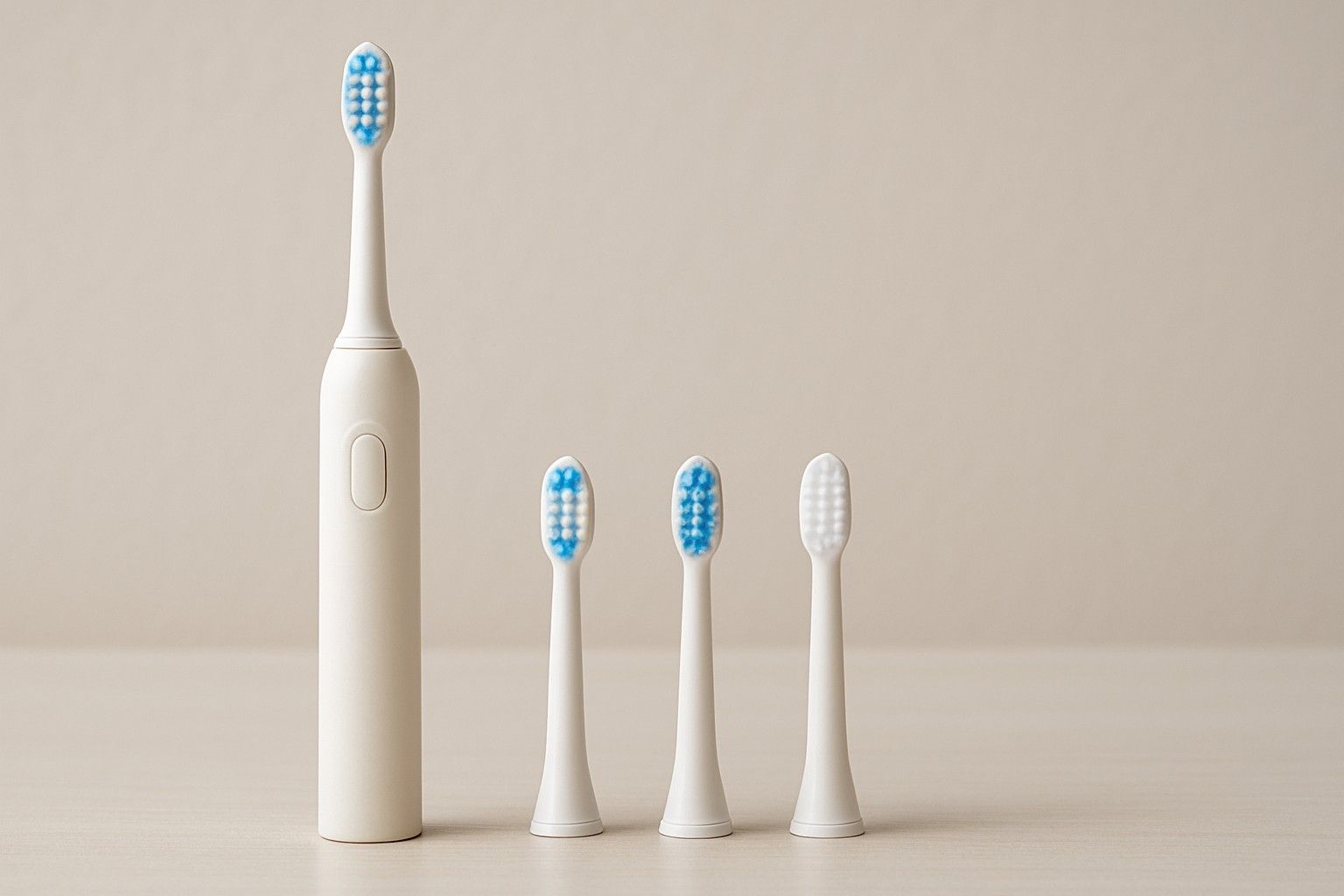
If you're comparing electric toothbrush prices, the handle is only half the sum — the brush heads you'll buy for the next few years are the other half, and often the bigger one. This guide breaks down how often heads need changing, what genuine and compatible heads cost in India, and how to keep that ongoing spend from quietly eating up whatever you saved on the handle.
How Often Brush Heads Actually Need Replacing
Most dental advice pegs brush head replacement at roughly every three months, the same interval recommended for manual toothbrush bristles, and this holds regardless of what the handle costs. Bristles splay and lose their cleaning edge well before they look visibly worn, so judging replacement purely by appearance means you're often brushing with a head that's past its useful life without realising it.
Some higher-end handles build in a reminder — a colour change in the bristles that fades, or an app notification tied to brushing time logged — but these are conveniences, not requirements. You can track the three-month mark on a phone calendar just as reliably. What actually shortens the interval is usage pattern: someone brushing twice daily for the full two minutes wears a head faster than someone brushing once, and heavier hand pressure (something pressure-sensor models are meant to correct for) accelerates bristle splay too.
The practical point for anyone budgeting is this: four heads a year, per person, is the baseline assumption to plan around. If a household has two or three people sharing one handle with separate heads, that multiplies directly, and it's worth doing that multiplication before deciding which brand's handle to buy in the first place, since the ongoing head cost is now a bigger commitment than the one-time handle purchase.
Genuine vs Compatible Third-Party Heads
Every electric toothbrush brand sells genuine heads designed for its own handle's fitting, bristle pattern, and sometimes sensor compatibility. Alongside these, a large market of compatible third-party heads has grown, made to fit the same handle mounts at a noticeably lower price. For an Indian buyer, this choice matters more than it might for the handle itself, because heads are bought repeatedly and the price gap compounds.
Genuine heads are the safer default if the handle has pressure sensing or a fitting that's tight enough that a slightly off-spec third-party head could sit loose or seat unevenly, since a poor fit undermines both cleaning and the handle's sensor accuracy. They also tend to hold their bristle stiffness and shape more consistently across a batch, which matters for gum sensitivity.
Compatible heads, sold widely through Indian online marketplaces, generally fit well on simpler handle designs without sensors, and the bristle quality on well-reviewed compatible options is often close enough that the difference isn't noticeable in daily use. The real risk isn't quality on average — it's variance. Third-party quality control varies far more between sellers than genuine stock does, so a compatible head that works well from one listing doesn't guarantee the next batch, or a different seller's stock, will match it. Buyers who go compatible should expect to spend a bit more time checking reviews per purchase, not just per brand.
Yearly Running Cost by Brand and Type
Handle prices in India span ₹199 to ₹14,999, with the average sitting around ₹1,999, but brush head pricing doesn't scale with the handle in a straight line. A handle bought in the ₹499 range typically uses simpler, single-pattern heads that are cheaper individually and often have wider third-party availability, since the fitting is common across several budget models. A handle in the ₹1,499 range usually steps up to a slightly more refined bristle design, and genuine heads for these sit a bit higher per piece, though compatible options are still widely available. Handles in the ₹4,999 range, and anything above it, often use proprietary head shapes tied more tightly to that brand's sensor or cleaning-mode system, which pushes genuine head prices higher and narrows the compatible-head market for that specific fitting.
Run the four-heads-a-year assumption against any of these tiers and the pattern is consistent: over two to three years of ownership, cumulative head spend catches up to and frequently overtakes the original handle price, especially at the lower end where the handle itself was cheap. This is precisely why head cost deserves its own line item when comparing models, rather than being treated as an afterthought — a handle that looks like the better deal upfront can end up the costlier one to own once head replacement is factored in over its full working life.
Availability of Replacement Heads in India
Availability is a genuinely India-specific risk, not a minor inconvenience. Brands with a strong offline retail presence and established online marketplace listings tend to have heads in stock consistently, with multiple pack sizes available and reasonable reorder turnaround. Lesser-known or newer brands, especially those sold mainly through a single online channel, can have patchy head availability — a model that was easy to find heads for at purchase time can become harder to restock a year or two later if the brand deprioritises that line or shifts focus to newer handles.
Before buying any handle, it's worth checking not just whether heads are available today, but whether multiple sellers stock them and whether pack sizes (two-packs, four-packs) are consistently listed, since single-seller availability is a warning sign of thin supply. It's also worth checking city-level reality if you're outside a major metro: online ordering closes most of this gap, but same-day offline availability for a forgotten or split head is still uneven outside larger cities. A handle with a slightly higher upfront price but broad, multi-seller head availability is often the more dependable long-term choice than a cheaper handle whose heads are hard to reorder reliably.
How Head Cost Changes the True Price of Cheap Handles
A handle priced near ₹199 looks like an easy decision on the shelf, but that number only reflects the day-one cost. Once you factor in four head replacements a year at whatever rate that specific fitting commands, a handle bought cheap can end up costing as much over three years as a handle bought in the ₹1,499 or even ₹4,999 range that has cheaper, more widely available heads. This is the single most common miscalculation buyers make when comparing electric toothbrush prices purely on the handle sticker.
The correct comparison isn't handle price against handle price — it's total three-year cost, handle plus roughly twelve head replacements, against the same for the alternative. A pricier handle with a genuinely cheap, widely stocked head fitting can be the better financial decision even though it looks worse on day one. This is exactly the calculation to run before treating the cheapest handle on the shelf as the default safe choice, and it's worth working through in full — you can see how this affects which price tier is genuinely worth it before finalising a budget.
Reducing Long-Term Brush Head Spend
A few habits meaningfully lower what you spend on heads over the ownership life of a handle without compromising on cleaning quality. Buying heads in multi-packs rather than one at a time is the simplest lever — per-unit cost drops noticeably at pack sizes of three or four, and since you know you'll need them anyway, there's no downside to buying ahead. Sticking to a handle whose head fitting has strong multi-seller availability, as covered above, also keeps prices competitive since sellers aren't able to charge scarcity premiums.
For households with more than one person on the same handle brand, buying heads in bulk across users rather than per person again brings the per-unit price down. And for buyers still deciding between handles, checking genuine head pricing at the time of the handle purchase — not just the handle price — avoids the situation of discovering three months in that the ongoing cost is higher than expected.
None of this should turn into second-guessing the purchase after the fact; it's simply a factor to weigh alongside features and handle price before buying, so the number you're comparing across models is the real one. It's worth taking this running-cost view and choosing to fold this into your overall buying decision rather than treating head cost as a detail to figure out later.
Brush head cost isn't a footnote to the electric toothbrush buying decision — for most owners, it's the larger part of what the toothbrush actually costs over its life. Knowing the replacement interval, the genuine-versus-compatible trade-off, and how availability varies by brand means you can now weigh a handle's price against what it will actually cost to keep running, rather than judging it on day-one price alone.

Comments
Be the first to comment.