Electric Toothbrush Features That Matter: Timers, Modes and Sensors
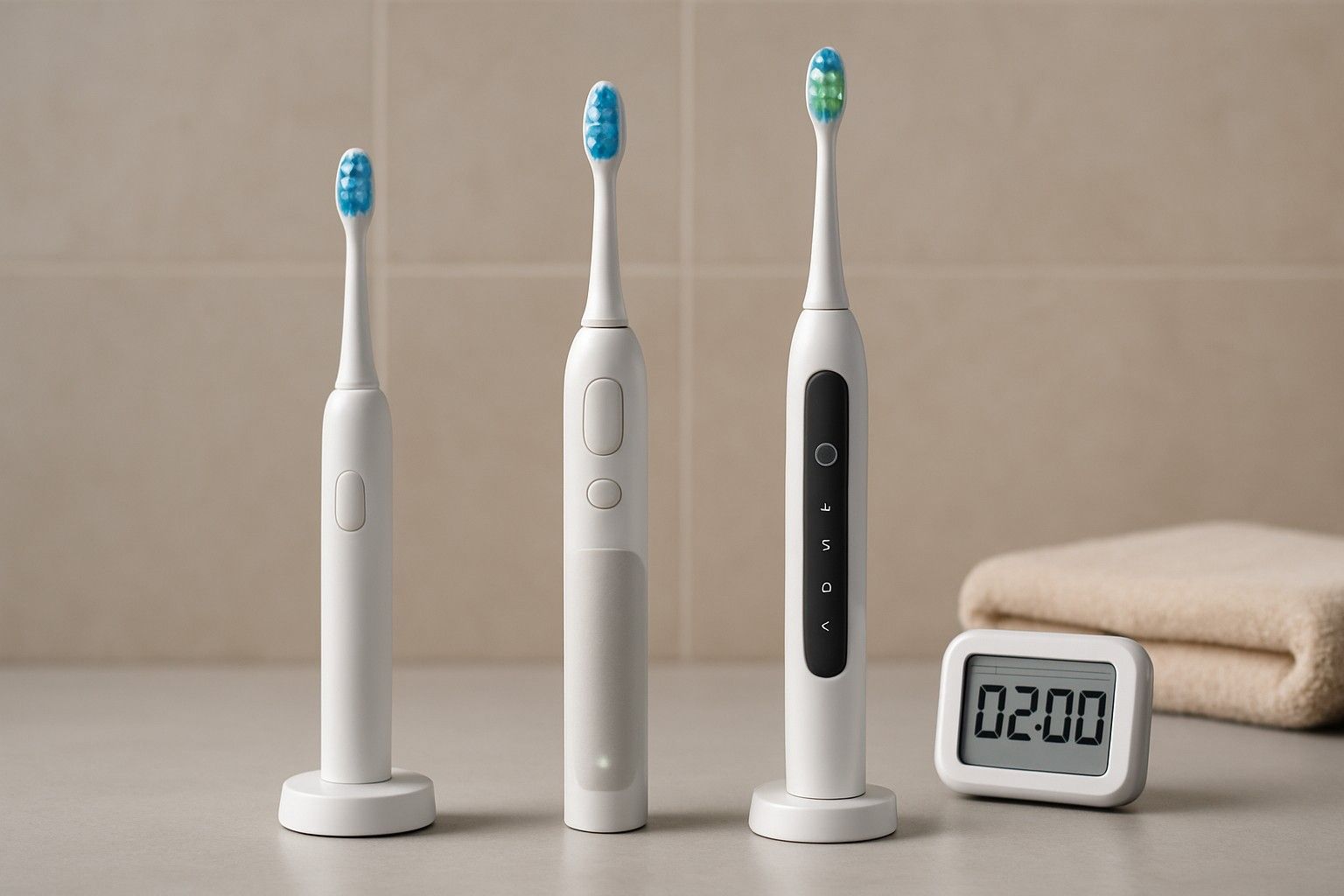
Most electric toothbrush listings throw the same jargon at you — timers, sensors, five cleaning modes, an app that syncs to your phone — and leave you to guess what's actually worth paying for. This article breaks down each feature on its own merits, so you can tell which ones change your brushing outcome and which ones just push the price up. By the end, you'll know exactly what to look for instead of picking whatever has the longest spec list.
Two-Minute Timers and Quadrant Pacers
This is the one feature dentists actually talk about, and for good reason. Most people brushing with a manual toothbrush stop well before two minutes without realising it — studies on brushing behaviour consistently show under a minute is common. A built-in two-minute timer, usually marked by the brush pausing or pulsing briefly, forces you to cover the full recommended duration instead of guessing. Quadrant pacers take this further by giving a short buzz or pause every 30 seconds, nudging you to move to the next section of your mouth — upper left, upper right, lower left, lower right. Without this cue, it's easy to spend 40 seconds on your front teeth out of habit and rush the back molars, which are exactly where plaque and cavities tend to build up.
This feature is close to universal now, appearing even on brushes at the very bottom of the price range, so it shouldn't be a deciding factor between two models — it's more of a baseline check. What's worth confirming is whether the pacer is a genuine four-beat interval or just a single buzz at the two-minute mark, since the quadrant cue is what actually improves coverage. If a brush has a timer but no quadrant pacer, you're still better off than a manual brush, but you're not getting the full behavioural nudge that makes the two-minute habit stick evenly across your mouth.
Pressure Sensors and Why They Protect Your Gums
Pressure sensors solve a problem most people don't know they have. Brushing harder feels like it should clean better, but excess pressure on an electric brush — which is already doing the mechanical work for you — is one of the leading causes of gum recession and enamel wear over time. A pressure sensor detects when you're pushing too hard, usually through a light that flashes, a short pause in the motor, or a small vibration change, and signals you to ease off immediately rather than after the damage shows up months later.
This matters more for an electric brush than it ever did for a manual one, because the vibration or rotation already provides the cleaning force. Many first-time electric brush users unconsciously apply the same pressure they used manually, and without a sensor, there's no feedback loop telling them to stop. If you or a family member has a history of sensitive teeth, receding gums, or a heavy-handed brushing style, a pressure sensor is one of the few features here that has a direct, measurable health benefit rather than being a convenience add-on. It tends to show up starting in the mid-range rather than the cheapest models, so it's worth checking for specifically rather than assuming every electric brush has one. If gum protection is your main concern, this is the feature to prioritise over cleaning modes or app connectivity.
Cleaning Modes: How Many Do You Really Use?
Cleaning modes are where marketing tends to outpace actual utility. A brush advertised with five or six modes — daily clean, gum care, whitening, sensitive, tongue clean, deep clean — sounds comprehensive, but in practice most users settle into one or two modes within the first week and never touch the rest. The core difference between modes is usually the intensity and pattern of vibration or oscillation, and for most people with no specific dental concern, the standard daily clean mode does the job the other modes are quietly variations of.
Where multiple modes genuinely help is in households sharing one brush handle with swappable heads, or for someone managing a specific condition — a sensitive mode with gentler vibration for someone with exposed dentin, for instance, or a gum care mode with a slower pulse for someone recovering from gum treatment. If you fall into one of these cases, two or three well-differentiated modes are useful. Beyond that, each additional mode adds marginal value while adding to the sticker price. A practical way to shortlist is to ask what modes you'd actually use based on your current dental concerns, rather than treating a higher mode count as a proxy for a better brush. A three-mode brush used consistently beats a six-mode brush where you default to one setting anyway.
App Connectivity and Smart Tracking: Worth It or Not
App connectivity is the most polarising feature on this list, and whether it's worth paying for depends entirely on how you use it. At its best, a connected app tracks brushing duration, coverage across quadrants, and pressure over time, turning brushing into something you can actually monitor and improve — useful for someone building a new habit, or for parents trying to get children to brush properly. Some apps also send reminders to replace the brush head, which is a genuinely useful nudge since most people run heads well past their effective life.
The catch is that this feature has the shortest real-world usage curve of anything on this list. Most buyers open the paired app enthusiastically for the first week or two and then stop checking it, at which point the connectivity adds nothing beyond what a good pressure sensor and timer already deliver on the brush itself. It also usually pushes a model well above the average price point of ₹1,999 without necessarily improving the actual clean, since the brushing mechanics don't change — only the reporting does. If you know you're the type to track a fitness app or habit tracker consistently, app connectivity earns its keep. If you're buying primarily for a cleaner brush and healthier gums, it's reasonable to treat this as a nice-to-have rather than a deciding factor.
Bristle Type, Head Size and Handle Grip
These three physical details matter more day-to-day than most of the electronic features above, simply because they affect comfort and consistency of use. Bristle type generally falls into soft, medium, and specialised sensitive or whitening bristles — for most adult users, soft bristles are the safer default since they clean effectively without adding to gum wear, and dentists generally steer people away from medium or firm bristles on an electric brush since the motor already supplies mechanical force. Head size matters especially for people with smaller mouths or a strong gag reflex; a compact head reaches back molars more comfortably than a standard-size one, even if it means slightly more passes to cover the same area.
Handle grip is easy to overlook while comparing specs online but shows up immediately in daily use. A slim handle can feel less stable with wet hands, while a contoured rubberised grip holds steady through a full two-minute session without needing a tighter grip that itself adds pressure on your teeth. If you have larger hands or arthritis-related grip concerns, a wider, textured handle is worth prioritising over a slimmer, sleeker-looking one. None of these three details carry a strong price premium on their own, which makes them worth checking in person or through detailed images before you commit, rather than assuming a higher-priced model automatically gets this right.
Matching Features to Your Budget
Not every feature above is available at every price point, and knowing which ones cluster where helps you avoid paying for a feature set you won't use, or missing one you actually need. Brushes under ₹499 typically cover the basics well — a two-minute timer and sometimes a quadrant pacer — but rarely include a pressure sensor or multiple modes. The ₹1,499 range is usually where pressure sensors start appearing consistently, along with two or three real cleaning modes, making it a practical middle ground for most buyers. Once you move into the ₹4,999 band, app connectivity, a wider mode selection, and refined handle ergonomics become common, though as covered above, not all of these translate into a meaningfully better brushing outcome.
Across the full range of ₹199 to ₹14,999, with an average around ₹1,999, the jump in price tends to track feature count more than it tracks core cleaning performance, which is worth keeping in mind if your priority is gum health and consistent habit-building rather than smart tracking. For a fuller sense of what typically shows up at each price point and how to match that against your own needs, you can see which features show up in each price band. That breakdown pairs well with everything above — this section tells you what each feature does, and the price-tier view tells you where to realistically expect to find it.
Between a timer that keeps your two minutes honest, a pressure sensor that protects your gums, and a bristle-and-head combination that actually fits your mouth, you now have a clear read on which electric toothbrush features earn their place and which ones are mostly there to justify a higher number on the box. Use that to shortlist by function first, price second, and you'll land on a brush that matches how you actually brush — not just how it reads on a spec sheet.

Comments
Be the first to comment.