Choosing a Mattress That Stays Cool in Indian Heat and Humidity
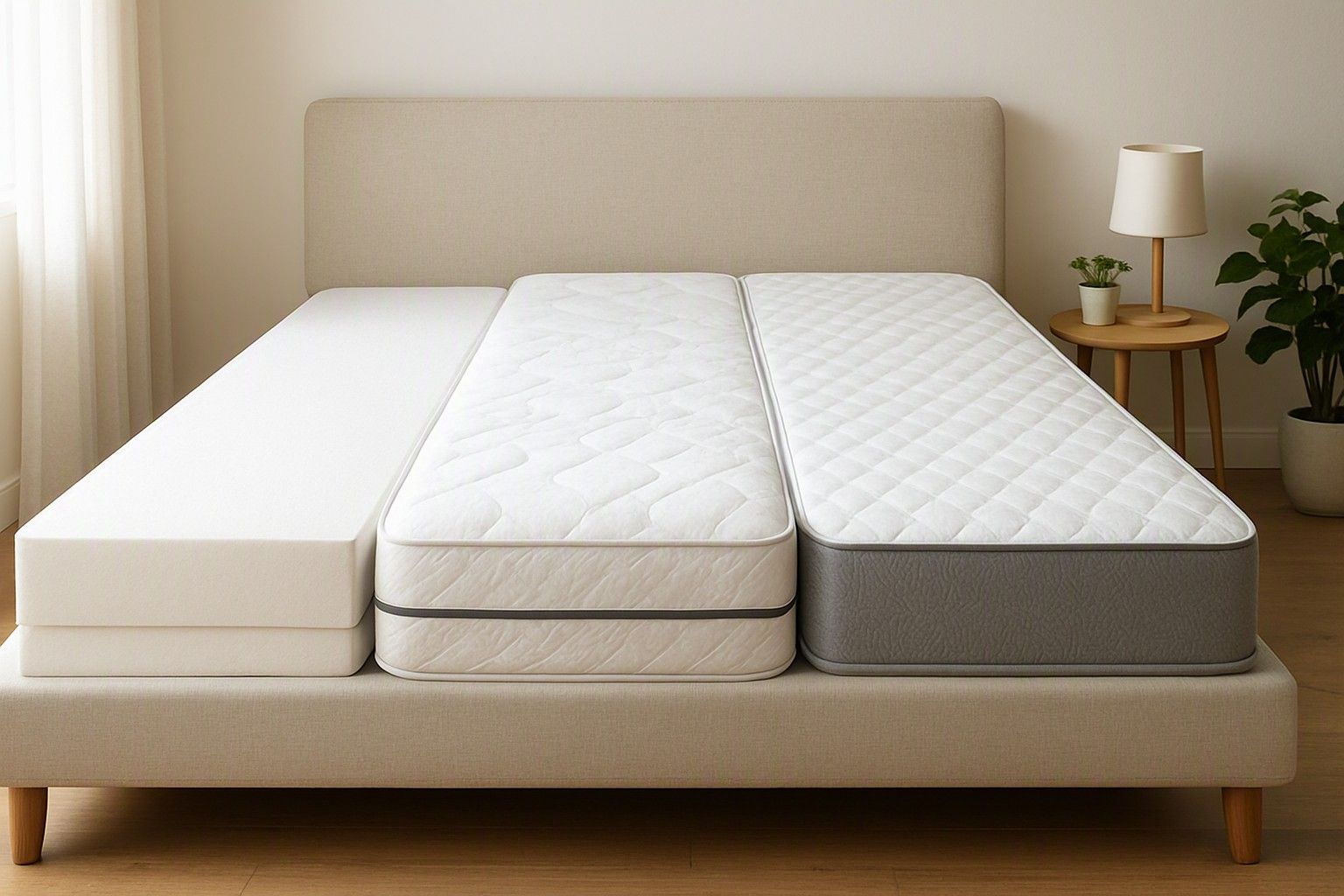
If you've woken up drenched in sweat on a humid night, or your last mattress developed a musty smell within a year, the material and cover matter far more than the brand name on the label. This article walks through why mattresses trap heat, which constructions actually breathe, and which cooling claims are worth paying for versus which are marketing gloss — so you can pick something that suits an Indian bedroom, not a showroom in a cold country.
Why Some Mattresses Feel Hot at Night
Heat retention in a mattress comes down to two things: how much your body sinks into the material, and how easily trapped air and moisture can escape from inside it. Dense foams, especially memory foam, mould closely around the body. That close contact feels supportive, but it also blocks airflow around the areas touching the surface — shoulders, hips, lower back — so body heat has nowhere to go except back at you. In an Indian bedroom without round-the-clock air conditioning, that trapped heat builds up over the night rather than dissipating, which is why so many people describe memory foam as feeling fine in a showroom's air-conditioned chill but uncomfortably warm at home.
The second factor is humidity, not just temperature. Indian nights, especially in coastal or monsoon-affected regions, carry moisture in the air itself, so a mattress that can't wick sweat away leaves you lying on a slightly damp surface even with a fan running. This is different from a mattress simply feeling warm — it's the combination of heat and trapped moisture that makes sleep uncomfortable and, over time, damages the mattress itself. Understanding this distinction matters because a mattress can be cool to the touch initially but still trap sweat over a full night, which is the actual complaint most hot-sleeper buyers have.
Breathability of Foam, Spring and Coir
Construction type is the single biggest lever you have over how hot a mattress sleeps, and it's worth understanding before you look at any cooling add-on. Open-coil and pocket-spring mattresses have air gaps built into their structure by design, so warm air generated by your body has somewhere to move and escape rather than sitting trapped underneath you. Coir mattresses, made from coconut fibre, are even more ventilated — the fibre itself doesn't hold heat the way foam does, and the natural gaps between fibres allow constant airflow, which is one reason coir has stayed popular in warmer parts of the country for generations despite feeling firmer underfoot.
Memory foam sits at the other end of the spectrum. Its density and slow-recovery structure are exactly what make it feel hot, because that same density is what blocks airflow. This doesn't mean memory foam should be ruled out entirely — some buyers genuinely need the pressure relief it offers for joint pain or back issues — but it does mean going in with realistic expectations, and possibly pairing it with a breathable cover or a hybrid build that adds spring or foam-with-channels underneath rather than a solid memory foam slab. For a fuller breakdown of how each construction type breathes and where memory foam struggles, it helps to weigh this alongside firmness and support needs rather than picking on temperature alone, since the same construction choice affects both.
Gel, Copper and Cooling Cover Claims Decoded
Gel-infused foam, copper-infused foam and "cooling" fabric covers are the three cooling claims you'll see most often on mattress packaging in India, and they don't all work the same way or to the same degree. Gel infusion works by absorbing and spreading body heat across a larger surface area within the foam layer, which can genuinely reduce the initial hot feeling when you first lie down. The effect is real but limited — gel doesn't ventilate the mattress, it just delays heat buildup by a few degrees and for a limited time, so on a genuinely hot, humid night the benefit fades a few hours in.
Copper infusion is marketed similarly, with added claims around antimicrobial properties, but its cooling effect works on the same principle as gel: heat dispersion rather than heat removal. Neither gel nor copper turns a dense memory foam mattress into a breathable one; they simply take the edge off.
Cooling covers, usually a moisture-wicking or phase-change fabric layered over the mattress, tend to make the most noticeable difference to how a mattress feels to touch and how it handles sweat, because they interact directly with your skin rather than being buried inside the foam. A good cooling cover paired with a breathable core construction — spring, coir, or a foam-spring hybrid — will outperform a gel-infused solid foam mattress with a plain cover, even if the plain foam mattress advertises the cooling technology more prominently. When comparing two mattresses on a shelf, it's worth asking what the core is made of before getting swayed by the cover's cooling claim printed on the tag.
Handling Humidity, Sweat and Mould in Coastal Homes
Heat is only half the problem in Indian conditions — humidity brings a separate, longer-term risk that matters more in coastal cities and during monsoon months: mould and mildew growing inside the mattress. This happens when moisture from sweat, humid air, or an accidentally wet mattress gets absorbed into the foam or coir core and has no way to dry out, especially if the mattress sits directly on a solid wooden base with no ventilation underneath. Once mould sets in, it's usually inside the mattress rather than on the surface, which means it's not something you can simply wipe away, and it often shows up as a musty smell before it's visible.
A few practical habits reduce this risk regardless of which mattress you buy. Airing the mattress out in sunlight periodically, using a bed base with slats rather than a solid platform, and choosing a breathable or removable, washable cover all help moisture escape rather than accumulate. Coir and open-cell foam mattresses handle humidity better than dense memory foam precisely because trapped moisture has a path out through the material's natural gaps. If you live in a coastal city or a flat with limited cross-ventilation, this factor should weigh at least as heavily in your decision as firmness or price, because a mattress that develops mould within a year effectively costs you the full replacement price again, regardless of how much you originally paid for it.
Do Cooling Features Justify Their Extra Cost
Mattresses across the Indian market range from ₹2,500 to ₹85,000, with the average sitting around ₹12,000, and cooling features tend to cluster in the mid-to-upper part of that range rather than at the very bottom. In the ₹4,000 tier, you're unlikely to find genuine gel or copper infusion at all — mattresses here are usually basic foam or coir without added cooling layers, so the practical way to manage heat at this price point is choosing coir or a simpler spring construction over dense foam, rather than paying for a cooling label. In the ₹12,000 range, gel-infused foam and cooling covers start appearing more consistently, and this is often where the cost genuinely buys a noticeable improvement over plain foam at the same price tier.
Once you move into the ₹35,000 bracket, cooling technology tends to be paired with better overall build quality too — sturdier springs, higher-density foam layers, more durable covers — so it becomes harder to isolate whether you're paying for the cooling feature specifically or for the general quality jump. This is worth sitting with before assuming a cooling label alone justifies a price increase: the same rupees might buy a better hybrid construction that keeps you cool through breathable design rather than gel infusion, and the construction-based cooling is usually more durable over years of use. For a clearer sense of whether paying more for cooling tech makes sense at your budget, it helps to look at what else that price bracket typically includes, since cooling rarely comes as an isolated add-on.
Fitting Climate Comfort Into Your Overall Choice
Cooling performance matters, but it's one factor among several — firmness, support for your sleeping position, motion isolation if you share the bed, and durability all pull in their own direction, and sometimes against each other. A very breathable coir mattress, for instance, may run firmer than someone with joint pain would prefer, while a supportive memory foam mattress may need a compromise on heat through a better cover or a hybrid build. Neither choice is wrong; it depends on which trade-off matters more for how you actually sleep and where you live.
The honest way to approach this is to treat climate comfort as a filter rather than the only criterion: use it to rule out constructions that clearly won't work for your city or home — dense memory foam in a non-air-conditioned coastal bedroom, for instance — and then choose within the remaining options based on firmness, support and budget. This keeps you from either ignoring heat entirely, which leads to disappointment within weeks of purchase, or fixating on cooling alone and ending up with a mattress that doesn't actually support your back. To weigh cooling against the other things that decide your mattress, it's worth stepping back to the full set of factors before finalising, since the right mattress for Indian heat is still ultimately the right mattress for your body first.
Between construction type, cover material and how a home handles humidity, the real answer to what stays cool in Indian conditions isn't a single feature on a label — it's the combination of a breathable core and sensible habits like ventilation and airing the mattress out. With that laid out, you're in a position to judge any mattress on the shelf by what's actually inside it rather than by what the tag promises.
Comments
Be the first to comment.