Memory Foam vs Spring vs Latex vs Coir Mattresses Explained
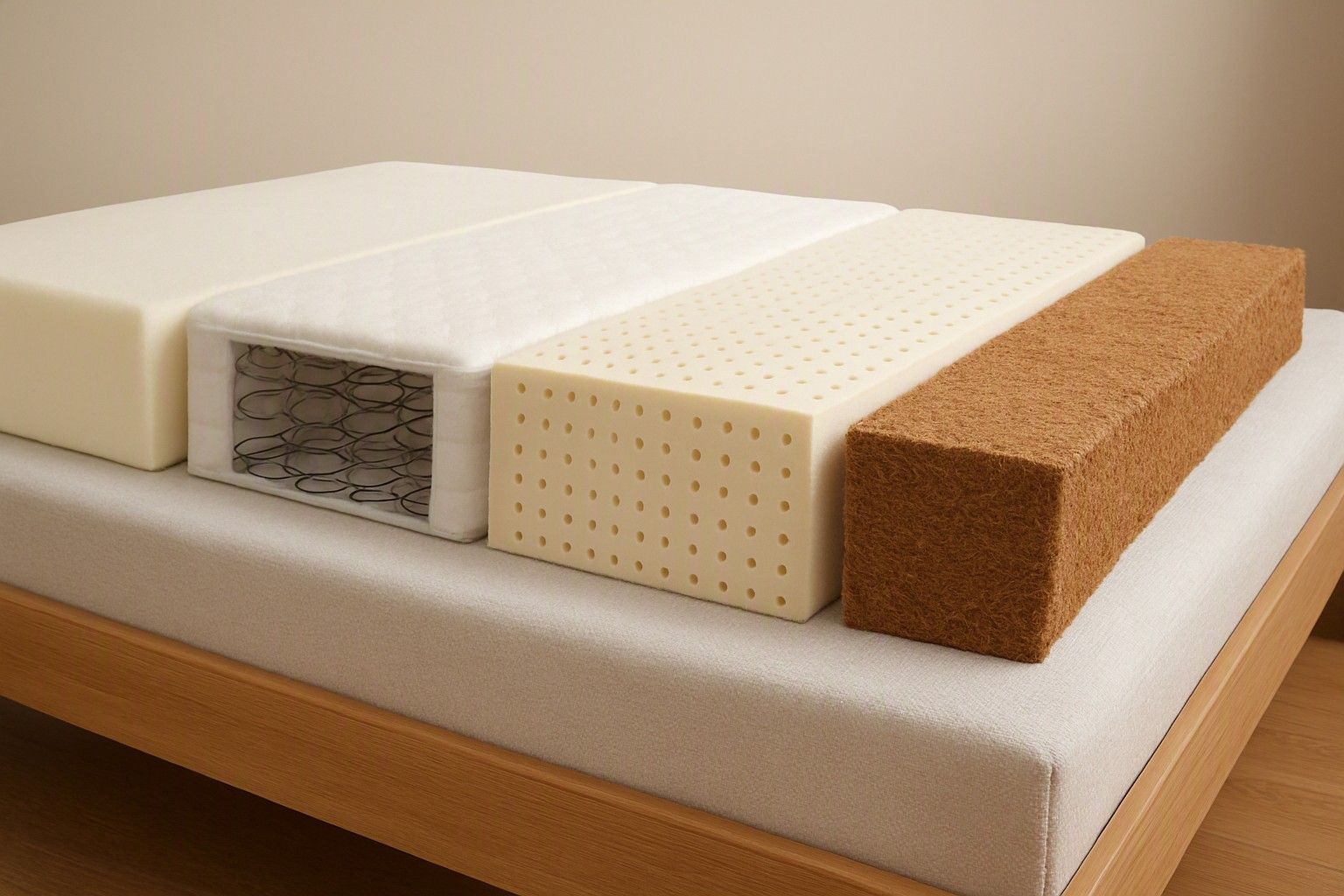
Should you buy a memory foam, spring, latex or coir mattress? Each construction feels different under your body, ages differently in Indian heat and humidity, and sits at a different price point, so the "right" one depends on what you sleep like, not what's trending. This article walks through all four types on feel, durability, heat and budget so you can pick with confidence instead of guessing.
Memory Foam: Contour, Comfort and Its Downsides
Memory foam is the mattress type most people mean when they say a mattress feels like it's "hugging" them. It's made from viscoelastic polyurethane foam that softens with body heat and slowly moulds around your shoulders, hips and lower back, spreading weight evenly across the surface instead of pushing back against pressure points. For side sleepers and anyone dealing with joint or shoulder pain, this contouring is genuinely useful, and it's a big reason memory foam has become a default recommendation for people upgrading from an old coir or cotton mattress.
The downsides are just as real and matter more in Indian conditions than they do in cooler climates. Memory foam retains body heat because the same slow-recovery structure that gives it contour also traps warmth against your skin, which can make it uncomfortable through humid summers without air conditioning, especially in single-layer or older-generation foams. It also tends to feel soft and sinking rather than supportive, which isn't ideal for people who need firm back support, and very cheap memory foam mattresses can develop permanent body impressions within a couple of years if the foam density is low. Higher-density memory foam holds up better and costs more, so if you're drawn to this type, it's worth checking foam density and layer thickness rather than buying on softness alone. It suits people who sleep on their side, run warm-blooded reasoning aside, or already know they like a plush, slow-sinking feel, but it's not the automatic right answer for every sleeper.
Bonnell vs Pocket Spring Mattresses
Spring mattresses work on an entirely different principle from foam: individual steel coils provide bounce and support, and the type of coil system changes how the mattress behaves. Bonnell spring mattresses use an interconnected coil network where all the springs are linked together, so pressure on one part of the mattress affects the coils around it. This makes Bonnell construction firmer, bouncier and noticeably more affordable, but it also means motion transfer is higher; if your partner shifts position at night, you'll likely feel it too. Bonnell mattresses tend to sit at the more accessible end of the market and are a common choice for guest rooms, growing children, or anyone prioritising firm support over plush comfort.
Pocket spring mattresses take a more refined approach: each coil is individually wrapped in its own fabric pocket, so springs move independently rather than as a connected network. This gives pocket spring mattresses far better motion isolation, more precise contouring to body shape, and generally quieter performance over years of use, since coils aren't rubbing against each other in a shared frame. The trade-off is cost — pocket spring construction is more expensive to manufacture and sits higher up the price ladder than Bonnell. For couples with different sleep schedules, or anyone who's been woken up by a partner turning over on an old Bonnell mattress, pocket springs are usually worth the extra spend. For a single sleeper on a tighter budget who mainly wants firm, bouncy support, Bonnell remains a reasonable and durable choice.
Natural Latex and Its Premium Positioning
Latex mattresses, especially natural latex made from rubber tree sap rather than synthetic or blended latex, occupy the premium end of the mattress market in India, and the pricing reflects it. Natural latex offers a responsive bounce that's springier than memory foam but still contouring, so it supports the body without the slow, sinking feel of foam. It's naturally more breathable than memory foam because of its open-cell structure, resists dust mites and mould reasonably well, which matters in humid Indian cities, and tends to be among the most durable mattress materials available, often outlasting foam and entry-level spring mattresses by several years with proper care.
The catch is price and authenticity. Genuine natural latex mattresses are expensive to produce, and that cost is passed directly to the buyer, which is why latex sits well above average mattress pricing in most Indian retail listings. A meaningful share of what's sold as "latex" in the budget-to-mid segment is actually synthetic latex or a latex-foam blend, which is cheaper but doesn't carry the same durability or breathability benefits as natural latex, so it's worth checking whether a listing specifies natural, synthetic, or blended before assuming you're getting the premium version. If your budget stretches to it and you want a mattress that balances support, cooling and long-term durability without frequent replacement, natural latex is a legitimate long-term investment rather than an impulse upgrade. If budget is tight, it's usually not the type to start with.
Coir and Orthopaedic Mattresses in the Indian Context
Coir mattresses are made from coconut fibre, either alone or bonded with a foam or rubber layer, and they remain one of the most India-specific mattress choices on this list because coir is a cheap, locally abundant material well suited to Indian climate conditions. Pure coir mattresses are firm, don't trap heat the way foam does, resist moisture and mould reasonably well in humid regions, and are typically the most affordable option in the market, which is why they're still common in smaller towns and for guest or children's beds. The trade-off is comfort and refinement: coir alone feels hard and unyielding compared to foam or pocket springs, and it doesn't contour to the body at all, so people with back or joint sensitivity may find it uncomfortable for regular use.
This is where orthopaedic mattresses come in, and it's worth being clear that "orthopaedic" isn't a separate material — it's a firmness and support category that can be built using coir, foam, or spring as the base, marketed specifically toward firm, even support for the spine. In the Indian market, orthopaedic mattresses are frequently coir-based or coir-foam hybrids because that combination delivers firm support at a low cost, which suits both budget buyers and anyone advised by a doctor to sleep on a firmer surface. If you've been told you need a firm mattress for back support, look for a coir or coir-hybrid orthopaedic option rather than assuming firmness only comes from spring or higher-priced foam construction.
How Each Type Handles Heat and Airflow
Indian bedrooms, especially without round-the-clock air conditioning, make heat retention a real factor in mattress choice, and each of these four types behaves differently once a room warms up. Memory foam is the biggest offender: its dense, slow-recovery structure traps body heat against the sleeper, and in a hot, humid night this can mean waking up sweating even on a good-quality foam mattress. Spring mattresses, both Bonnell and pocket, do noticeably better here because the coil structure leaves open space for air to move through the mattress core, so heat doesn't build up the same way. Coir performs best of all on this front since its fibrous structure is naturally ventilated and doesn't retain warmth, which is part of why it has remained popular in warmer parts of the country for generations. Natural latex sits in between — better airflow than memory foam thanks to its open-cell structure, though not quite as breathable as an open coil or coir core.
For a full breakdown of how foam traps warmth while spring and coir breathe better in hot weather, including how this plays out across different Indian regions and seasons, it's worth reading the dedicated comparison, but the short version is this: if you sleep hot or don't run AC through the night, weight your decision toward spring or coir over memory foam, or at minimum choose a foam mattress with a ventilated or gel-infused top layer rather than a dense, basic one.
Which Type Fits Which Budget
Mattress prices in India span a wide range, from ₹2,500 at the very entry level up to ₹85,000 for premium natural latex and high-end pocket spring builds, with the market averaging around ₹12,000. Each construction type clusters fairly predictably across the three common budget bands. In the ₹4,000 band, you're mostly looking at basic coir mattresses and thin, low-density foam, both firm and functional but without much contouring or long-term durability. Move into the ₹12,000 band and mid-density memory foam, coir-foam hybrids, and entry-level Bonnell spring mattresses become available, which is where a lot of everyday household buying happens. The ₹35,000 band opens up better pocket spring construction, higher-density memory foam with cooling layers, and entry-level natural or blended latex, while true premium natural latex mattresses typically run above this range toward the ₹85,000 end.
Rather than picking a type and then hunting for a price, it's often more practical to work the other way: decide what you can realistically spend, then choose the best-suited construction within that band rather than stretching for a type that's out of reach. A well-made coir or Bonnell mattress in the right budget tier will usually serve you better than a bargain-basement latex or memory foam mattress bought purely for the label. For the full breakdown of what each construction typically costs across the common budget bands, including where quality tends to jump within each tier, the dedicated price guide goes into more detail than makes sense here.
Narrowing Down From Type to Your Final Pick
Knowing the difference between memory foam, spring, latex and coir answers the first and biggest branch in your decision, but it's only one input alongside firmness preference, body weight, sleeping position, and who else shares the bed. A firm-support seeker with back pain and a tight budget lands somewhere very different from a couple who wants motion isolation and can stretch toward pocket springs or latex. To see how mattress type slots into the rest of your decision, including how it interacts with firmness, size and thickness choices, the main buying guide walks through the complete process step by step rather than in isolation.
Between the four, there's no single correct answer, only the one that matches how you actually sleep and what you're willing to spend. Memory foam rewards contour-seekers who don't mind trapped heat, spring mattresses split into firm-and-affordable Bonnell versus quieter, pricier pocket coils, natural latex earns its premium price with durability and airflow, and coir remains the practical, heat-friendly choice for firm support on a budget. With that framework, the question you started with — memory foam, spring, latex or coir — should now have a clear answer for your specific situation.

Comments
Be the first to comment.