Stroller Features That Actually Matter on Indian Roads
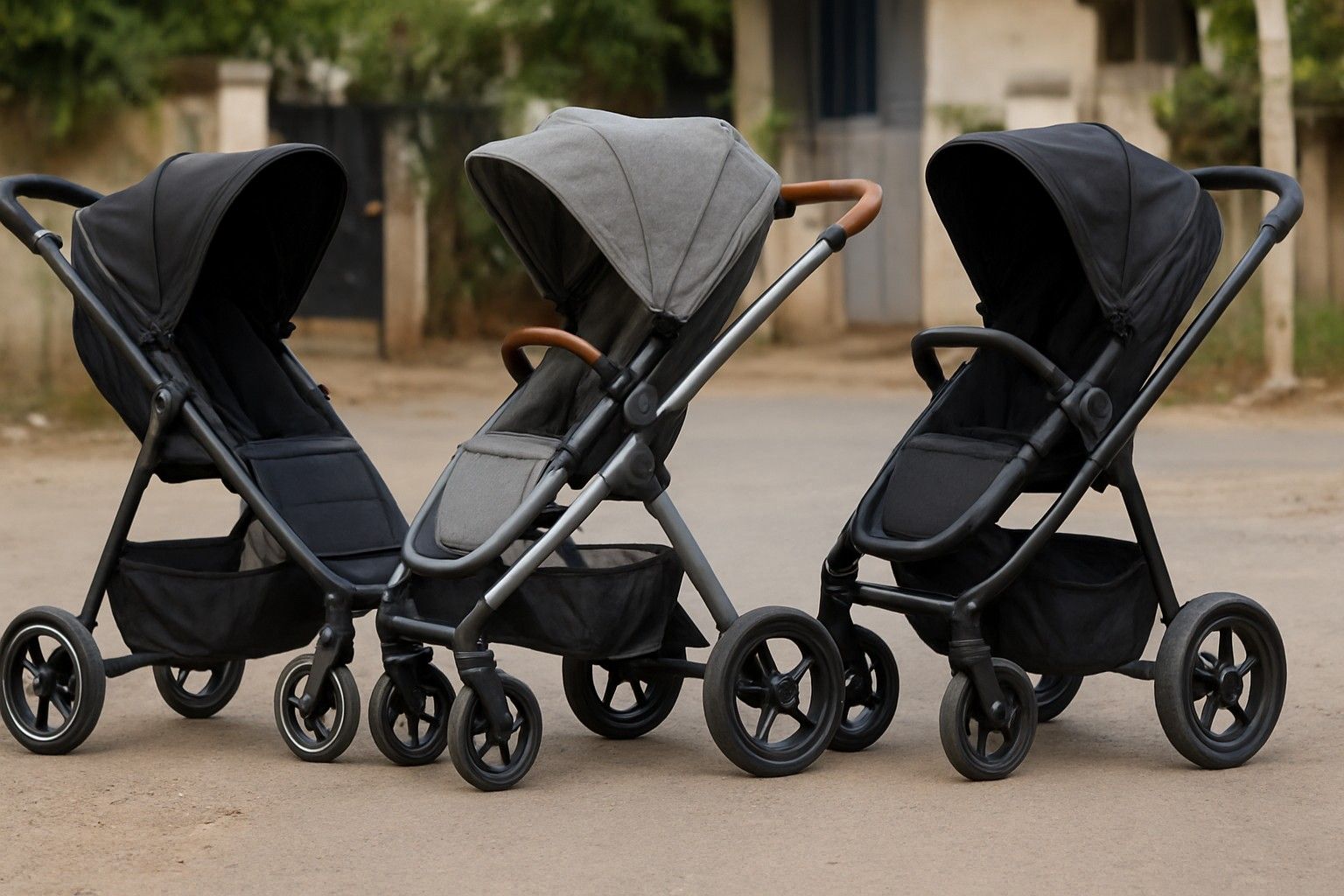
If you're past the "which type of stroller" stage and now staring at spec sheets full of wheel sizes and fold mechanisms, this is for you. Indian roads, apartment lifts and cramped car boots punish the wrong choices in ways that don't show up in a showroom test-push. Here's which features are worth paying for, and which are just marketing noise.
Wheels and Suspension for Uneven Roads
Wheels are the single feature most Indian buyers underweight, and it shows within the first month of use. Small, hard plastic wheels under 12 cm feel fine on a smooth mall floor but transmit every pothole, expansion joint and broken pavement slab straight into the frame and your baby. Look for larger wheels, ideally with some rubber or foam lining rather than bare plastic, since these absorb shock instead of just rolling over it. Front wheels that swivel are easier to manoeuvre through narrow society gates and crowded markets, but a swivel lock matters just as much: on gravel, unpaved colony roads or broken tar, a locked-straight front wheel keeps the stroller tracking instead of jittering sideways.
Suspension is often listed as a spec but rarely explained. On strollers in this category, it usually means a simple spring or flexible joint near the wheel mount rather than anything like a vehicle's shock absorber. Even that basic version makes a real difference on Indian roads, smoothing out the small, constant vibration from rough tar rather than the occasional big bump. If you're comparing two strollers at a similar price, one with even basic front-wheel suspension is worth choosing over one without it, because this is the feature that affects daily comfort more than almost anything else on the spec sheet.
Fold Type and How It Fits in Car Boots and Flats
How a stroller folds decides whether it becomes a daily habit or something you avoid taking out. Umbrella folds are compact and light, sliding into a hatchback boot or standing in a corner of a one-bedroom flat without eating up floor space, but they usually offer less structure and a shallower recline. Tri-fold or bi-fold strollers with a wider wheelbase tend to fold into a bulkier package, better suited to families with a sedan or SUV and a dedicated storage corner, but awkward if you're navigating a narrow lift or auto-rickshaw.
Think about your actual daily geography before your actual usage. If you're carrying the stroller up two floors with no lift, or wedging it into a two-wheeler-dependent household's car only occasionally, a fold that collapses one-handed and stands on its own without leaning against a wall saves real daily friction. If it lives mostly in the car boot for weekend outings, boot volume matters more than standing footprint. Check the folded dimensions against your specific boot or storage spot rather than trusting words like "compact" on a listing, since that word means different things across brands and price tiers.
Weight and One-Hand Handling
Stroller weight sounds like a minor spec until you're carrying a sleeping baby in one arm and folding the stroller with the other, in a lift that won't hold the door. Lighter strollers, generally under 7 kg, are easier for a single parent or a grandparent to manage solo, especially where domestic help isn't lifting the stroller in and out of the car every day. Heavier strollers with a sturdier frame tend to handle rougher roads and last longer under regular use, but they demand two hands and more effort at every doorway, staircase and boot lift.
One-hand folding is worth testing in person if you can, because listed weight alone doesn't tell you how awkward the mechanism feels under real conditions. Some strollers need a two-step unlock-then-fold action that's hard to manage while holding a child; others collapse with a single strap pull. If your daily routine includes stairs, autos, or a car without someone else free to help, prioritise a stroller that folds and lifts with one hand over one that's marginally sturdier but needs two people to manage.
Recline, Canopy and Harness
Recline range decides how much of your child's early life a stroller can actually cover, and it's worth checking before you assume one stroller works from birth to toddlerhood. A near-flat recline suits very young infants who can't sit upright, while an upright, multi-position seat suits older babies who want to sit up and look around. Buying a stroller with limited recline for a newborn often means buying a second one within months, so it's worth deciding early which stage you're buying for; you can see how recline connects to your baby's age to match this feature to your actual timeline.
Canopy coverage matters more in India than in cooler climates, given how much of the year involves direct sun or sudden rain. A canopy that extends low and wide protects better than a small half-shade that leaves the baby's face exposed by mid-morning. Ventilation panels or mesh windows help in humid weather when a fully closed canopy turns stuffy. On the harness, a five-point system distributes force across shoulders and hips rather than just the waist, which matters more on uneven roads where sudden jolts are common, not just for the toddler who tries to climb out.
Storage Basket and Everyday Practicality
The underseat basket is easy to ignore while comparing wheels and recline, but it's one of the most-used features in daily Indian life, holding a diaper bag, a water bottle, groceries picked up on the walk back, or a folded umbrella for the sudden shower. A shallow or narrow basket looks fine in photos but fills up fast and forces you to hang bags off the handlebar, which unbalances the stroller and can tip it if the child leans forward. A deeper basket with reasonable ground clearance, sitting a bit clear of speed bumps and driveway ramps, holds more without dragging.
Access matters as much as size. Some baskets are only reachable from the front, which means walking around the stroller mid-push, awkward on a narrow footpath with traffic beside you. A basket accessible from either side or the back saves that detour. Cup holders and phone pockets are minor conveniences rather than deciding factors, but a basket that fits a diaper bag comfortably is a genuine daily-use feature worth checking in listing photos or dimensions rather than assuming it'll be adequate.
Build Quality and Durability Red Flags
Build quality is hard to judge from a photo, but a few signals hold up across price points. Frame joints that look like separate pieces bolted together rather than a continuous moulded or welded structure tend to develop play and rattle sooner, especially once the stroller is folded and unfolded daily over uneven roads. Push the seat frame side to side in your mind, or in person if you can test it: excessive wobble at the joints is an early sign of the kind of wear that gets worse, not better, with Indian road conditions.
Fabric matters too. Look for a seat cover that can be removed and washed, since dust and spills are unavoidable, and thin fabric that pills or tears within weeks is a sign of corners cut elsewhere in the build. Wheel locks, brake pedals and the recline lever are the parts that fail first on cheaper units, so check reviews or descriptions for mentions of these specifically rather than trusting overall star ratings. It's worth taking these build details and cross-checking these against the safety checklist before finalising, since durability and safety concerns often point to the same weak spots in a stroller's construction.
Prioritising Features Within Your Budget
No stroller at any price gets every feature right, so the real task is ranking what matters most for your specific roads, your building, and your child's age, then spending where it counts. Strollers under ₹2,999 usually compromise on wheel size, suspension and basket depth first, since these cost more to build well; if your budget sits here, prioritise a stable fold and a decent harness over extras like reclining ranges or storage capacity. In the ₹4,499 range, you start seeing better wheels and some front suspension, which is often the better upgrade than a fancier canopy or added accessories. Once you're in the ₹14,999 band, most of the core mechanical features, wheels, suspension, fold quality and harness, should already be solid, and differences come down to fabric quality, basket size and finer recline control.
Across the full range from ₹2,399 to ₹25,990, with an average around ₹5,000, the jump in quality isn't linear, so it's worth checking where a specific stroller's asking price sits against its historical range before deciding, rather than assuming a higher number always means better wheels or suspension. If you're still weighing this against the broader decision of which stroller type suits your family at all, it's worth stepping back to return to the buying guide to balance features and price before locking in a specific model.
Wheels, fold type and weight decide daily comfort on Indian roads far more than any single headline feature, and now you have a way to weigh each of them against your own building, car and budget instead of guessing from a spec sheet. Match these priorities to your child's stage and your storage reality, and the choice stops being about which stroller looks best in photos and starts being about which one actually holds up on your street.

Comments
Be the first to comment.