Stroller vs Pram: Which One Should Indian Parents Buy?
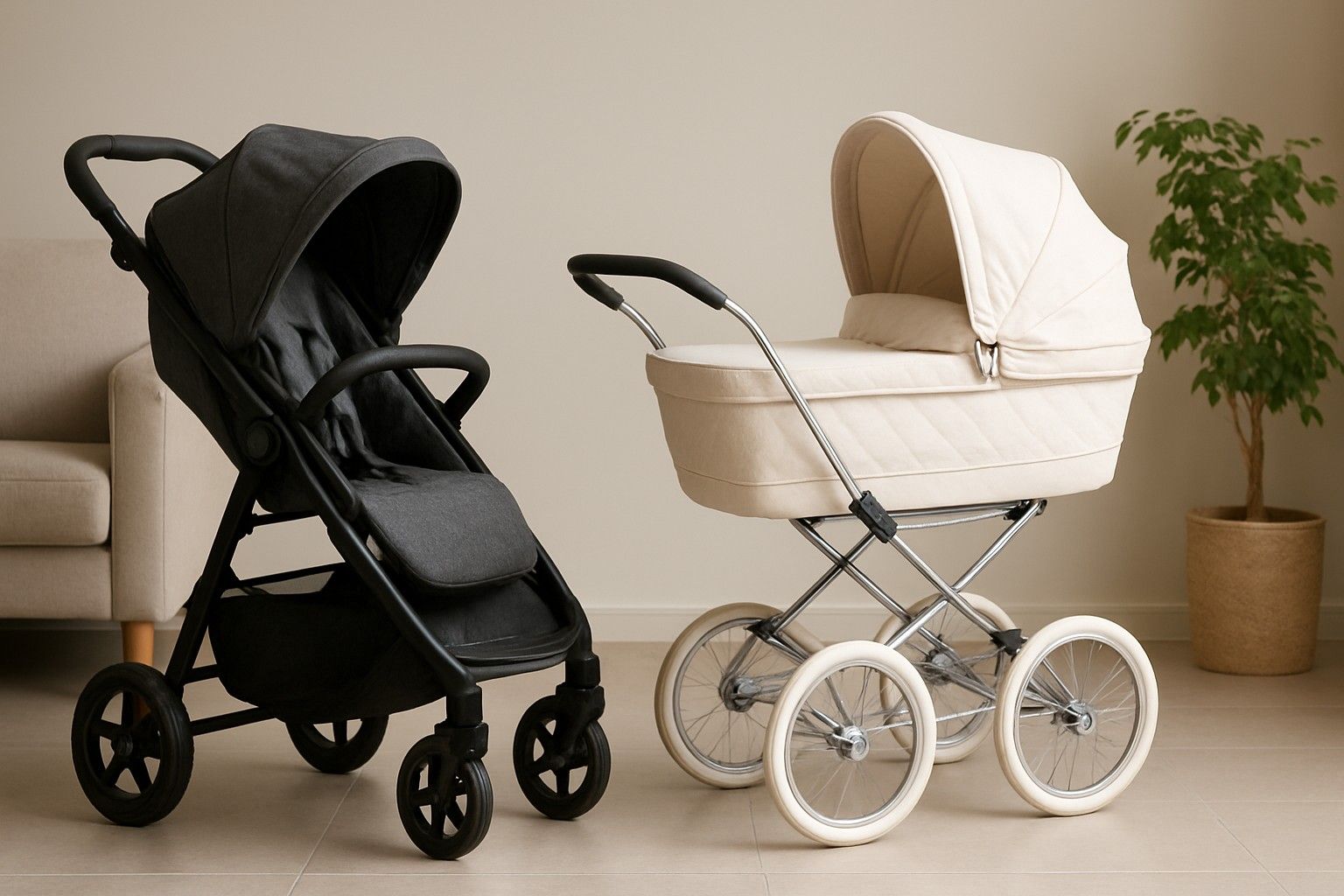
If you've been calling every baby-carrying wheeled contraption a "pram" your whole life, you're not alone — but the two are built differently and suit different stages of parenting. This guide clears up exactly what separates a stroller from a pram, and which one actually fits your baby's age, your home, and your budget. By the end, you'll know which term applies to what you need, not just what your neighbour called theirs.
What Is a Pram and What Is a Stroller?
A pram, in its original sense, is a fully flat, bassinet-style carriage designed so a newborn lies horizontally, facing the parent, with no upright seating option. It was built for infants who can't yet hold their heads up or sit unsupported — the flat base supports the spine fully. A stroller, on the other hand, is a more flexible seating system that usually offers multiple recline positions, from near-flat to fully upright, and is meant to grow with the child from early infancy through toddlerhood.
In India, the word "pram" gets used loosely for almost any baby stroller sold in shops or online, which is where the confusion starts. Very few products sold locally are true prams in the strict British sense — most are strollers with a deep recline that mimics a pram-like flat position for newborns. So when an Indian parent asks "pram or stroller," they're often really asking whether they need a dedicated newborn-only carriage or a multi-stage stroller that handles the newborn phase and continues well beyond it. Understanding this distinction matters because it changes how long the product stays useful, and whether you'll need to buy a second one as your baby grows.
Key Differences in Recline, Weight and Portability
The most functional difference between the two lies in recline range. A true pram offers one position only — flat — because that's all a newborn needs. A stroller offers a spectrum: fully flat for the first few months, a semi-upright angle once the baby starts sitting with support, and a full upright position for toddlers who want to see the world around them. This flexibility is the main reason strollers dominate the Indian market over dedicated prams.
Weight and build are the second major divide. Traditional prams tend to be heavier, with a larger fixed chassis, sprung suspension, and bigger wheels meant for smooth, flat pushing rather than frequent folding. Strollers are generally engineered to be lighter and collapsible, since Indian parents need to lift them into car boots, carry them up stairs when lifts are unreliable, or fold them one-handed while holding a baby with the other arm.
Portability is where strollers win decisively for most Indian households. A pram's non-folding or bulky-folding frame makes sense if you own a large car and live in a ground-floor house with a garden to stroll in. But if you're managing autos, elevators, narrow gates, or train travel, a stroller's compact fold and lighter frame — often under a few kilograms lighter than an equivalent pram — makes daily use realistic instead of a chore you avoid.
Which Suits a Newborn Better?
For the first four to six months, a newborn's spine and neck need full horizontal support, which is exactly what a true pram's flat base was designed for. This is the strongest argument in favour of a pram-style product if you're buying purely for the newborn stage. However, most Indian parents don't buy a separate pram for this short window — they instead choose a stroller that reclines completely flat, effectively converting it into a pram-mode for the early months and then adjusting the recline as the baby grows.
This approach avoids a second purchase a few months later, which matters given how quickly infants outgrow single-purpose gear. Before deciding, it's worth understanding exactly what a newborn's body actually requires from a recline angle, weight distribution, and harness design — you can check what a newborn really needs from a stroller to confirm a chosen model's flat-recline setting is genuinely newborn-safe rather than just marketed as one. Once you've matched the recline capability to your baby's current stage, the stroller-versus-pram question mostly resolves itself for Indian buyers looking for one product across multiple stages.
Space and Storage in Indian Apartments
Indian homes, especially apartments, rarely have a dedicated mudroom or wide entryway to park a bulky pram permanently. This is a practical factor that often outweighs the recline-and-weight debate entirely. A traditional pram's fixed or minimally-folding frame can occupy a footprint similar to a compact scooter, which becomes a daily irritation in a one- or two-bedroom flat, especially near the entrance or in a car boot shared with groceries and other essentials.
Strollers are built around folding mechanisms — umbrella folds, tri-folds, or standing folds — that reduce the product to a fraction of its open size, letting it slide behind a door, stand in a corner, or fit into a car boot alongside other luggage. For families who travel by train or flight to visit relatives, a stroller's compact folded dimension also matters for overhead storage and check-in convenience, something a pram's rigid frame rarely accommodates.
If you live in a bungalow with a porch, garage space, and a car large enough to swallow a pram's bulk without a second thought, the storage argument weakens considerably. But for the majority of urban Indian buyers dealing with lift queues, narrow stairwells, and shared parking, a stroller's fold-and-store convenience isn't a minor bonus — it's often the deciding factor over anything related to recline or ride comfort.
Cost Comparison of Prams vs Strollers
Pricing in this category spans a wide range, from ₹2,399 at the absolute entry point to ₹25,990 for heavily featured, premium builds, with the overall average sitting around ₹5,000. Traditional dedicated prams, where they're sold in India, tend to cluster in the mid-to-upper part of this range because of their heavier frames, suspension systems, and larger wheelbases — features that add manufacturing cost without adding the multi-stage flexibility a stroller offers.
Strollers, by contrast, are available across every tier. Under ₹2,999, you'll mostly find basic umbrella-fold strollers with limited recline, suited to short outings for older infants who can already sit up. The ₹4,499 band is where genuine newborn-friendly recline, better wheel suspension, and sturdier harnesses start appearing, making it the realistic starting point for a stroller meant to serve from birth. Between ₹4,499 and ₹14,999, you get reinforced frames, multi-position reclines, better under-seat storage, and reversible handlebars — features that directly replace what a separate pram purchase would have covered.
Because a well-chosen stroller in the ₹4,499 to ₹14,999 range can functionally replace both a newborn pram and a toddler stroller, most Indian parents find better long-term value skipping a dedicated pram altogether. If you want the fuller picture of what each price band actually includes feature-by-feature, you can see how both compare across price tiers before finalising a budget.
Which One Should You Choose?
If your priority is a short newborn phase in a spacious home with easy car access and no space constraints, a traditional pram's dedicated flat-lie comfort is hard to beat for those first few months. But for the vast majority of Indian parents juggling apartment living, unreliable lifts, shared car boots, and a baby who won't stay a newborn for long, a stroller with a genuine flat recline covers the pram's core benefit while adding years of continued use as your child grows into toddlerhood.
The decision, in practice, comes down to how long you need the product to remain useful and how much storage and portability matter in your specific home. A stroller resolves both concerns for most buyers without forcing a second purchase down the line. For a broader view of how strollers stack up on age suitability, folding types, and safety features beyond just this pram comparison, you can return to the full stroller buying guide and use it to narrow down the exact type that fits your situation.
The stroller-versus-pram question really comes down to how long you need the product to stay useful and how much your home's layout can accommodate — not which name sounds more premium. For most Indian parents, that points toward a stroller with a true flat recline rather than a separate newborn-only pram, and now you have the specifics to make that call with confidence rather than guesswork.

Comments
Be the first to comment.