Foldable Treadmills for Small Indian Flats and Apartments
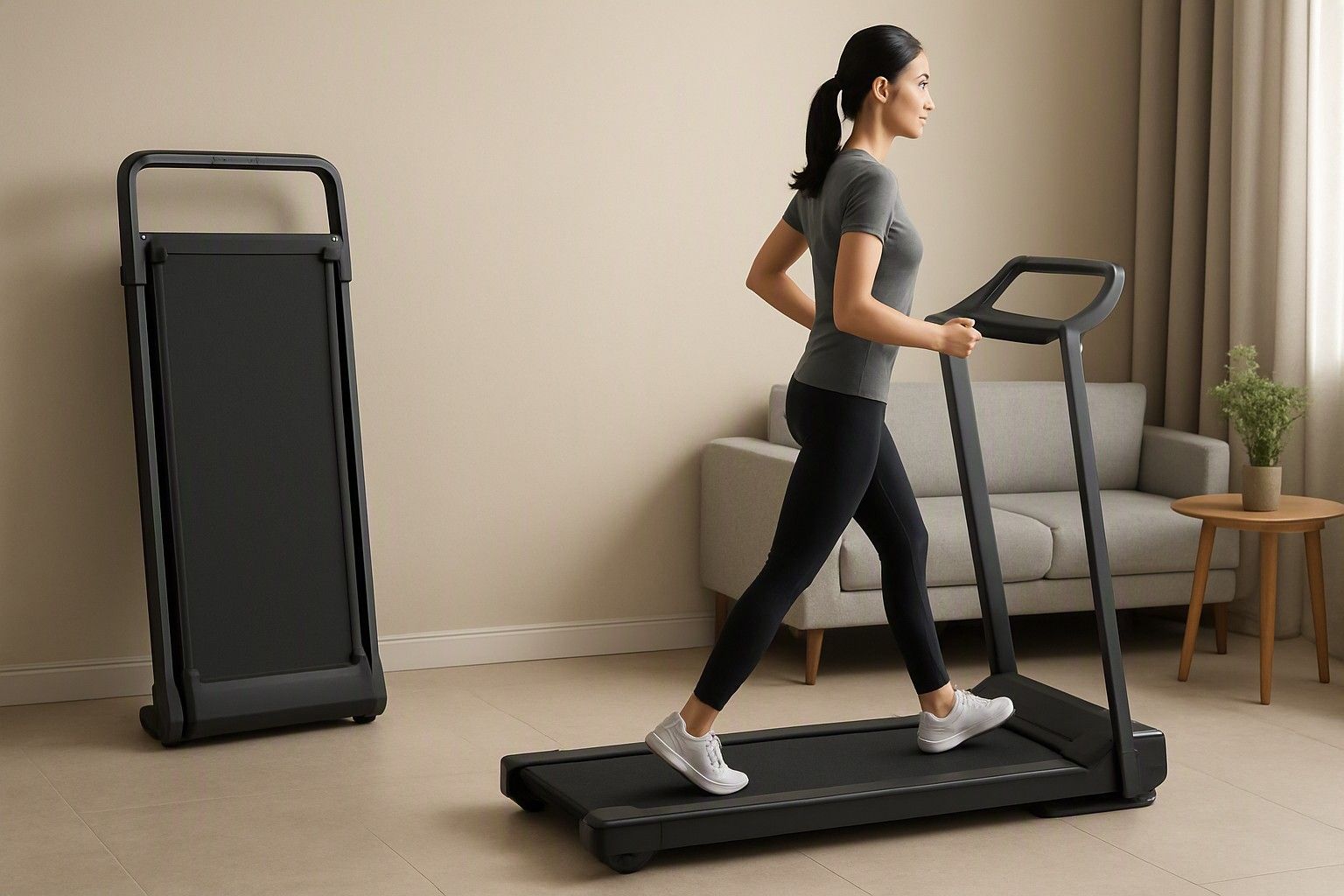
If your main worry isn't power or price but whether a treadmill will actually fit in your flat and disappear into a corner when you're done, this is the question this article answers. Small Indian apartments come with real constraints — narrow bedrooms, low ceilings, shared living spaces — that change which treadmill makes sense far more than they would in a larger house. We'll walk through folding mechanisms, real footprint numbers, weight and portability, and the trade-offs that come with a space-saving design, so you can judge a treadmill by how it lives in your home, not just how it runs.
How Folding Mechanisms Work and How Much Space They Save
Most folding treadmills use a hinge at the front of the deck, letting the running belt swing up and lock against the motor console vertically. A smaller number use a hinge closer to the middle, which folds the deck in half rather than upright — this is less common in India but shows up in a few compact models aimed specifically at small homes. The upright fold is what most Indian buyers will encounter across every budget tier, from machines priced near ₹8,000 to premium ones closer to ₹2,00,000.
The space saved depends on deck length more than anything else. A treadmill with a longer running surface, which matters if anyone in the house is tall or runs rather than walks, will still fold down, but the folded height and depth increase proportionally. So the actual space you reclaim isn't fixed — it's a trade-off against the running surface you're giving up. Some models also include a hydraulic or gas-assisted hinge that controls the fold and unfold speed, which matters less for space and more for safety, since an unassisted heavy deck can drop suddenly if not held properly. When you're evaluating a machine specifically for a small flat, ask not just "does it fold" but "how much of the floor does it give back once folded" — those are two different questions, and manufacturers tend to advertise the first while glossing over the second.
Footprint When Open vs Folded
This is the number that actually matters for apartment living, and it's worth thinking about in two separate states rather than one. Open, a treadmill needs its full length plus clearance behind and beside it — you can't push it flush against a wall and expect to run safely, since most usage guidance calls for space behind the machine roughly equal to a step or two, in case you need to step off quickly. Folded, the same machine typically shrinks to something you can slide against a wall, under a bed frame with enough clearance, or into a corner of a store room.
The gap between open and folded footprint is where budget tiers start to diverge in practical terms. Machines in the ₹12,000 range tend to have shorter, narrower decks, which means both their open and folded footprints are smaller — genuinely useful if your flat's spare room is tiny. Machines in the ₹30,000 and ₹80,000 range often add deck length and width for comfort, which improves the walking or running experience but means the folded unit is taller and deeper too. There's no getting around this: a treadmill built for a 6-foot runner will never fold as small as one built for brisk walking. Before buying, physically measure the spot where you intend to store it folded, including the swing radius needed to tilt it upright, since that motion itself needs floor clearance you might not have accounted for.
Weight, Wheels and Moving It Between Rooms
Folding solves height and depth, but moving the treadmill at all depends on weight and wheels, and Indian flats often need both — a treadmill that lives in a spare room by day and gets wheeled into a corner when guests visit, or one that has to be pushed from a balcony-adjacent room back to a store area. Most folding treadmills include small transport wheels built into the base, meant for tilting the folded unit onto its wheels and rolling it a short distance on flat flooring. These wheels handle tile and wooden flooring reasonably well but struggle on carpets, uneven thresholds, or the small step-downs common between a balcony and a room in many Indian apartments.
Weight varies widely with motor size and frame material, and heavier machines — generally the sturdier ones in the ₹80,000 range — are harder to manoeuvre solo even with wheels, often needing two people to lift over a threshold or up a small step. Lighter machines near ₹12,000 are easier to shift around but that lighter frame is also why they tend to feel less planted during faster walking or jogging. If you live in a flat with no lift and expect to move the treadmill between floors occasionally, weight matters more than almost any other spec, and it's worth checking the actual kilogram figure rather than assuming "foldable" implies "light."
Floor Load, Ceiling Height and Apartment Considerations
Two things get overlooked until move-in day: how much load your floor can bear in one concentrated spot, and whether your ceiling height still works once the treadmill is upright and folded. Indian apartment floors, particularly upper floors in older buildings, are generally built to handle household loads without issue, but a treadmill concentrates its full weight plus the user's weight onto four small contact points rather than spreading it out, so placing it directly on tiled or marble flooring without a mat can transmit vibration to the flat below more than most buyers expect.
Ceiling height matters specifically when the unit is folded upright and stored, since a folded treadmill against a wall can reach shoulder height or higher depending on deck length, and in flats with low false ceilings or exposed beams near storage areas, this can be tighter than it looks in a showroom. It's also worth thinking about where you'll actually use it while running, not just where you'll store it — a folded treadmill wheeled out into a living room needs enough headroom to unfold and lock safely without catching a fan or light fixture, which is a real issue in some older Indian apartments with lower-than-standard ceiling heights. None of this is dealbreaker territory for most flats, but it's worth a five-minute check with a measuring tape before you commit to a model, especially one on the larger end of the size range.
Do Foldable Models Compromise on Stability?
This is the trade-off buyers worry about most, and the honest answer is: sometimes, but not automatically. A folding hinge is a moving joint, and moving joints can introduce a small amount of flex compared to a fixed, welded frame — but on well-built machines, this flex is minimal and doesn't affect the running experience in any way you'd notice day to day. The bigger factor isn't the fold itself, it's what the fold is paired with: a lighter frame, a smaller motor, and a shorter deck often go hand in hand with a foldable design simply because that's the segment they're built for, not because folding inherently weakens the machine.
So stability is really a function of the whole spec sheet, not the hinge. Before deciding a foldable model is "less serious" than a fixed one, it's worth comparing it properly — you can cross-check this against the motor and belt specs that matter to see whether a given foldable machine's motor rating and belt dimensions actually match your intended use, whether that's daily walking or regular running. A foldable treadmill with a motor and deck sized for running will feel just as stable mid-run as a fixed-frame equivalent at a similar price point; a foldable one built primarily for walking will feel exactly as capable as it's meant to for that purpose, and unstable only if pushed well beyond it. The fold is a storage feature, not a shortcut on build quality by itself.
Picking a Space-Friendly Model
Once you know your storage spot, your floor's tolerance, and how you plan to move the machine, picking a model becomes a matter of matching deck size and weight to your actual flat rather than chasing the smallest folded footprint on the spec sheet. If your household is mostly walking briskly, a compact frame nearer the ₹12,000 to ₹30,000 range folds smaller and moves easier, and that's a reasonable trade against having a slightly shorter deck. If anyone in the house runs regularly, prioritise deck length and a sturdier frame even if it means accepting a larger folded footprint and a heavier unit to wheel around — trying to save space with an undersized deck for a runner tends to backfire in comfort and safety both.
Across the full price spread from ₹8,000 to ₹2,00,000, with the market averaging around ₹35,000, space-friendly design shows up at every tier, so budget alone won't tell you whether a machine suits a small flat — the deck dimensions, folded height, and weight will. If you haven't yet weighed this space question against motor power, warranty, or overall value, it's worth stepping back to return to the main guide to balance space against everything else before finalising a decision, since footprint is one important factor among several that together determine whether a treadmill earns its keep in a small home.
You now have a concrete way to judge fit — not just whether a treadmill folds, but how much space it actually gives back, how it moves between rooms, and what it takes on your floor and ceiling. That's the real answer to whether a treadmill will work in your flat, and it's one no single spec sheet number will give you on its own.

Comments
Be the first to comment.