Treadmills and Indian Power Supply: Voltage Swings and Power Cuts
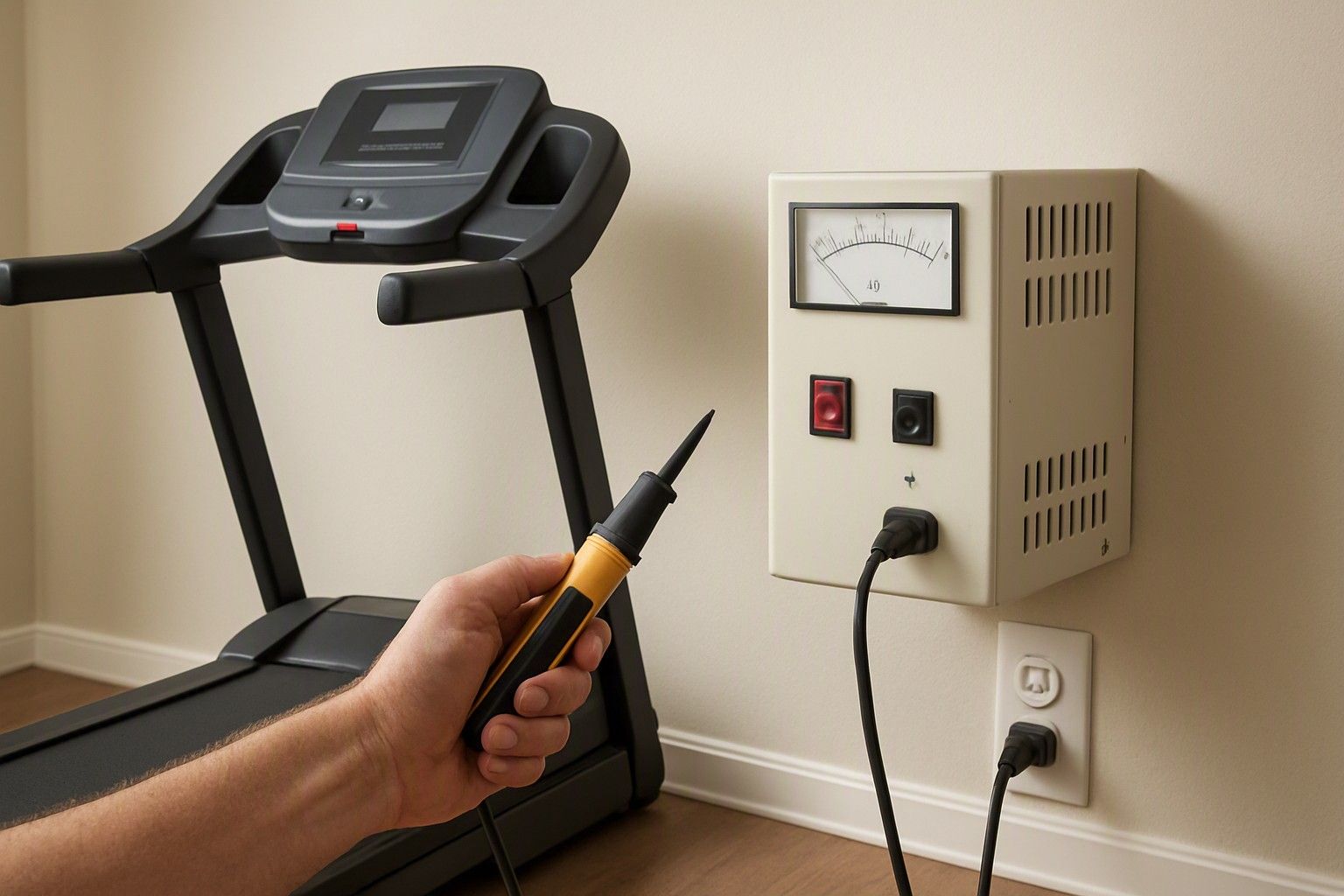
If your area has erratic voltage or frequent outages, that's a legitimate worry before you buy a treadmill — the motor and control board are more sensitive to power quality than most home appliances. This article works through exactly what damages a treadmill electrically, what you actually need to guard against it, and what you don't need to spend money on. By the end you'll know whether your home's power situation needs a stabiliser, a rewired socket, or nothing at all.
How Voltage Fluctuations Affect Treadmill Motors and Boards
A treadmill's motor control board converts your home's AC supply into the regulated DC power that drives the motor at a steady, controllable speed. This board is the single most failure-prone part of any treadmill sold in India, and it's also the part most exposed to bad power. When incoming voltage spikes above the normal range, sensitive components on the board — capacitors, MOSFETs, the rectifier circuit — can be pushed past their rated tolerance and degrade or fail outright, sometimes immediately, sometimes slowly over months of small stress events you never notice. When voltage sags too low, the motor draws more current to maintain the same speed and torque, which heats up the windings and the board's power stage, shortening their working life even if nothing fails that day.
Sudden power cuts create a different kind of stress: the motor and belt have inertia, and an abrupt loss of power while you're mid-stride at a fast pace means the board has to handle an uncontrolled deceleration, which some cheaper boards manage poorly. None of this is unique to one brand or price point — it's a function of how universal these motor controllers are built, and it's precisely why unstable supply is a genuine India-specific concern rather than a generic warning. Homes on old wiring, rural or semi-urban grids, and buildings sharing transformers with heavy industrial or commercial load are the ones most exposed to this kind of swing, and that's worth knowing honestly about your own area before you plug in a treadmill and assume it's fine.
Do You Need a Stabiliser for Your Treadmill?
The honest answer is: it depends on your area's power quality, not on how much your treadmill costs. If you live somewhere with visibly flickering lights, appliances that reset themselves during storms, or voltage that a stabiliser on your fridge or AC is already correcting, then yes — your treadmill's board deserves the same protection, because it's arguably more failure-prone than either of those appliances. If your area has clean, stable supply and you've never needed a stabiliser for anything else in the house, a treadmill in the ₹12,000 to ₹30,000 range typically runs fine without one, since most boards in this segment already include basic surge tolerance.
Where it becomes less optional is at the higher end. A treadmill priced toward ₹80,000 or beyond usually has a more sophisticated motor controller — sometimes with a larger or more powerful motor — and replacing that board is proportionately more expensive if it burns out, which makes the cost of a stabiliser look trivial by comparison. A stabiliser isn't about the treadmill being fragile; it's about matching the level of protection to what you'd lose if the board failed. If you're unsure, check what your voltage actually does with a simple plug-in meter for a week before deciding — that's more useful than guessing based on price alone. Skipping this step and hoping for the best is the single most avoidable mistake buyers make with treadmills in areas with known grid issues.
Power Consumption and Its Impact on Your Electricity Bill
A treadmill's day-to-day running cost is usually a smaller concern than motor protection, but it's still worth putting real numbers to it so you're not surprised later. Motor size varies a fair bit across the range — treadmills near ₹8,000 typically use smaller, less powerful motors meant for walking and light jogging, while machines closer to ₹2,00,000 often carry larger motors built for sustained running and higher user weights, and larger motors draw more continuous current under load. For a household running a treadmill for a normal 30-45 minute session most days, the added cost to your monthly electricity bill is generally modest compared to running an AC or geyser for equivalent hours, but it's not zero, and it does scale with how hard you push the incline and speed settings.
The bigger power-bill risk isn't the running cost itself — it's inefficient use caused by unstable supply. A motor working harder to compensate for voltage sag draws more current for the same output, which quietly inflates your bill over time even though the treadmill feels like it's performing normally. This is another reason power quality at home matters beyond just protecting the hardware: a treadmill running on clean, stable voltage is also the more efficient, cheaper-to-run version of the same machine.
Safe Placement, Wiring and Earthing at Home
Where and how you plug in a treadmill matters more than most buyers assume, and it's a separate issue from voltage stability altogether. Always use a dedicated, properly earthed socket rather than a shared extension board or a multi-plug adapter carrying other appliances — treadmills draw meaningful continuous current, and a poorly rated extension cord can heat up, cause voltage drop at the plug, or in the worst case become a fire risk. Earthing isn't optional here either: a treadmill's motor and electronics are exactly the kind of load where a fault without a proper earth path can deliver a shock through the frame, and many Indian homes, especially older constructions, still have inconsistent or missing earthing on certain circuits.
Placement affects safety too. Keep the treadmill away from direct sunlight and away from areas prone to dust or moisture, since dust ingress into the motor housing and control board is a slow but real cause of electrical faults over time, and moisture near the plug point is an obvious hazard. If your home is prone to power cuts followed by sudden restoration, it also helps to switch the treadmill off at the wall rather than leaving it on standby, since some units draw an inrush of current the moment power returns that a stabiliser or a simple switch-off habit both guard against equally well.
Protecting Your Investment Over the Long Run
Treadmills across the price spectrum — from budget models near ₹8,000 to premium ones near ₹2,00,000, with the average buyer spending around ₹35,000 — all share the same vulnerability to India's power conditions, and the fixes are the same regardless of what you paid: stable supply or a stabiliser where needed, a dedicated earthed socket, sensible placement, and switching off rather than leaving on standby through outages. None of this is expensive relative to the treadmill itself, and skipping it is how an otherwise well-chosen machine ends up with a dead board well before its time.
The other half of protecting your purchase is understanding what's actually covered when something does go wrong despite your precautions, because even careful owners occasionally lose a board to a freak surge. It's worth taking the time to see how this ties into warranty coverage and servicing, since motor and board coverage terms vary meaningfully between manufacturers and matter more in India's power environment than in markets with cleaner grids.
Voltage swings and power cuts won't necessarily damage your treadmill — but only if you match your home's actual power quality to the right precautions rather than assuming a good machine takes care of itself. Check your area's supply honestly, earth the socket properly, and decide on a stabiliser based on real conditions rather than price alone, and the electrical side of treadmill ownership stops being a worry and becomes a solved problem.
Comments
Be the first to comment.