Treadmill Motor Power and Belt Size: How Much Do You Really Need?
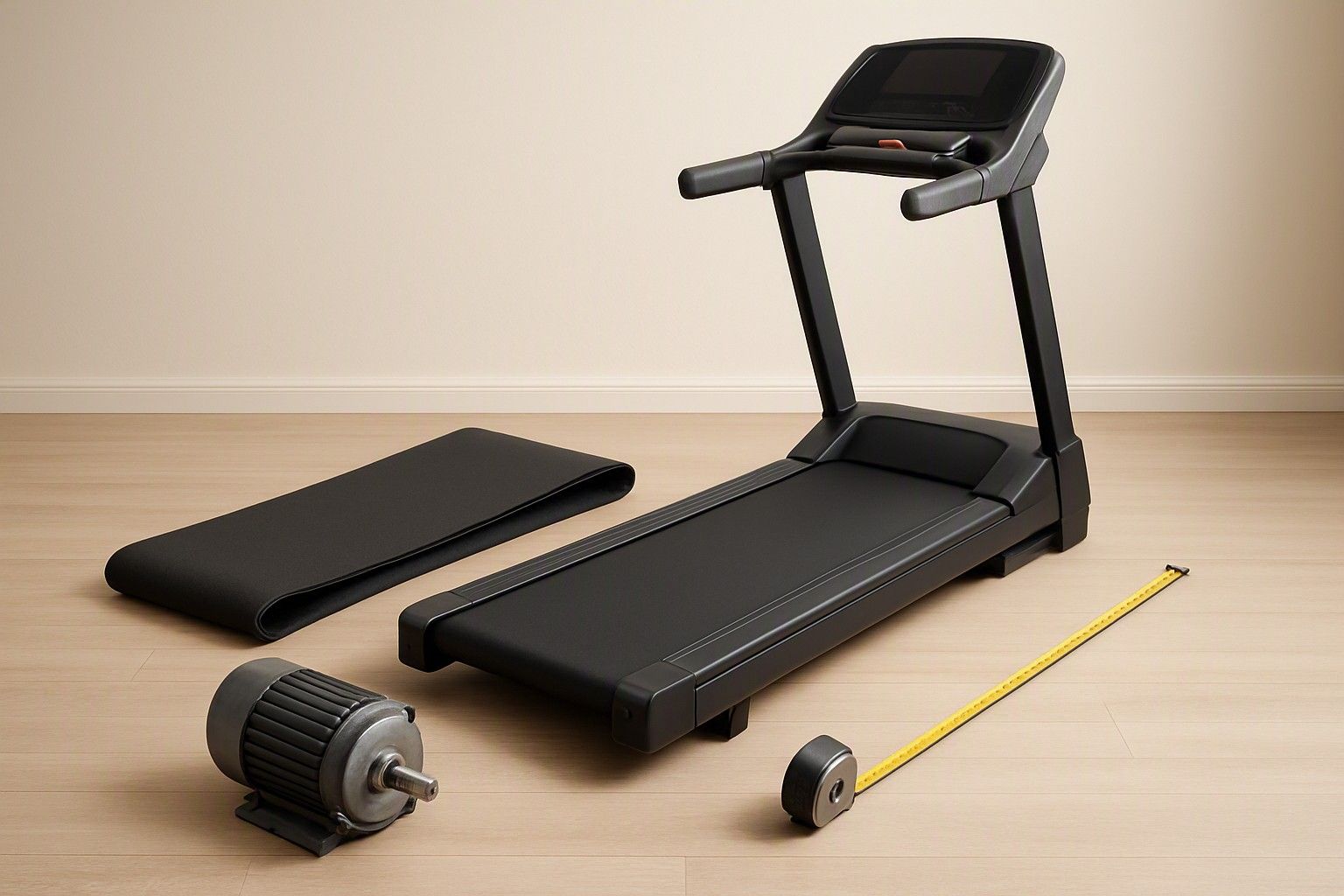
If you've been comparing treadmills and feel like the motor HP and belt size numbers are just marketing noise, you're not wrong to be confused — most listings make these specs look more impressive than they are. This article breaks down what continuous HP, peak HP and belt dimensions actually mean for your body weight, your stride, and whether you'll be walking or running, so you can match the spec sheet to your actual use instead of guessing.
Continuous vs Peak HP: What the Numbers Mean
Almost every treadmill listing in India shows two horsepower figures, and sellers usually highlight the bigger one. Peak HP is the motor's maximum output in short bursts — a number the motor can hit for a few seconds under ideal conditions, not something it sustains during an actual workout. Continuous HP (often written as CHP) is what the motor can deliver reliably for extended periods, and it's the number that actually tells you how the machine will behave twenty minutes into a run.
A treadmill advertised with a high peak HP but a modest continuous rating will often feel underpowered once you're moving at a steady pace, because the motor is doing sustained work, not brief bursts. This is exactly where buyers get misled: two machines priced close to each other can have similar peak figures but a meaningful gap in continuous HP, and that gap shows up as belt hesitation, motor strain, or a machine that runs hot and loud after 15-20 minutes.
When you're comparing spec sheets, treat continuous HP as the real number and peak HP as a secondary detail. For most home users, anything below 1.5 CHP is going to struggle with regular use beyond brisk walking, and this single distinction explains why two treadmills that look similar on paper can feel completely different underfoot.
Matching Motor Power to User Weight and Walking vs Running
Motor power requirements scale with two things: how much weight the belt is moving and how fast that weight is moving. A lighter user walking at a gentle pace asks very little of the motor, while a heavier user running places continuous, high-torque demand on it — and this is where a lot of Indian households get the buying decision wrong, because they size the treadmill for the lightest or most frequent user rather than the heaviest one who'll actually use it.
As a working guide, walking-only use for users under roughly 70-75 kg is comfortably handled by 1.5-2 CHP. If the household includes users above that weight, or if running (even occasional jogging) is part of the plan, you're looking at 2-2.5 CHP or higher to avoid the motor labouring and wearing out faster than it should. Multi-user homes — a common scenario in India where one treadmill serves parents, an adult child, and sometimes a heavier or older user — should size for the heaviest expected user and the most demanding use case, not the average.
Underpowering the motor doesn't just affect performance today. A motor that's constantly working near its ceiling degrades faster, gets noisier, and is a common reason treadmills get abandoned within a year or two. If your household genuinely needs running capability for even one member, it's worth spending for the higher CHP rather than assuming a lighter machine will manage.
Belt Length and Width for Different Heights and Strides
Belt size is the second most misunderstood spec, and it matters just as much as motor power for anyone taller than average or planning to run rather than walk. A short belt forces a runner to shorten their stride unnaturally to avoid stepping off the back, which is both uncomfortable and a genuine safety concern at higher speeds.
As a rough guide for the Indian market: belts around 130-140 cm in length are adequate for walking-focused use by users up to about 5'8". Anyone taller, or anyone who intends to jog or run, should look for belts in the 150 cm and above range, since running strides are naturally longer than walking strides regardless of height. Belt width matters too — narrower belts (under 40 cm) can feel cramped even for walking, while 45-48 cm gives more comfortable arm clearance and a steadier feel underfoot.
This is where the price-versus-spec trade-off shows up clearly. Compact, budget-oriented treadmills often shrink the belt to keep the frame small and the price down, which is a reasonable compromise for a walking-only, space-constrained household but a poor fit if anyone in the house runs or is above average height. Before finalising a model, it's worth measuring an actual stride at a comfortable jog — most people underestimate how much belt length they need until they've stepped off the back of a short one.
Incline, Cushioning and Their Effect on Joints
Incline and cushioning don't get as much attention as motor power or belt size, but they directly affect how a treadmill feels on your knees and ankles over months of use, which matters more in daily practice than most buyers expect. Incline — even a basic manual or auto incline of 10-15% — lets you vary the workout intensity without increasing speed, which is gentler on joints than constantly pushing pace higher, and it also more closely mimics outdoor walking or running where surfaces are rarely perfectly flat.
Cushioning refers to the shock-absorption built into the deck under the belt, and it's what separates a treadmill that feels harsh and jarring from one that feels closer to running on a track. Cheaper decks with minimal cushioning transfer more impact directly into your joints, which matters a great deal if you or another household user has existing knee sensitivity or plans to use the treadmill several times a week. This is a spec that's hard to judge from a listing alone, since "cushioned deck" is described inconsistently across brands and price points, but it's reasonable to expect noticeably better cushioning as you move up through the price tiers.
Neither incline nor cushioning is a reason to overspend if your use is occasional, light walking. But for anyone using the treadmill regularly, especially for running, treating these as afterthoughts after motor and belt size is a common mistake that shows up later as joint discomfort rather than at the time of purchase.
How Higher Specs Push You Into a Higher Budget
Once you start stacking up the specs that actually matter — continuous HP above 2, belt length past 150 cm, real cushioning, and usable incline — you naturally move out of the entry price band and into a higher one, and it helps to know where that shift happens before you start comparing individual listings. Treadmills priced under ₹12,000 are typically built around lighter, walking-focused motors and shorter, narrower belts, which is a fair trade-off if your household use matches that profile but a limiting one if it doesn't.
Moving into the ₹30,000 range generally brings better continuous HP ratings, somewhat longer belts, and improved cushioning, making this band the realistic starting point for households with a mix of walking and light running use. The ₹80,000 band is where you start seeing the combination of high continuous HP, full-length belts, proper incline motors, and sturdier frames that suit regular running and multi-user, mixed-weight households.
Across the full market, prices run from ₹8,000 to ₹2,00,000, with the average sitting around ₹35,000 — a useful anchor when you're checking whether a specific listing's price reflects its actual spec sheet or is priced above what its motor and belt size would justify. Rather than shopping by budget alone, it's more useful to first decide the specs your household genuinely needs, then see which price band those specs land you in. If you want to see exactly how these individual specs translate into the market's pricing structure, it helps to understand how these specs move you between price bands.
Choosing Specs Without Overpaying
The goal isn't to buy the highest HP and longest belt available — it's to buy specs that match how your household will actually use the treadmill, and nothing more. Someone who walks briskly for 20-30 minutes a few times a week doesn't need the same continuous HP or belt length as a household with a regular runner, and paying for that extra capacity is money spent on headroom you'll never use.
The practical approach is to work backwards from your heaviest user and your most demanding use case — walking versus running, height and stride, frequency of use — and then find the lowest price band that comfortably covers those numbers, rather than starting with a budget and hoping the specs fit. This keeps you from both underbuying, which leads to a strained motor and a short belt within a year, and overbuying, which just ties up money in capacity you didn't need.
Once you've settled on the motor power and belt size that fit your household, it's worth stepping back and looking at how these decisions fit into the rest of the purchase — frame stability, warranty, and where you'll actually place and use the machine. That's covered in more depth if you want to tie your spec choice back into the overall buying decision.
Motor power and belt size aren't specs to skim past — they're the two numbers that decide whether a treadmill still feels right six months in, once the novelty has worn off and the routine has settled. Match continuous HP and belt dimensions to your heaviest user and your actual walking-versus-running mix, and you'll have a clear, confident answer to what looked like a confusing spec sheet.

Comments
Be the first to comment.