Motorised vs Manual Treadmills: Which Should You Buy?
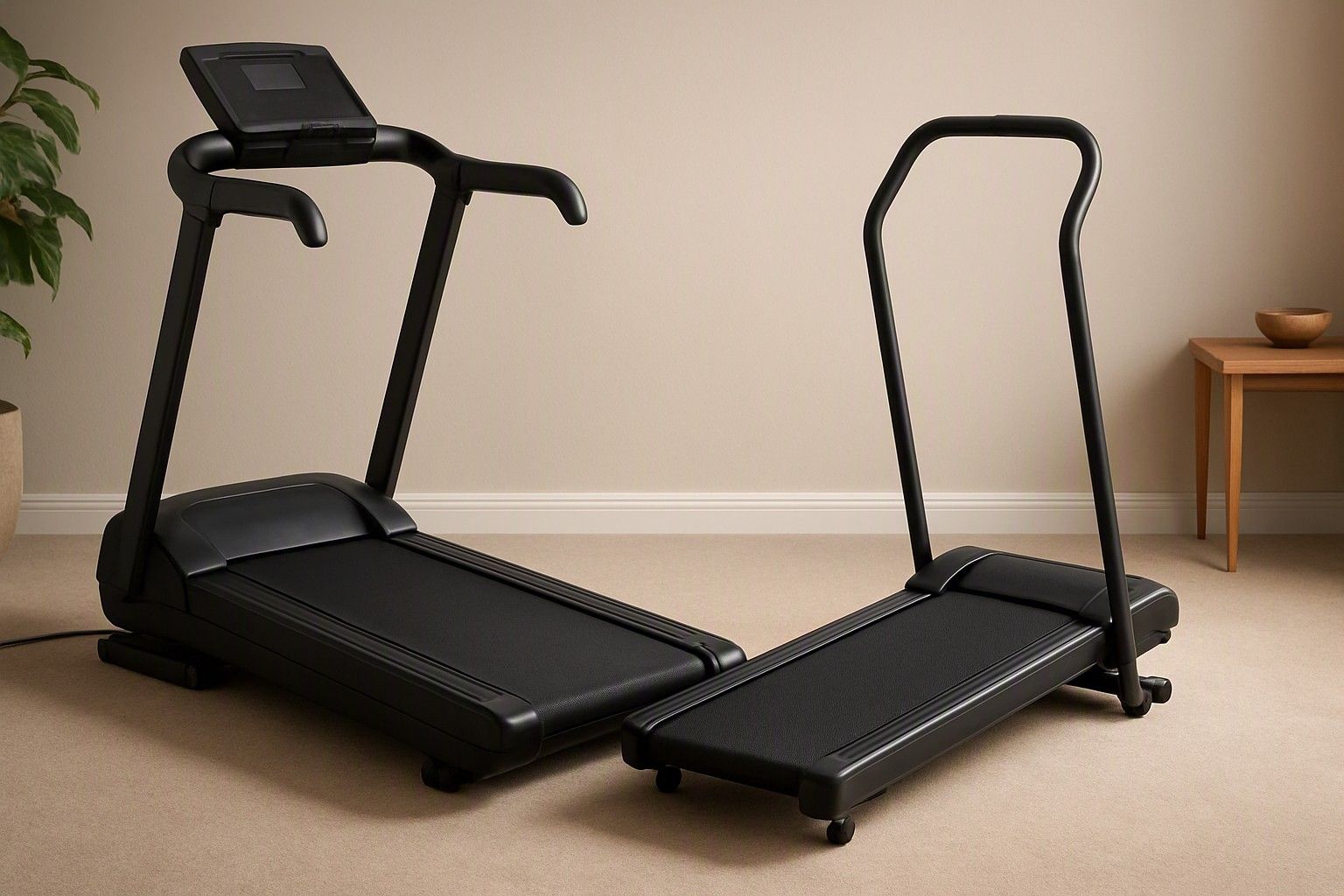
If you're standing between a motorised and a manual treadmill and not sure which one actually fits how you'll use it, this is the fork to sort out before anything else. The two work on completely different mechanics, cost very differently, and suit different kinds of Indian households — so the right pick depends less on brand or features and more on your body, your space, and how consistently you'll actually use it.
How Motorised and Manual Treadmills Actually Work
A motorised treadmill uses an electric motor to turn the belt, so once you set a speed and incline, the machine drives the movement and you simply keep pace with it. You press a button, the belt moves at a fixed pace, and the machine controls the effort curve for you, which is why it feels closer to outdoor running or walking. A manual treadmill has no motor for the belt at all — the belt only moves when your own footstrike pushes it backward, which means the machine is entirely dependent on the force and rhythm of your steps. Most manual models sold in India are curved-deck or flat-deck designs that rely on this push-off action, and some use a basic flywheel or resistance mechanism to make the belt feel less jerky.
This difference in mechanism is the reason everything else in this article — price, effort, noise, maintenance — plays out so differently between the two. A motorised unit has a motor, a control board, wiring and often a display, all of which add cost and things that can eventually wear out. A manual treadmill is mechanically simpler: fewer parts to fail, but also no assistance, no programmed incline, and no way to hold a fixed pace without deliberately concentrating on your stride. Understanding this basic mechanical split answers a lot of downstream questions before you even look at a spec sheet, because it tells you upfront whether the treadmill will set the pace for you or whether you'll be setting it yourself, step by step.
Effort, Speed Control and Workout Type Differences
This is where the two categories genuinely part ways for most buyers. On a motorised treadmill, you pick a speed — say a brisk walk or a steady jog — and the belt holds that pace whether or not your form is perfect, which makes it far easier to do structured workouts like interval training, a fixed-duration run, or a steady cardio session at a set heart rate. Incline is usually motor-controlled too, so you can simulate an uphill walk without changing anything about your stride. This predictability is what makes motorised treadmills suit people training for a 5K, following a weight-loss plan with defined targets, or anyone who wants the same measurable workout every day.
A manual treadmill demands more from your body to get the belt moving at all, particularly on a curved-deck model, where you have to push through your midfoot and drive the belt with your own force. This naturally engages the legs and core more than a motorised walk would, and some buyers deliberately choose manual for that reason — it can feel like a tougher, more natural workout even at what seems like a modest pace. But it also means speed is inconsistent by nature: you slow down, the belt slows down, so holding an exact pace for a timed session is genuinely difficult. Manual treadmills are a poor fit for structured running plans or incline-based training, and they're generally unsuitable for anyone with joint concerns, balance issues, or anyone elderly, since there's no assisted, even belt movement to rely on. If your goal is casual, self-paced walking, manual can work; if you want repeatable, measurable workouts, motorised is the more honest answer.
Price Gap Between Manual and Motorised Models
Manual treadmills in India are almost always the cheaper entry point, and this is reflected clearly across the market's price spread of ₹8,000 to ₹2,00,000, with an average around ₹35,000. Most manual models, including basic curved-deck ones, sit in or near the ₹12,000 tier, since there's no motor, control board, or display driving up the cost. Motorised treadmills start appearing meaningfully once you move into the ₹30,000 range, and the more capable ones — with higher motor continuous horsepower, wider decks, and multiple incline levels — sit comfortably in the ₹80,000 tier and above.
This isn't a gap you should read as manual being a compromised version of motorised at a lower price — they're different products serving different needs, and the price difference reflects genuinely different engineering, not lesser quality within the same category. A well-built manual treadmill at the lower tier can be a completely sound purchase for basic daily walking, while a motorised treadmill at the higher tier earns its price through a stronger motor, sturdier frame, and smoother, quieter belt movement built for sustained running. Because prices across both types have stayed fairly consistent across this range rather than swinging wildly, you don't need to time your purchase around a hoped-for drop — the current spread already tells you what a fair price looks like for the type you're choosing. If you want a clearer sense of what you actually get at each spend level, you can see how these two types sit across the different budget tiers before deciding where to land.
Noise, Maintenance and Long-Term Reliability
Motorised treadmills are, by design, noisier — the motor hums continuously while running, and belt friction adds to that, especially at higher speeds or inclines. In an Indian apartment with shared walls or a downstairs neighbour, this matters more than it might first seem, and it's worth actually standing near a running unit before buying rather than judging from a spec sheet alone. Manual treadmills are considerably quieter since there's no motor driving the belt, which makes them a better fit for early-morning or late-night use in tight households, though the belt and deck can still produce a rhythmic clunk depending on build quality.
Maintenance follows the same logic as the mechanism does. Motorised treadmills need periodic belt lubrication, motor and board checks, and occasional servicing, and because they have more components, there's simply more that can eventually need attention or replacement over years of use. Manual treadmills have far less to maintain — mainly the belt and deck surface — and because there's no motor to fail, they tend to have fewer breakdown points over their lifespan. That said, "fewer parts" doesn't automatically mean "lasts longer" in every case; a poorly built manual deck can wear unevenly and get noisy or stiff faster than a well-built motorised one that's properly serviced. The realistic takeaway is that manual treadmills are lower-maintenance by nature, while motorised treadmills need a bit more upkeep in exchange for the smoother, assisted workout they deliver.
Who Each Type Suits Best in Indian Homes
A manual treadmill tends to suit someone with a small apartment, a tight budget, and a simple goal — daily walking, light cardio, or just staying consistently active without a structured plan. It's also a reasonable choice for a household that wants a quiet, low-fuss machine that doesn't need much looking after, and doesn't mind that pace and incline aren't precisely controlled. It's a poor fit, though, for anyone planning to run rather than walk, anyone with knee or joint sensitivity, or older adults who need steady, even belt movement rather than self-driven momentum.
A motorised treadmill suits households where at least one person wants to run, follow a fitness plan with specific pace or incline targets, or simply prefers a machine that does the pacing so they can focus on the workout itself. It's the safer choice for elderly users or anyone recovering from an injury under guidance, since the belt moves independently of effort and can be set to a gentle, consistent walking speed. It asks for more upfront budget and a bit more tolerance for motor noise and occasional servicing, but in return gives you a far more versatile machine across walking, jogging, and running use cases. If you're still weighing this against everything else that goes into a treadmill purchase — space, deck size, motor rating, warranty — it helps to start from the full checklist of what to weigh before buying rather than deciding on this one factor alone.
The motorised-versus-manual question really comes down to what you need the treadmill to do: hold a pace for you, or simply give your legs something to push against. If you're running, training to a plan, or buying for someone who needs steady, assisted movement, motorised is the sound answer despite the higher cost and upkeep. If you want a quiet, low-maintenance machine for basic daily walking on a tighter budget, manual does the job without over-buying. Either way, you now have the actual trade-offs in front of you rather than a spec sheet to guess from.

Comments
Be the first to comment.