Copper vs Aluminium Condenser Coil: Which Lasts Longer in Indian Conditions?
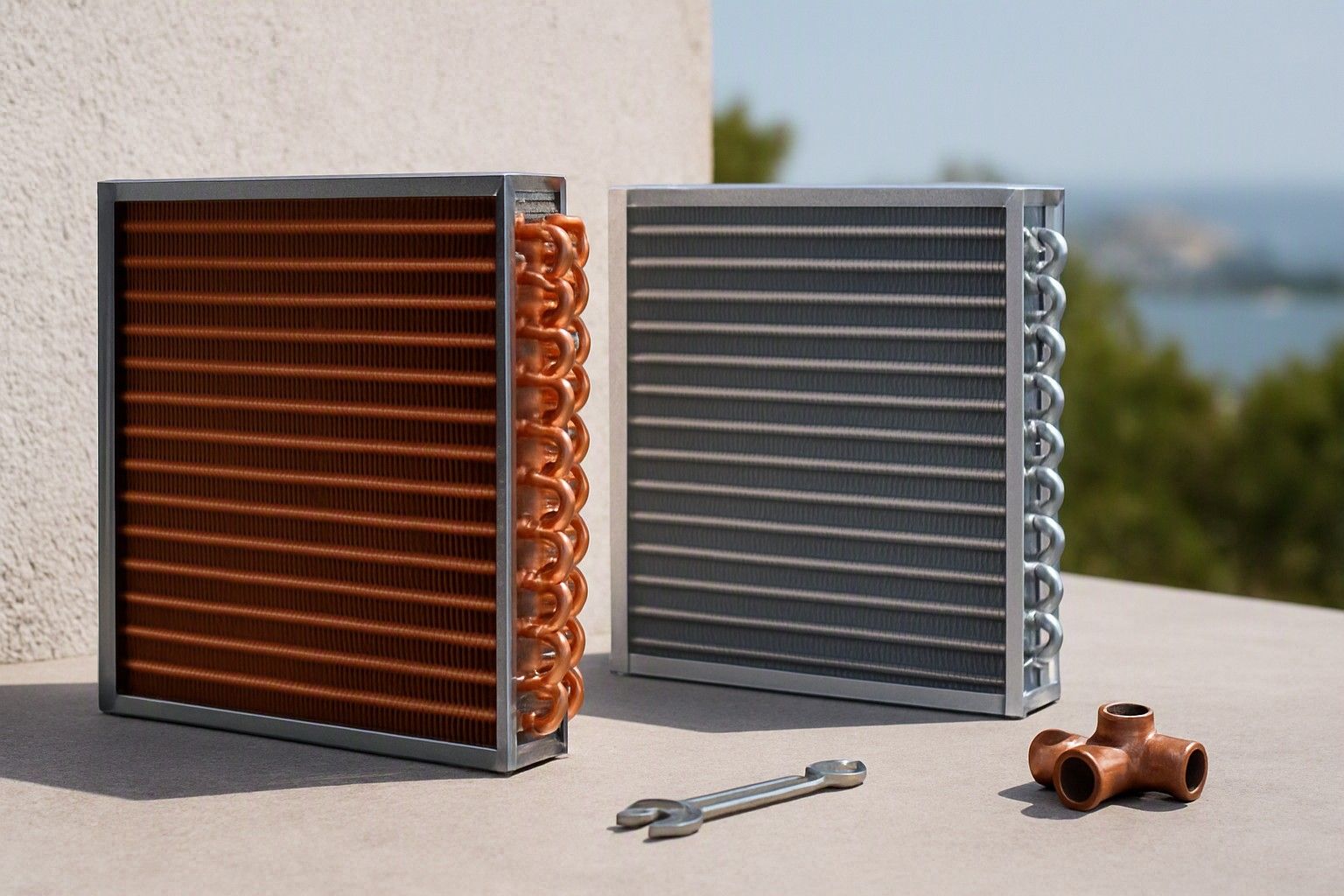
If you are choosing between an AC with a copper condenser and one with an aluminium condenser, the short answer is that copper is usually the safer long-term choice in India, mainly because it is easier to repair and holds up better when a leak develops. Aluminium is not automatically a bad pick, though, and the right call depends on where you live and how long you plan to keep the unit. This article walks through heat transfer, repairs, corrosion, gas type and price so you can read the spec sheet and decide today.
How the Condenser Coil Affects Heat Transfer and Cooling
The condenser is the outdoor coil that throws away the heat your AC has pulled out of the room. The faster it releases that heat, the less hard the compressor has to work, and the more steadily the unit holds its rated cooling. Copper conducts heat considerably better than aluminium, so a copper coil can shed heat efficiently even with a compact design.
In practice, this does not mean a copper AC will feel dramatically colder on day one. Most buyers will not notice a difference in the first season, because the fins on both types are usually aluminium and a well-designed aluminium coil can be made to perform well. The gap tends to show up over time and in harsh heat: a coil that sheds heat well keeps compressor load lower on a 45 degree afternoon, and a coil that has corroded or clogged with dust loses that advantage quickly.
So read the coil material as a durability and consistency spec rather than a headline cooling spec. If a brochure claims a big cooling advantage purely from coil metal, treat that with some caution and look at the rated capacity and efficiency figures instead.
Repairability: Why Technicians Prefer Copper
Ask a service technician in any Indian city and most will tell you the same thing: they would rather work on copper. A leaking copper tube can be cleaned and brazed on site with standard tools, and the AC is back in service the same day. Aluminium tubing is far harder to join reliably, needs specialised welding or sealing, and a repair often does not hold under the vibration and pressure cycles of a running compressor.
That difference shapes what you pay later. A pinhole leak in a copper coil is typically a repair job followed by a gas refill. The same fault in an aluminium coil often ends with the entire coil being replaced, and that is a larger bill that may also depend on part availability. For a realistic idea of what gas leaks and coil repairs typically cost, it helps to factor the coil material into the numbers, since the repair route is different for each.
Aluminium coils can also be harder for small local technicians to handle, so you may end up depending on the brand's authorised service network. If you live in a smaller town where that network is thin, copper gives you more options and less downtime.
Corrosion Near the Sea and in Polluted Cities: Coatings That Matter
Corrosion is where the copper versus aluminium debate gets most practical in India. Salt-laden air in coastal cities and sulphur and acidic particles in heavily polluted urban areas attack bare metal on the outdoor unit. Aluminium is especially prone to pitting, which creates tiny leaks that are hard to fix. Copper tubing resists this better, though the aluminium fins attached to it can still degrade and lose heat-transfer ability.
This is why coatings matter as much as the base metal. Look for a spec sheet line that mentions an anti-corrosion or protective coating on the condenser fins, often described as a treated or blue or gold fin, and check whether it covers the fins, the tubes, or both. Brands use different names, so ask the seller to explain exactly what is applied and what the warranty says about coil corrosion.
If you live in coastal and high-pollution conditions, a copper coil with a protective coating is the combination to prioritise. An uncoated aluminium coil in those areas is the setup most likely to give trouble within a few years. In a dry inland city with cleaner air, the risk is lower and the argument for paying extra for copper weakens.
Refrigerant Gas on the Spec Sheet: R32 and R410A
Spec sheets often list the refrigerant right next to the coil material, so it is worth knowing how the two relate. Most current ACs use either R32 or R410A. R32 is a single-component gas, generally more efficient for the same cooling and with a lower global warming impact, and it is simpler to top up because it does not need to be recharged as a blend. R410A is a blend that has been widely used and is still found on many models.
Neither gas is tied to a particular coil metal. You can find copper and aluminium condensers paired with either refrigerant, so do not assume that a newer gas means a better coil or the other way round. They are separate decisions.
What the gas does affect is service. Technicians need to be familiar with the refrigerant in your unit, and the gas type should be clearly printed on the outdoor unit and in the manual. Since leaks and refills are exactly where coil quality shows up, treat the refrigerant line as a way to confirm the unit is a current design, then judge the coil on its own merits.
Price Difference Between Copper and Aluminium Models
Across the range we track, AC prices run from ₹21,990 to ₹89,990, with an average of ₹34,990. Copper condensers add to the manufacturing cost, because the metal itself is more expensive, so they tend to appear more often as you move up the price ladder, while aluminium condensers are more common at the entry end.
In the ₹25,000 bracket, expect to see aluminium coils more often, and you will need to read spec sheets carefully to find copper. In the ₹35,000 bracket, copper becomes much easier to find and is a reasonable thing to insist on. In the ₹55,000 bracket, copper condensers are close to standard, so the question becomes the quality of the coating and the warranty rather than the metal.
The useful way to think about the extra cost is against what you might spend later. If an aluminium coil develops a leak and needs replacing, the bill can wipe out the saving you made at purchase. If you plan to keep the AC for many years or live near the coast, paying for copper now is a sound decision. If you expect to move or replace the unit within a few years in a dry, mild-pollution area, an aluminium model can be a defensible way to stay within budget.
Spec-Sheet Lines to Check Next
Once you have confirmed the coil material, check a few related lines before you commit. First, look at whether the condenser is described as all-copper or copper tube with aluminium fins, since most good models use the latter, and see if the fins carry a protective coating. Second, read the warranty terms separately for the compressor and for the coil or condenser, because some brands cover the coil for a shorter period or exclude corrosion.
Third, confirm the refrigerant type and make sure it is printed clearly on the unit. Fourth, compare the rated capacity and efficiency figures, since these tell you more about everyday cooling and running cost than coil metal alone. Finally, ask what the installation includes, such as pipe length and stand, because poor installation can stress the coil connections regardless of material.
For the other specifications worth comparing alongside coil material, the buying guide covers tonnage, star rating, inverter technology and more, so you can match the whole spec sheet to your room and budget.
So, is an AC with a copper condenser better than one with an aluminium condenser? For most Indian buyers, yes: copper is easier to repair, resists leaks better, and is safer near the coast or in polluted cities, especially with a protective fin coating. Aluminium can still make sense for a shorter ownership horizon in a mild, dry location, as long as you accept the replacement risk. Check the coil line on the spec sheet, match it to your conditions, and you can decide with confidence now.
Comments
Be the first to comment.