Air Cooler or AC: Which One Actually Works in Your City's Summer?
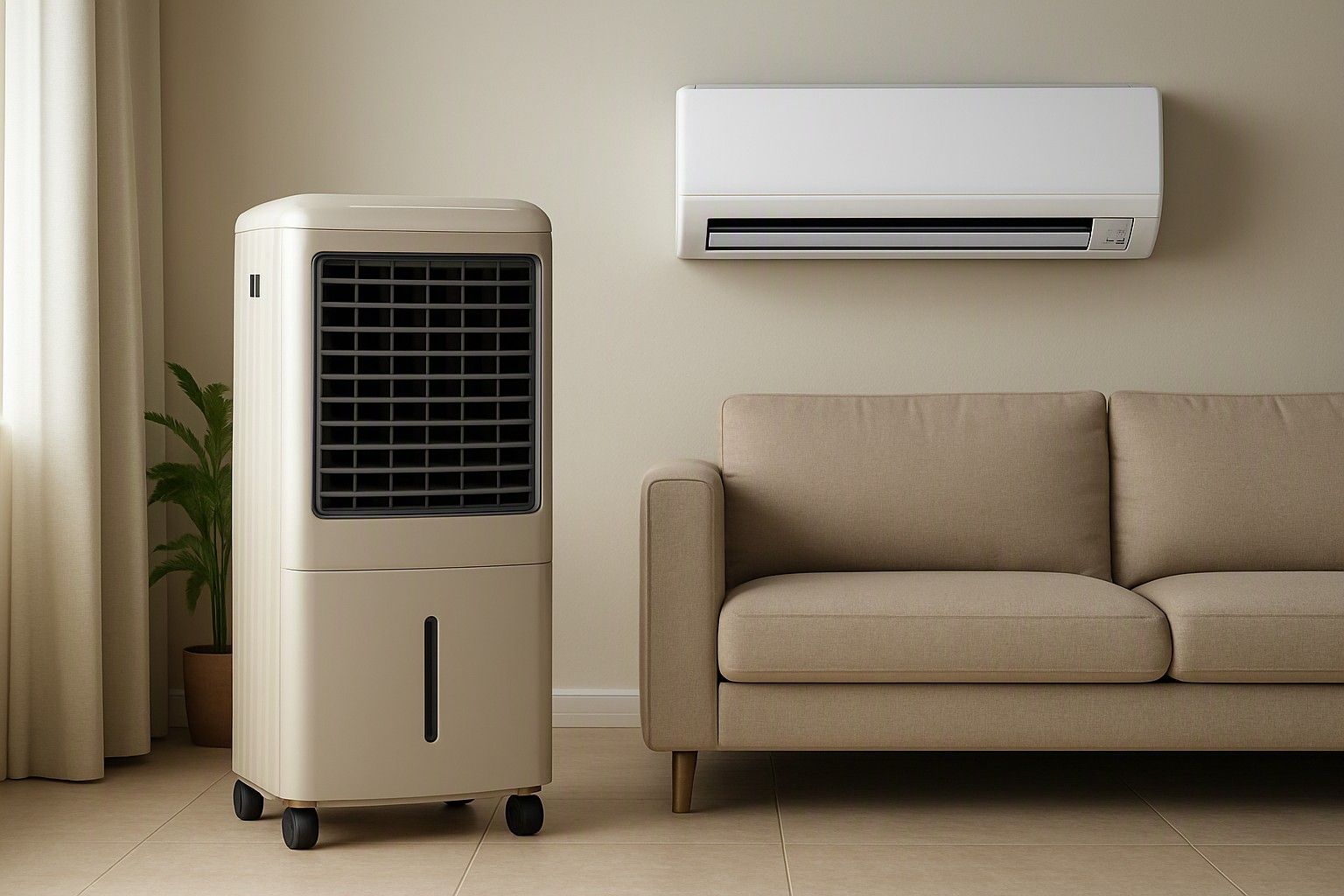
If you are standing between a cooler and an AC for a bedroom or living room, the honest answer depends on two things: how humid your city gets, and whether you can keep the room closed. This article is for anyone who has the budget to consider an AC but is not sure it is worth paying for over a cooler. By the end you will know which one suits your city, your room and your electricity bill.
How Evaporative Cooling and Refrigerant Cooling Differ
An air cooler works like a wet cloth in a breeze. A fan pulls outside air through water-soaked pads, some of the water evaporates, and that evaporation takes heat out of the air before it blows into the room. The air is cooler, but it is also damper, and it only stays cool if fresh outside air keeps entering and the used, moist air has somewhere to leave.
An AC does something fundamentally different. A compressor circulates refrigerant through a closed loop, absorbs heat from the room air at the indoor unit and throws it out through the outdoor unit. The same room air is cooled again and again, and moisture is pulled out of it as water drips away. That is why a closed room with an AC feels cooler and drier, while a room with a cooler feels cooler but slightly clammy.
The practical consequence is control. A cooler's performance is decided by the weather outside, so the same machine feels very different in May and in July. An AC holds a set temperature almost regardless of outdoor conditions, within the limits of its capacity and the room's heat load. Everything else in this comparison, from running cost to daily upkeep, flows from this one difference.
Why Coolers Struggle in Humid Monsoon and Coastal Weather
Evaporation needs dry air to work with. In the dry heat of a pre-monsoon summer in much of north and central India, air can absorb a lot of moisture, so a cooler produces a noticeable drop in temperature. Once the monsoon arrives, or if you live in a coastal city, the air is already close to saturated. Water barely evaporates from the pads, so the cooling effect shrinks, while the cooler still pushes extra moisture into your room.
This is why many people in humid cities say a cooler "just blows damp air". The room feels sticky, sweat does not dry, and sleep suffers even though the airflow is strong. An AC avoids the problem because it removes moisture as part of its normal cycle, which is a big reason it feels comfortable on warm, muggy nights.
If you want to understand how humidity changes the kind of cooling you need, start with the months your city is actually uncomfortable. If those are mostly dry-heat months, a cooler can be a reasonable choice. If your worst weeks are humid ones, or you face long monsoon and post-monsoon stickiness, a cooler will let you down in exactly the weeks you need it most.
Running Cost: Cooler Fan Motor vs AC Compressor
A cooler is cheap to run because its electrical load is small: a fan motor and a small water pump. An AC's load is dominated by the compressor, which draws far more power whenever it is actively cooling. Over a long summer, that gap shows up clearly on the monthly bill, and the cooler wins this round on pure electricity cost.
But the comparison is not as lopsided as it first looks. An inverter AC does not run flat out all day; once the room reaches the set temperature, the compressor slows down and draws much less. A higher star rating and a sensible set temperature narrow the gap further. A cooler, meanwhile, runs its fan continuously and often needs to be on for longer to feel effective, especially on a humid day.
What matters is your usage pattern: how many hours a day, how many months a year, and in how many rooms. For a bedroom used mainly at night, the AC's added cost may be more modest than you fear. To get a realistic figure for your home, estimate what an AC adds to your monthly electricity bill using your own hours of use and local tariff before assuming a cooler is the only affordable option.
Room Sealing, Ventilation and Daily Water Refills
Here the two machines ask for opposite things. A cooler needs a window or door open so fresh air can come in and humid air can go out. Without that, the room turns stuffy and the cooling fades. An AC needs the room closed: shut windows, door gaps minimised, curtains drawn against afternoon sun. Leave a window open and the AC is cooling the street.
That difference changes daily life. With a cooler you accept outside dust, noise, insects and traffic pollution through the open window. With an AC the room stays quieter and cleaner, which matters in busy neighbourhoods and for anyone with allergies or light sleep.
Then there is upkeep. A cooler needs its tank refilled, often daily in peak heat, and the water should be changed and the tank cleaned regularly. Stagnant water can smell and attract mosquitoes, and the pads wear out and need replacing. A cooler is also not very useful during a power cut unless you have backup.
An AC asks for less daily effort. It needs periodic filter cleaning and an occasional service, but no refilling and no standing water in the room. If you are away from home most of the day, that difference is easy to underestimate.
When the Upfront AC Cost Is Worth It Over a Cooler
An AC costs noticeably more to buy than a cooler, and it needs installation. Across this category, prices run from ₹21,990 to ₹89,990, with an average of ₹34,990. Most buyers shop in three bands: under ₹25,000, ₹35,000, and ₹55,000. Those are the figures to hold up against what you would otherwise spend on a cooler plus water, upkeep and the discomfort of weeks it cannot handle. Prices in this range reflect what an AC typically costs to own, so a decision made now is a sound one rather than something to put off.
The extra spend is easiest to justify in these situations:
- You live in a humid or coastal city, or your discomfort peaks in monsoon and post-monsoon weeks.
- The room is a bedroom where sleep quality matters, or you work from home through the afternoon heat.
- Your home is on a top floor or has a sun-facing wall, so rooms stay hot well into the night.
- There are infants, elderly family members or someone with allergies, who do better in a closed, filtered room.
- You live somewhere noisy, dusty or polluted, where keeping a window open for a cooler is not realistic.
If your summers are short and dry, the room is large and well ventilated, and you can live with a window open, a cooler may still serve you well for the money.
Signs You Have Outgrown a Cooler
Most people do not switch because a cooler stopped working. They switch because the compromises became harder to live with. These are the signs that usually point to an AC:
- The room feels sticky and uncomfortable even with the cooler on full speed, especially at night.
- You keep a window open for the cooler and then close it because of noise, dust or mosquitoes.
- Cooling fades noticeably through the monsoon, and you end up using fans anyway.
- Refilling and cleaning the tank has become a daily chore someone resents.
- Your sleep, work or a family member's health is suffering in the heat.
- The room stays hot after sunset because of a terrace above or a sun-facing wall.
If two or three of these sound familiar, an AC is likely to solve a problem the cooler cannot. When you reach that point, the checks that matter once you have settled on an AC over a cooler cover capacity for your room, star rating, installation and the other decisions that follow.
The choice comes down to your city's humidity and your ability to keep the room closed. A cooler suits dry heat and open, ventilated spaces at a lower running cost, while an AC suits humid weather, bedrooms and closed rooms where steady comfort matters. Check your own worst weeks against the signs above, and you will have your answer.
Comments
Be the first to comment.