3 Star vs 5 Star AC: Reading the BEE Label to Predict Your Electricity Bill
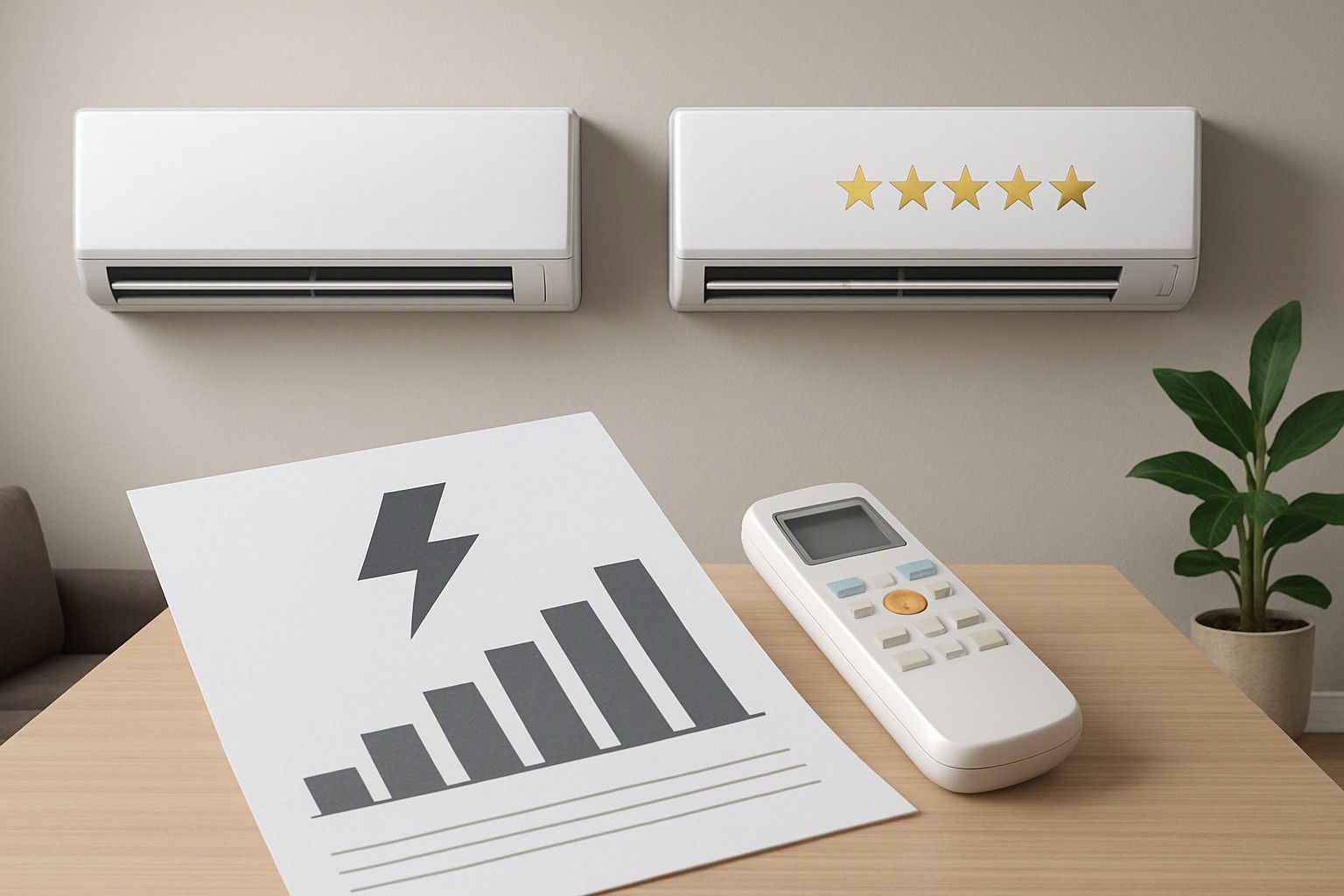
A 5 star AC typically draws about a fifth less power than a 3 star of the same tonnage. For a 1.5 ton split AC running eight hours a day, that is roughly 60 units a month. This article shows you how to read the BEE label, turn it into units and rupees at your own tariff, and judge whether the star gap is worth paying for in your home.
What the BEE Star Label and ISEER Number Measure
The star count on the label is a summary. The number that does the work is ISEER, the Indian Seasonal Energy Efficiency Ratio. It divides the cooling the AC delivers over a typical Indian season by the electricity it uses to deliver it. A higher ISEER means more cooling for every unit of electricity.
BEE sorts ISEER values into bands and assigns stars to each band. A 3 star split inverter AC sits at an ISEER of around 4, and a 5 star sits at 5 or above under the recent bands. Those cut-offs change from time to time, so read the number printed on the label rather than relying on the star count.
The label also shows the rated cooling capacity in watts and an estimated annual energy consumption. That annual figure assumes a fixed number of running hours across the season. It is useful for comparing two models side by side, but it is not a prediction of your own bill, because your hours, room and thermostat setting will differ. The next section turns the label into a figure you can check against your own usage.
Calculating Monthly Units and Cost at Your State's Tariff
You need three things from the label and your own routine: the rated cooling capacity in kW, the ISEER, and the hours you run the AC.
Average power draw (kW) ≈ cooling capacity (kW) ÷ ISEER
Monthly units = power draw × hours per day × days of use
Take a 1.5 ton AC with a rated capacity of about 5 kW. At an ISEER of 4 (a typical 3 star), the draw works out to about 1.25 kW. At an ISEER of 5 (a 5 star), it is about 1.0 kW. Run both for 8 hours a day over 30 days, which is 240 hours:
- 3 star: about 300 units a month
- 5 star: about 240 units a month
- Difference: about 60 units a month
To get the cost, multiply the units by your rate. Tariffs differ across states and usually rise in slabs, so look at your own bill for the rate in your top slab. Summer AC units usually land in that top slab, so the saved units are valued at the highest rate, not the average one. If your bill shows a high slab rate, a 60-unit gap costs you noticeably more than the same gap in a low-tariff state.
Treat the result as a comparison tool. Real draw varies with outdoor temperature, room heat load and compressor cycling.
When 5 Star Pays Back and When 3 Star Is Enough
The payback test is simple. Work out the units a 5 star saves per year, multiply by your slab rate, and compare that with the extra you pay at purchase. The gap is easy to check, because the prices in this category run from ₹21,990 to ₹89,990, with an average of ₹34,990, and what the extra stars add to the sticker price differs by tier.
Using the 0.25 kW difference from the previous section, annual savings look like this:
- Light use, 3 hours a day for about 150 days: roughly 110 units a year
- Moderate use, 8 hours a day for about 240 days: roughly 480 units a year
- Heavy use, 12 hours a day for about 270 days: roughly 810 units a year
Divide the price gap by the units saved over the years you expect to keep the AC. The result is the break-even rate per unit. If your slab rate is above it, the 5 star pays for itself.
5 star tends to win in the bedroom of a home that runs the AC most nights, in a home office, in a high-tariff state, or for a buyer who plans to keep the unit ten years.
3 star is enough for a guest room, a room used only on the hottest weeks, or a budget that sits in the ₹25,000 band where the gap would stretch the purchase. A 3 star you will actually buy beats a 5 star you postpone.
Why Star Ratings for the Same Model Get Revised
You may notice that a model you saw rated 5 star is now listed as 4 star, or that the same model carries different stars in different shops. The hardware often has not changed. BEE periodically tightens the ISEER bands, so a given efficiency earns fewer stars than before. A unit that was comfortably 5 star under the old bands can slip down a star under the new ones.
This also explains why two ACs on sale at the same time can carry labels from different periods. Stock manufactured under an earlier schedule can legitimately keep its older label until it is sold. Each label carries its validity period, so check it.
The practical response is to compare ISEER values rather than star counts. A 4 star unit with a higher ISEER than a 5 star from an older label may be the more efficient machine. Stars are a coarse summary that shifts with the bands, but the ISEER number is a direct measure.
It also means a lower star count on a newer label is not a sign of a worse AC. Check the ISEER, the label period and the stated annual consumption, and decide on those.
Settings That Cut Consumption: 24°C Default, Timers and Sleep Mode
Settings can shift your bill as much as the star difference does, and they cost nothing.
- Set 24°C as the default. It is the temperature the government recommends as a default for room ACs. Each degree you raise the setpoint is commonly cited as saving around 6 percent of consumption, so 24°C against 20°C is a large difference over a season.
- Use the timer. Set the AC to switch off an hour or so after you fall asleep, or to switch on shortly before you arrive. This avoids hours of cooling an empty room.
- Use sleep mode. It raises the setpoint gradually through the night, usually by a degree an hour for the first few hours, then holds it. The room stays comfortable while the compressor works less.
- Pair with a fan. A ceiling fan at low speed lets you hold a higher setpoint at the same comfort.
- Keep the room sealed and the filter clean. Closed doors, curtains on sun-facing windows and a clean filter reduce the load the compressor has to cover.
A 3 star AC run at 24°C with a timer can use less electricity than a 5 star run at 18°C all night.
Weighing Efficiency Against Other Buying Factors
Running cost matters, but it is one factor among several. The right tonnage for your room comes first, because an undersized AC runs flat out and an oversized one costs more upfront without delivering savings. Installation quality, the compressor and condenser warranty terms, noise levels, and the strength of local service support affect your experience over the years just as much.
For most buyers, the sequence is room size and tonnage, then warranty and service, then efficiency, then extras. If you want to see where running cost ranks on the full AC checklist, the buying guide lays out the whole order.
Price should be read against what the category typically costs. With the market average at ₹34,990, models in the ₹35,000 band and the ₹55,000 band often give you a choice between spending on stars and spending on other features. If your daily hours are high, put the money into stars. If they are low, put it into a sound warranty and a correctly sized unit. You can decide now, because the calculation does not depend on timing.
You can now answer the question for your own home. Read the capacity and ISEER from the label, divide to get the power draw, multiply by your daily hours and your slab rate, and compare the 3 star and 5 star results. If the saved units clear the price gap within the years you will own the AC, take the 5 star. If not, a correctly sized 3 star run sensibly will serve you well.

Comments
Be the first to comment.