Inverter vs Non-Inverter AC: Does Variable Speed Pay Off for Your Usage Hours?
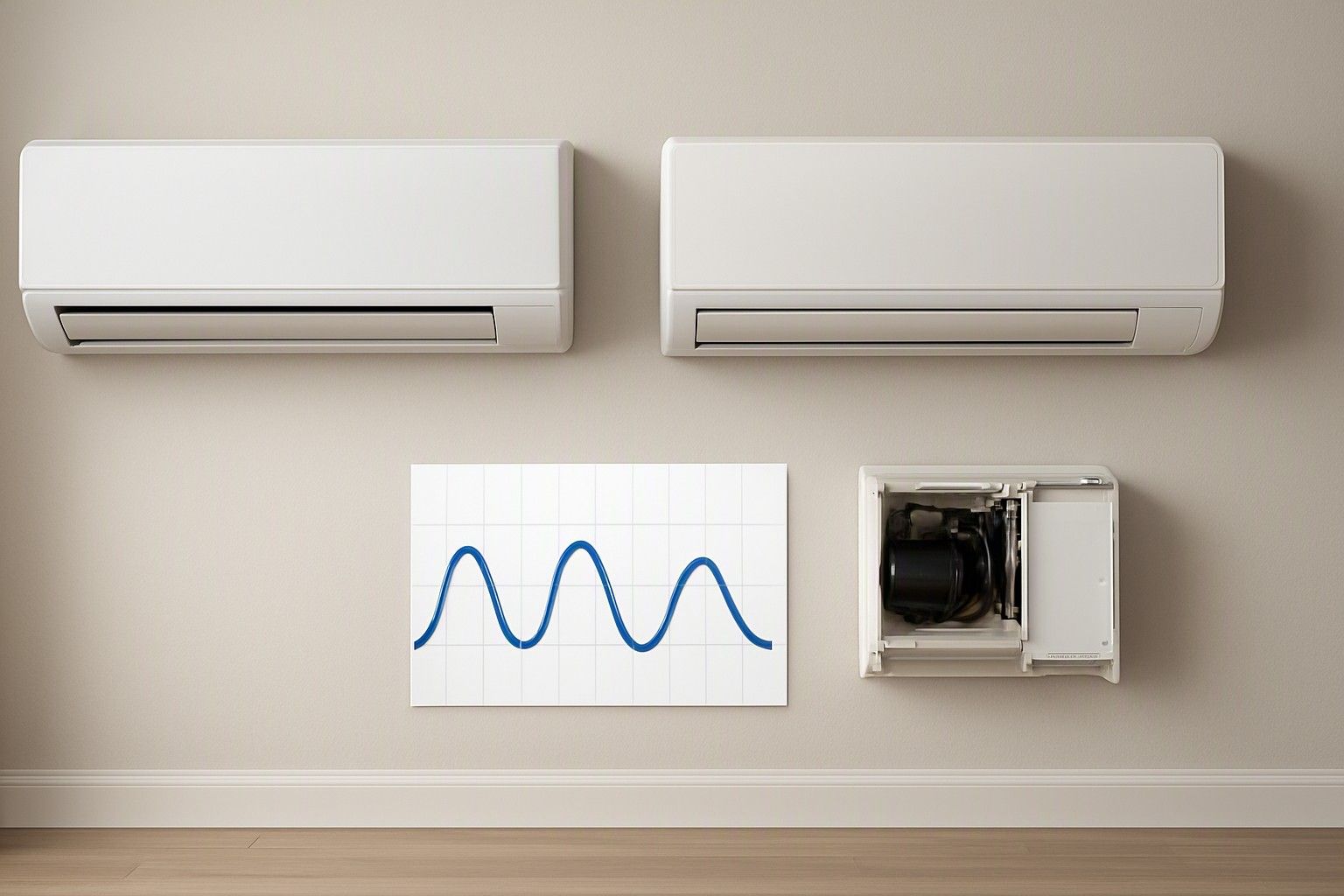
If your AC runs for most of the day through an Indian summer, an inverter model almost always earns back its extra cost. If it runs only a couple of hours a night, the gap is much narrower and the answer depends on your voltage, your budget and your repair risk. This article walks through each of those factors so you can decide today which compressor type suits your usage.
Variable-Speed Compressors vs On-Off Cycling
A non-inverter (fixed-speed) AC has a compressor that runs at one speed only. When the room reaches the set temperature, the compressor switches off completely. When the room warms by a degree or so, it switches back on at full power. That repeated start-stop cycle means every restart draws a surge of current, and the room temperature swings slightly above and below your setting.
An inverter AC changes the compressor's speed instead of switching it off. It runs fast to pull the temperature down, then slows to a low, steady speed to hold it. The compressor rarely stops, so there are fewer high-power restarts, the room stays closer to the set temperature, and the unit usually runs more quietly once the room is cool.
The saving comes from that holding phase. A fixed-speed unit spends its power in repeated full-load bursts, while an inverter spends it in a low, continuous trickle. The longer the AC stays in holding mode, the more the inverter gains. That is why usage hours matter more to this decision than any feature on the spec sheet, and it is what the next section works through.
Daily Usage Hours and the Payback on an Inverter Model
Think of the decision as extra upfront cost against savings that grow with every hour of running. Across this category, prices run from ₹21,990 to ₹89,990, with an average of ₹34,990, and a variable-speed model generally sits higher within the same tonnage than a fixed-speed one. The premium is a one-time payment. The saving is paid back on every electricity bill.
At light use, say a couple of hours at night for a few months a year, the saving per month is small, and the premium can take many seasons to recover. At moderate use of five to six hours a day, the payback shortens noticeably. At heavy use, such as a home office, a shop, or a bedroom in a hot-climate city where the AC runs eight hours or more for much of the year, the inverter is the clear choice because the compressor spends most of its time in the efficient holding phase.
Star label and compressor type work together, so check both. If you want to see how a rating changes what you pay, you can translate star labels into rupees per month and then compare that against the premium. If you are shopping in the ₹25,000 bracket and use the AC lightly, a fixed-speed unit is still a defensible choice. In the ₹35,000 and ₹55,000 brackets, inverter models are the more sensible default for most households.
Convertible Modes and Dual-Inverter Claims: What They Really Change
Many inverter ACs now offer a convertible mode, which lets you set the cooling capacity to a fraction of the rated tonnage. The idea is that a 1.5-ton unit can run as, say, a smaller-capacity AC when only one person is in the room or the weather is mild. What it really changes is how hard the compressor is allowed to work. A lower setting caps the maximum speed, which reduces power draw and cooling output together.
This helps in a specific case: you bought a size that suits peak summer, but for months you use it in a lightly occupied room. It does not turn a badly sized AC into a right-sized one. If a room needs more tonnage on its hottest afternoons, running a convertible unit at a lower setting will simply cool slowly.
"Dual inverter" is largely a marketing label. It generally points to variable-speed control of the compressor and, in some designs, the fan motor too, aimed at smoother operation and wider capacity range. Treat it as a feature to verify, not a guarantee. Ask what exactly is variable, and look at the rated efficiency figures on the label rather than the badge. A plain inverter with a good efficiency rating is a better buy than a dual-inverter claim with weaker numbers.
Inverter ACs, Low Voltage and Home Power Backup
Voltage trouble is a real part of Indian homes, and inverter ACs react to it differently from fixed-speed ones. Many inverter units are designed to operate across a wider voltage band, and because they ramp up gently instead of slamming the compressor on at full load, they handle fluctuating supply better than an on-off unit. But the electronics are also more sensitive to sharp spikes and surges, which is where a damaged control board often begins.
If your area sees frequent dips or surges, check the unit's stated operating voltage range before buying, and ask whether a separate stabilizer is recommended or already built in. Do not assume that an inverter AC removes the need for protection. In areas with unstable supply, many buyers add a stabilizer or a surge-protective arrangement to protect the board.
Power backup is a separate question. An AC draws a heavy load at startup and under high demand, and a home inverter battery is usually sized for lights and fans, not cooling. Before you plan around it, read through whether a stabilizer or home inverter can handle the load for your tonnage and local conditions. Do this check before purchase, not after the AC is installed.
Repair Costs: PCB Failures and Spare Parts
The common worry about inverter ACs is repair cost, and it is a fair one. An inverter model has more electronics: a main control board, an outdoor unit board that drives the compressor, and sensors. When the outdoor board fails, often after a power surge, the replacement can be one of the costlier repairs on the unit. A fixed-speed AC has simpler electronics, so its typical failures, such as a capacitor or relay, tend to be cheaper to fix.
This does not mean inverter ACs are unreliable. Many run for years without a board problem, especially with decent voltage protection at home. It means the repair risk is real and worth planning for, not ignoring.
Three practical steps reduce the exposure. First, check the warranty terms for the PCB and the compressor separately, since they are often covered for different periods. Second, ask about the cost and availability of spare boards and whether service centres in your city stock them. Third, consider an extended warranty if you live where surges are common. Weigh the likelihood of a board repair against the electricity you save each month. For heavy users, the saving usually outweighs the risk. For light users, the simpler fixed-speed unit has a real argument.
Where Compressor Type Fits in the Bigger Decision
Compressor type is a major cost decision, but it is only one of several that shape how an AC performs in your home. A correctly sized unit of the wrong compressor type will still cool better than an inverter that is too small for the room. A good inverter with a poor installation, such as long pipe runs, a badly placed outdoor unit or weak support, will lose a lot of the efficiency you paid for.
A sensible order is to settle the room's tonnage first, then decide on the compressor using your daily hours, then check the star rating and voltage conditions. If you use the AC many hours a day, go for an inverter. If you use it only occasionally and your budget is tight, a fixed-speed model can still make sense, and the savings can go toward a stabilizer or an extended warranty.
To see how compressor type stacks up against tonnage and installation in an AC purchase, the buying guide puts all these factors in one place so you can finalise the shortlist without having to revisit each decision separately.
The extra cost of an inverter AC pays off when you run the AC for long hours, and the savings grow with every additional hour. For short, occasional use, a fixed-speed unit is still a reasonable and lower-risk purchase. Match the compressor to your actual hours, check your voltage conditions and warranty terms, and you can choose confidently at today's prices.

Comments
Be the first to comment.