Battery Life and IP Ratings: Choosing a Speaker for Power Cuts, Monsoon and Road Trips
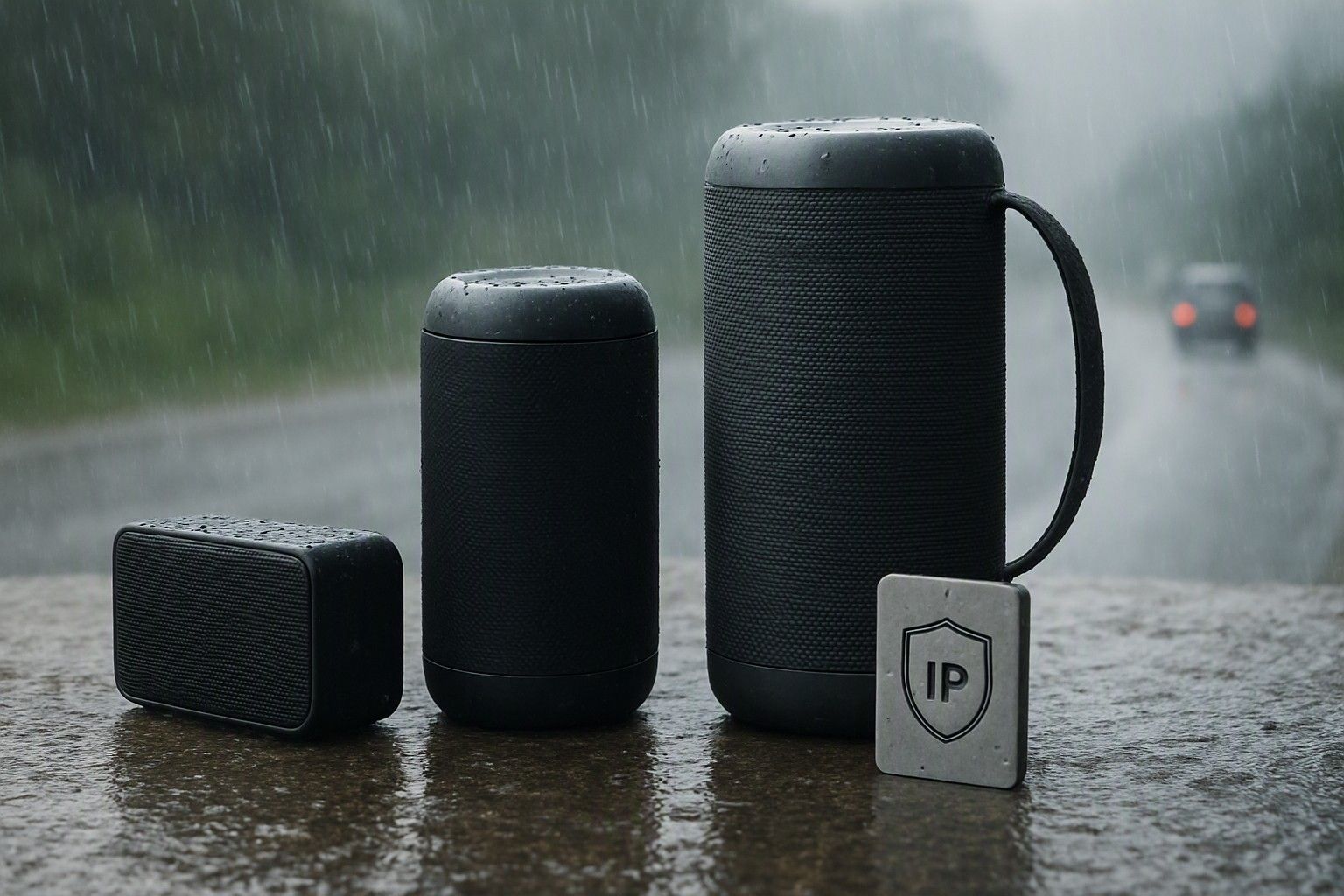
If you want a Bluetooth speaker that keeps playing through an evening power cut, survives a monsoon balcony or rides along on a road trip, two specs matter more than most: real battery runtime and the IP rating. This guide explains how to read both for Indian conditions, so you can decide how much of each you actually need. It is for buyers who already know roughly what they want to play and now need to compare speakers on stamina and water protection.
Rated vs Real Battery Life at High Volume
The hours printed on the box are almost always measured at a moderate volume, often around half, with no lighting effects and a steady, undemanding track. Turn the volume up for a gathering, add bass-heavy music and switch on the LED show, and the same bluetooth speaker of any brand can run for noticeably fewer hours. A sensible rule is to expect roughly half to two-thirds of the claimed figure when you are playing loudly.
Three things explain the gap. Amplifiers draw far more current as volume rises, so the last quarter of the volume dial costs much more battery than the first half. Bass is power-hungry, because moving a large driver or passive radiator takes real energy. And lights, microphone features and party-link modes all take a share of the same cell.
A bigger mAh number helps, but it is not a clean comparison across speakers, because efficiency and voltage differ. Read the claim as an upper limit and ask what volume it was measured at. If the listing does not say, assume the figure is a best case. For a speaker you plan to run loud, work out the hours you need first, then add a generous margin.
Using a Speaker Through Power Cuts and Load-Shedding
Backup during an outage is a different need from outdoor stamina. Here the speaker is usually indoors, played at moderate volume for two to four hours, and you want it ready the moment the lights go out. That makes a speaker with a comfortable runtime at medium volume more useful than one with a headline figure it only reaches at a whisper.
A few habits make a big difference:
- Charge the speaker whenever the power is on, rather than waiting for it to run flat. A speaker that is always near full is ready for an unplanned cut.
- Prefer a model that can play while it charges, so a short return of supply tops it up without interrupting the music.
- Remember that a Bluetooth connection also drains your phone. In a long cut you may run out of phone battery before the speaker, so a wired input or a USB or memory-card playback option is a useful fallback.
- If your area has long evening cuts, treat a speaker with a bigger battery as basic equipment, much like an emergency lamp.
Plan for the longest cut you usually face, not the average one.
Charging: Type-C, Fast Charging and Power-Bank Mode
Charging details decide how painful the battery is to live with. A Type-C port is the one to look for. You can charge it from the same cable as most current phones, it is reversible, and replacements are easy to find. Older micro-USB ports are fiddlier and tend to loosen with use.
Fast charging matters most when your power supply is unreliable. If the electricity returns for only an hour, a speaker that gains several hours of playback in that window is far more useful than one that needs a full night. Check the listing for a stated charge time and for whether a charger is included, since many speakers ship with only a cable.
Power-bank mode, where the speaker can charge your phone through a USB-A port, sounds ideal for outages and trips, but keep expectations modest. The output is usually slow, and every bit of charge it gives your phone comes out of the speaker's own runtime. Treat it as an emergency top-up that gets you through a bad evening, not as a replacement for a real power bank.
IP Ratings Decoded: IPX4, IPX5, IPX7 and IP67
An IP rating has two digits. The first covers solid particles such as dust and sand, and the second covers water. When the first digit is an X, as in IPX4, dust protection was simply not rated. When it is a number, as in IP67, dust was tested as well.
- IPX4: protects against splashes from any direction. It handles light rain, sweat and a drink spilled nearby, but is not meant for sustained spray.
- IPX5: protects against jets of water, so it copes with a rinse under a tap or a heavy shower of rain.
- IPX7: survives immersion in shallow water, up to about a metre for around thirty minutes. An accidental drop in a bucket or pool edge is covered.
- IP67: the same water protection as IPX7, plus a dust-tight seal. This is the one to look for if sand, construction dust or dry roads are part of your life.
Two cautions apply. These tests use fresh water, so salt water and chlorinated pool water can still harm seals over time, and a rinse afterwards is wise. And the charging port cover must be closed firmly, because a gap there defeats the rating.
Monsoon, Beach Trips and Bike Rides
Match the rating to how wet and how rough your use really is. For a balcony, kitchen shelf or a monsoon-season terrace where rain might blow in, IPX4 is usually enough, and IPX5 gives extra comfort for a speaker that stays outside. Humidity itself is a quieter risk: a sealed design copes with damp air better than an open one, and the port cover should always be shut.
Beach trips are tougher. Sand gets into every gap, and sea spray adds salt. Here IP67 is the safer target, and a rinse with fresh water afterwards, followed by a proper dry, will protect the seals. Keep the speaker off wet sand and out of direct midday sun.
Bike rides add vibration and splashes on top of the weather. Look for a rating of at least IPX5, a secure mount or strap, and a body that feels solid. A speaker that merely sits in a bag does not need the same toughness as one fixed to handlebars, so be honest about where yours will actually spend its time.
Battery Ageing in Indian Summer Heat
Lithium batteries lose capacity with every charge cycle, and heat speeds that up. Indian summers are hard on them. A speaker left on a car dashboard, in a parked vehicle or in direct sun on a terrace can be exposed to temperatures well above what the cell likes, and that wear does not reverse.
Simple habits slow it down. Keep the speaker in shade, avoid charging it in a hot car, and do not leave it sitting at a full charge in a warm room for weeks. Let it cool before plugging it in after a long, loud session. If you will not use it for a while, store it partly charged rather than empty or full.
Expect a noticeable drop in runtime after a couple of years of regular use, even with care. That makes it worth reading what the warranty usually says about battery wear, since batteries are often treated as wear items and may be covered differently from the rest of the speaker.
Weighing Battery Against Loudness
Battery life and loudness pull in opposite directions. A speaker that can fill a hall needs a stronger amplifier and larger drivers, and those drain the cell much faster when pushed. A compact speaker may last far longer on a charge, but it reaches its limit sooner and distorts if you try to make it louder than it was built to be.
So start with where you will use it. For one room, a desk or a small group, a compact speaker with a long, honest runtime is usually the better trade. For open-air gatherings or large rooms, you accept shorter hours at full volume in exchange for output that carries. Bigger models do carry larger batteries, but rarely enough to cancel out the extra power they draw at high volume.
If you are unsure how much output you need, how wattage and room size shape that trade-off is worth reading before you settle on a size. Buying more loudness than the space needs only costs you battery and portability.
Fitting Battery and Waterproofing Into Your Shortlist
Treat battery and water protection as filters, not as the whole decision. First, write down your longest likely stretch of use and the wettest place the speaker will go. For a power-cut speaker that stays at home, prioritise a sensible runtime at medium volume, Type-C charging and the ability to play while plugged in. For a monsoon or beach speaker, set your minimum IP rating first, then check the battery. For road trips, look for both a solid rating and a battery that holds up at the volume you really use.
Prices on this platform run from ₹699 to ₹29,999, with an average of ₹4,499. In the ₹1,500 bracket, expect basic splash resistance and modest battery. The ₹4,000 bracket is where stronger ratings and longer runtimes become common, and the ₹10,000 bracket adds bigger batteries and sturdier builds. Choose the tier that meets your minimum battery and IP needs today rather than stretching for features you will not use.
Once battery and waterproofing have narrowed the field, you can move on to rounding off your shortlist with sound, input and pricing checks.
For most Indian buyers, the answer comes down to a few clear numbers. Aim for a runtime that still covers your longest cut or outing once you halve the claimed hours, choose Type-C charging, and pick IPX4 or IPX5 for rain and IP67 for sand and sea. Decide those first, protect the battery from heat, and the rest of the shortlist gets much easier.
Comments
Be the first to comment.