Choosing a Speaker for Pujas, Sangeets and Terrace Parties
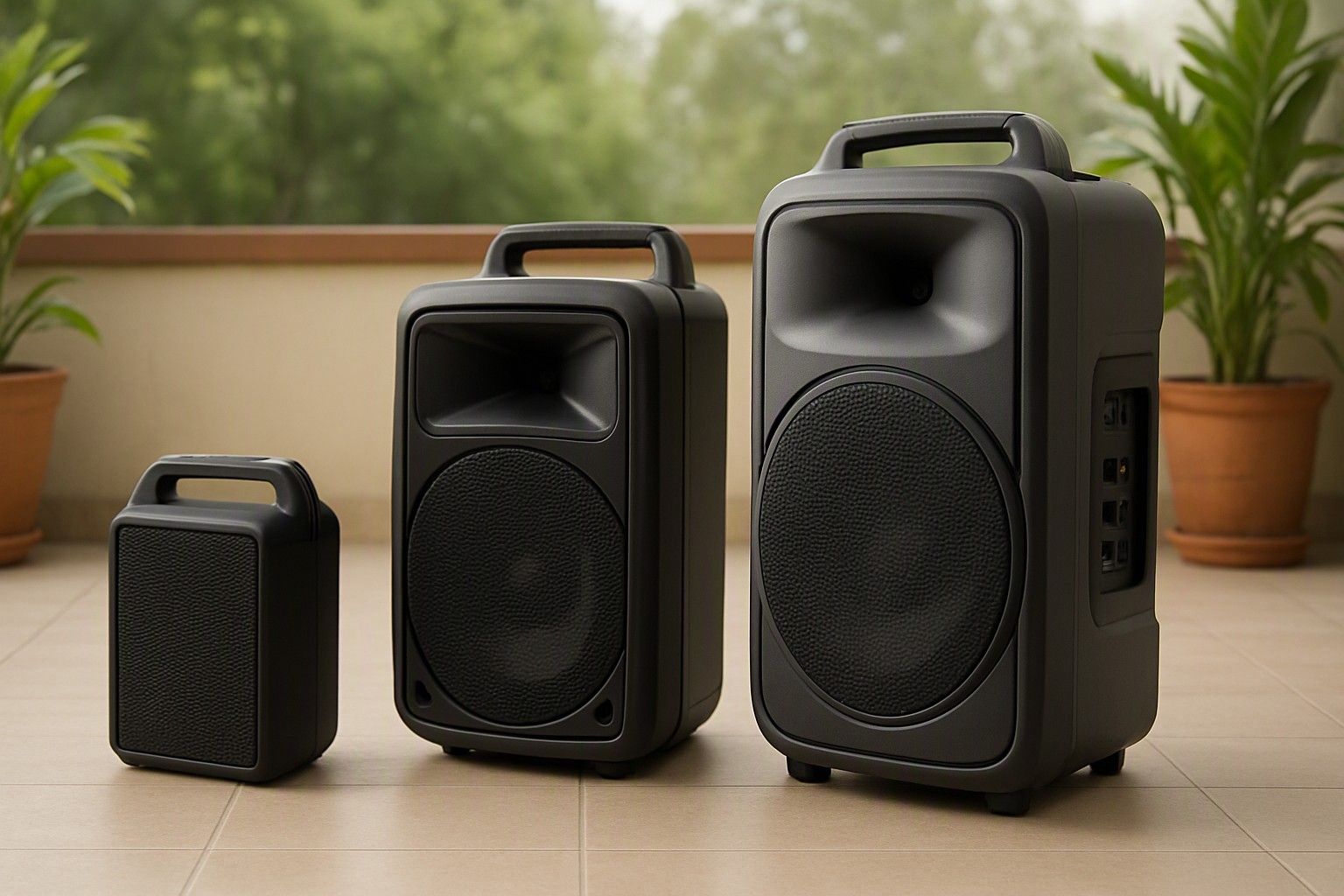
If you host pujas, sangeets, Diwali gatherings or terrace parties with 30 to 50 guests, a pocket-size Bluetooth speaker will not be enough, and this article is for you. A good portable bluetooth speaker for these occasions has to be loud, take a microphone, survive a power cut and be carried up a flight of stairs. Below, we go through each of those requirements so you can narrow the choice with confidence.
How Many People and How Much Space
Start with where the guests will actually stand. Thirty people in a closed living room is a very different job from thirty people on an open terrace. Walls bounce sound back at you indoors, while open air swallows it, so a speaker that feels loud in a drawing room can sound thin once you carry it outside.
As a rough guide, travel-size and pocket-size speakers are built for one to five people sitting close by. For a crowd of 30 to 50 you are looking at a large portable party speaker or a floor-standing unit with bigger drivers and a proper bass section. The number to look for is the continuous (RMS) rated output, not the "peak" or "PMPO" figure printed in large letters on the box, which says little about real loudness.
Plan for the harder of your two venues. If the same speaker has to cover a hall and a rooftop, size it for the rooftop. You can always turn it down indoors, but you cannot turn up a speaker that has run out of headroom. For a fuller breakdown of how rated output maps to space, see the wattage figures for halls and rooftops.
Placement also matters. Raise the speaker on a stand or table, aim it toward the guests and keep it away from corners that boom. A well-placed mid-range speaker often beats a bigger one left on the floor.
Wired Mic, Wireless Mic and Karaoke Modes
The mic is what separates a party speaker from a music speaker. At a puja it carries the aarti, the bhajans and the announcements. At a sangeet it carries the emcee, the family performances and the antakshari rounds. If the speaker has no mic input, you are stuck playing recorded tracks only.
Wired mic input. This is the simplest and most dependable option. There is no pairing, no interference and no mic battery to die halfway through a speech. Check which jack the speaker uses, because some take a larger quarter-inch plug and some a smaller one, and make sure the mic you plan to use fits without an adapter. The drawback is the cable, which limits how far a performer can move.
Wireless mic. Many party speakers ship with one or two wireless mics. They are better for dancing and walking around, but they need charged or fresh batteries and can pick up interference in crowded areas. Confirm what is actually in the box, since some listings mention wireless support without including the mic.
Karaoke modes. Useful controls include a separate mic volume knob, echo or reverb adjustment, and a mode that lowers the music when someone speaks. Without a separate mic volume, you end up fighting between a drowned-out voice and blasting music. For family singing nights, these controls matter more than extra bass.
Running on Battery vs Mains Power
Indian gatherings run into two power problems: cuts in the middle of the evening, and terraces or lawns with no socket nearby. A speaker that works both on its battery and on mains power covers both.
Battery mode gives you freedom. You can place the speaker where the guests are, not where the plug is, and a power cut does not stop the aarti. But claimed battery life is usually measured at moderate volume. Party volume with a mic in use drains it faster, so treat the claimed figure as a best case. Charge the speaker fully the night before, and plan for it to last a good part of the evening rather than all night.
Mains power is the safer choice for long events. If the speaker can play while plugged in, run it that way and treat the battery as backup. On a terrace, use a proper extension board kept off the floor, away from dew, drinks and the dance area.
If the event is outdoors or the weather is uncertain, check how the speaker is protected against water and dust. For details on runtime figures and power-cut backup, including how to read protection ratings, see our battery guide.
Weight, Wheels and Trolley Handles
A speaker that performs well on a spec sheet can still be a bad purchase if two people struggle to get it to the terrace. Party speakers are heavy, and Indian venues often add obstacles: narrow staircases, no lift, society clubhouses on the first floor and uneven lawns or rooftop surfaces.
Look at the listed weight and think about who will carry it. A speaker you can lift one-handed is easy to move but usually limited in loudness. A floor-standing unit with large drivers can be a two-person job, and that is where a trolley handle and wheels earn their place. Wheels roll well on smooth floors but are tiring to haul up stairs, so consider whether your venue has steps.
Carry handles are also worth checking. A single top handle on a heavy speaker puts strain on the wrist, while side handles let two people share the load. Check the build around the handle and the wheels too, as these are the parts that take stress during repeated transport.
Finally, count the extras. A mic, a stand, cables and an extension board add up. A speaker with a built-in storage space for the mic or a sturdy cover makes the whole kit easier to move and set up.
Neighbours, Housing Societies and Late-Night Volume Limits
The loudest speaker is not always the best fit for a flat or society. Loudspeakers and public address systems are regulated in India, and the general rule under noise pollution norms is that they are not permitted at night, roughly from 10 pm to 6 am, with limited relaxations for festivals that vary by state and city. Residential zones also have lower permitted noise levels than commercial ones. Check your local rules, and your society bylaws, before the function.
A few practical habits keep the evening trouble-free:
- Talk to neighbours and the society office early. A heads-up about timing usually avoids complaints, and some societies require permission for the clubhouse or terrace.
- Aim the speaker inward. Point it toward the guests and away from nearby windows. Bass travels through walls and floors much farther than vocals do.
- Prefer a speaker with clean sound at medium volume. Good drivers can fill a room without needing to run flat out, which is kinder to neighbours and to the speaker.
- Keep the mic level modest. Mics are the main source of late-night complaints, since voices and singing carry.
When the cut-off time arrives, switch to quieter background music and move the party indoors. A speaker with easy volume and bass control makes that shift simple.
Buying a Party Speaker vs Renting a DJ Setup
Renting a DJ setup brings powerful sound, an operator who handles the equipment and a bigger system than most households would buy. For a large wedding sangeet with well over 100 guests, a rented setup is often the more sensible choice, since a consumer speaker will struggle to fill that space.
Buying makes sense when you host regularly: Ganesh Chaturthi, Navratri, Diwali, housewarmings, birthdays, society events and the occasional terrace get-together. Rental charges recur every time, while a speaker you own is ready on short notice, works for smaller occasions and can be used for everyday listening too. You also skip the coordination with a vendor and the risk of a no-show.
On price, the category runs from ₹699 to ₹29,999, with an average of ₹4,499. Speakers that are realistic for a 30 to 50 person gathering generally sit in the ₹4,000 and ₹10,000 tiers, where you start to see mic inputs, larger drivers and more useful battery capacity. The ₹1,500 tier mostly serves personal and small-group listening.
A workable split for many families is to own a capable speaker for the regular functions and rent only for the one or two big events a year that truly need a full system.
Before You Pick a Speaker for the Next Function
Run through this short checklist before you decide:
- Space: Is the rated output enough for your harder venue, usually the terrace?
- Mic: Does it have the input type you need, and does the box include the mic?
- Controls: Is there a separate mic volume and echo control?
- Power: Does it work on battery and mains, and can it play while plugged in?
- Carrying: Can you and one helper lift it up your stairs, and are there handles or wheels?
- Neighbours: Can it sound good at moderate volume, and do you know your society's rules?
Party features are only part of the picture, because the speaker will also sit in your home between functions. Sound quality at low volume, Bluetooth stability, build and warranty all count. Our everyday factors that matter beyond the party features covers those, and it is worth reading before you finalise. If the checklist above is mostly ticked, you can decide now rather than hold off, because the features that suit your events do not change from one season to the next.
For a puja, sangeet or terrace party with 30 to 50 guests, you now know what to look for: output sized for your toughest venue, a proper mic input with its own volume control, battery plus mains power, a weight your family can carry, and a sound level your neighbours can live with. Match those to your usual events, rent only for the occasional large one, and you can choose a party speaker with confidence.
Comments
Be the first to comment.