Portable vs Party vs Smart Speaker: Which Bluetooth Speaker Type Fits Your Home?
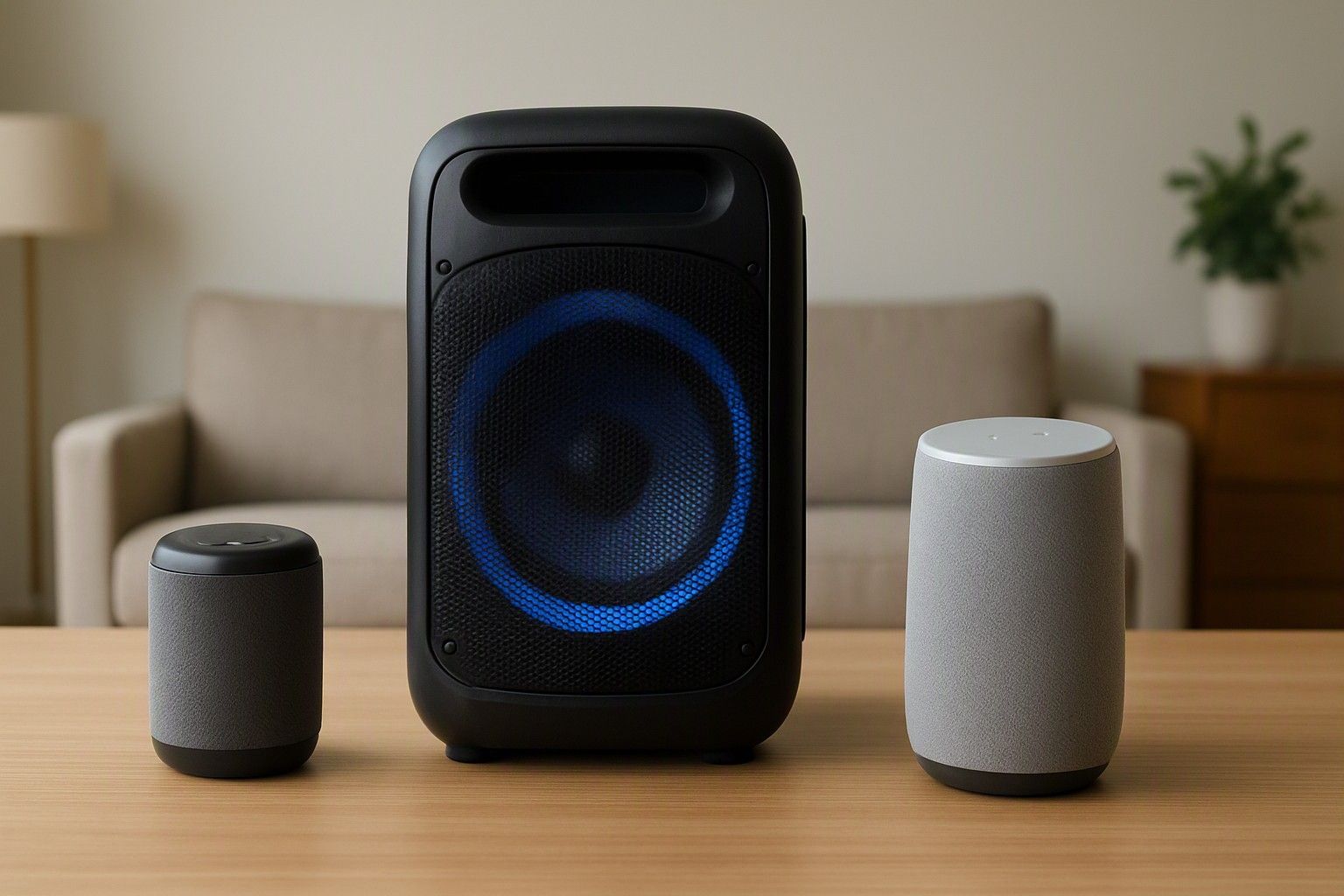
If you are stuck between a small pocket speaker, a large trolley-style party speaker and a voice-enabled smart speaker, this article settles that choice first. The format decides almost everything else: how loud it gets, where you can use it, how it is powered and what you pay. Read on to match the type to your home and the way you listen, before you start comparing individual specs.
What Separates a Portable, Party and Smart Speaker
Three things separate these formats: how the speaker is powered and carried, how much room it is built to fill, and how much intelligence it carries.
A portable speaker is built around its battery and its size. It fits in a bag or hand, pairs with your phone over Bluetooth and goes wherever you do. A party speaker is built around volume and inputs. It is large, often on wheels, and usually adds a microphone input, bass controls and lighting, so a hall or a terrace crowd can hear it. A smart speaker is built around the home network. It connects over Wi-Fi, listens for a voice assistant wake word and usually stays plugged in on a shelf or table.
These are different tools, not three sizes of the same product. A pocket speaker will not carry a sangeet, a party speaker is awkward on a train trip, and a smart speaker will not follow you to the park.
Prices across the category run from ₹699 to ₹29,999, with an average of ₹4,499. Your format choice largely decides where in that range you land, so settle it before you look at budgets for bluetooth speaker.
Portable Speakers: Pocket and Bag-Sized Options for Travel
Portable speakers are the easiest format to justify. They are small and light enough to carry in a backpack, hang off a bag strap or leave on a bedside table. You can use one on a trip, at a picnic, in the bathroom or for a few songs while cooking.
The trade-off is output. A compact driver can fill a bedroom or a small seating area, but it will sound thin and strained in a large hall or in the open. Bass is the usual compromise, since small enclosures cannot move much air. Most of these speakers are also mono, so you get one source of sound rather than a wide stereo spread.
What you gain is independence from a socket. Because they run on a built-in battery, the useful question is how long these compact units last away from a plug, along with how well they handle splashes and dust if you take them outdoors.
On price, the ₹1,500 tier is where most buyers start with this format, and ₹4,000 is where you generally find better build and sound. Choose a portable speaker if you move around a lot, live in a small space or want a personal speaker rather than a room-filler.
Party Speakers: Trolley Units, Mic Inputs and RGB Lights
Party speakers solve a problem a portable cannot: making music audible over a crowd. They are large and heavy, and many come with wheels and a pull handle, which is why they are called trolley units. Their size lets them hold bigger drivers and larger amplifiers, so they can handle open halls, terraces and courtyards.
The features reflect how Indian gatherings actually run. A microphone input lets someone make announcements or sing karaoke. Guitar or auxiliary inputs and USB or card playback let you run music without a phone. Bass and echo controls are common, and RGB lighting adds atmosphere for evening events. Some units are rated for long sessions on battery, but plan for a power point at big events.
The downsides are real. They are bulky, they take up storage space, and they are overkill for a small flat. Loud bass can also strain neighbours and society rules, which matters in apartment complexes.
If you host regularly or have a large family function in mind, read about setting one up for a Ganpati or sangeet crowd. Party speakers sit toward the upper part of the price range, closer to ₹10,000 and beyond, though simpler units can cost less.
Smart Speakers: Wi-Fi, Voice Assistants and Hindi Commands
A smart speaker works differently from the other two. It connects to your home Wi-Fi and streams music directly from online services, so your phone does not need to stay paired or nearby. You start a song, set a timer, ask for the news or control compatible smart devices with a spoken command.
For many Indian households, language support decides whether it gets used. Check that the assistant understands Hindi, and ideally the regional language your family speaks, instead of assuming it will. Test how it copes with mixed Hindi and English sentences, since that is how most people talk.
The limits are practical. Most smart speakers need mains power, so they are not meant for travel or the terrace. Everything depends on a working internet connection, and a patchy broadband line makes them frustrating. They also tend to be designed for convenience rather than raw volume, so a smart speaker will usually be quieter than a party unit.
They suit a living room, kitchen or bedroom where you want hands-free control and a steady source of music. Expect them mostly in the ₹4,000 and ₹10,000 tiers, and check what is included before paying for features you will not use.
Which Type Suits a 1BHK, a Family Hall or a Terrace
Start with the space you listen in most, then check it against how often you travel or host.
A 1BHK or small flat. A portable speaker is usually enough. It fills one or two rooms, moves between the bedroom and the kitchen and can go with you on weekends. If you want voice control and a fixed spot in the living room, a smart speaker is a reasonable alternative. A party speaker is hard to justify here, both for the space it takes and for the noise it makes close to neighbours.
A family hall or larger living room. A smart speaker fits well if the family wants hands-free playback every day. For festivals and family functions, a party speaker gives the extra volume a crowded hall needs. Many households keep a smart speaker for daily use and borrow or buy a party unit only for occasions.
A terrace or open area. Open space swallows sound, so output matters most. A party speaker is the realistic option for gatherings, while a portable one only works for a few people sitting close. Smart speakers are a poor fit because they need a plug and Wi-Fi.
If you travel often, a portable speaker goes with you whichever of these homes you live in.
Narrowing Down Once You Know the Type
With the format chosen, the decision shrinks considerably. Buyers of portable speakers should focus on battery life and durability, party-speaker buyers on inputs, power source and portability, and smart-speaker buyers on language support and network reliability.
On budget, use the price landscape as a guide rather than a reason to hesitate. The category runs from ₹699 to ₹29,999, with an average of ₹4,499, and the ₹1,500, ₹4,000 and ₹10,000 tiers each buy different things. Pick the tier that fits the format you need and decide with confidence today.
The pillar guide covers the other checks that matter once you have settled on a speaker format, including sound quality, connectivity and build.
Your question comes down to where and how you will use the speaker. A portable speaker suits travel and small spaces, a party speaker suits crowds and open areas, and a smart speaker suits a home with reliable Wi-Fi where voice control is useful. Choose the format that matches your main use, then go through the remaining specs for that type.

Comments
Be the first to comment.