Dome vs Bullet vs PTZ CCTV Cameras Explained
If you're standing in a shop or scrolling a site trying to decide between a dome, a bullet and a PTZ camera, the honest answer is that they're built for different jobs, not different budgets. This article walks through how each one actually works and where it fits in a typical Indian home, so you stop guessing and start matching camera shape to the spot you're trying to cover.
Dome, Bullet and PTZ: How Each Camera Type Works
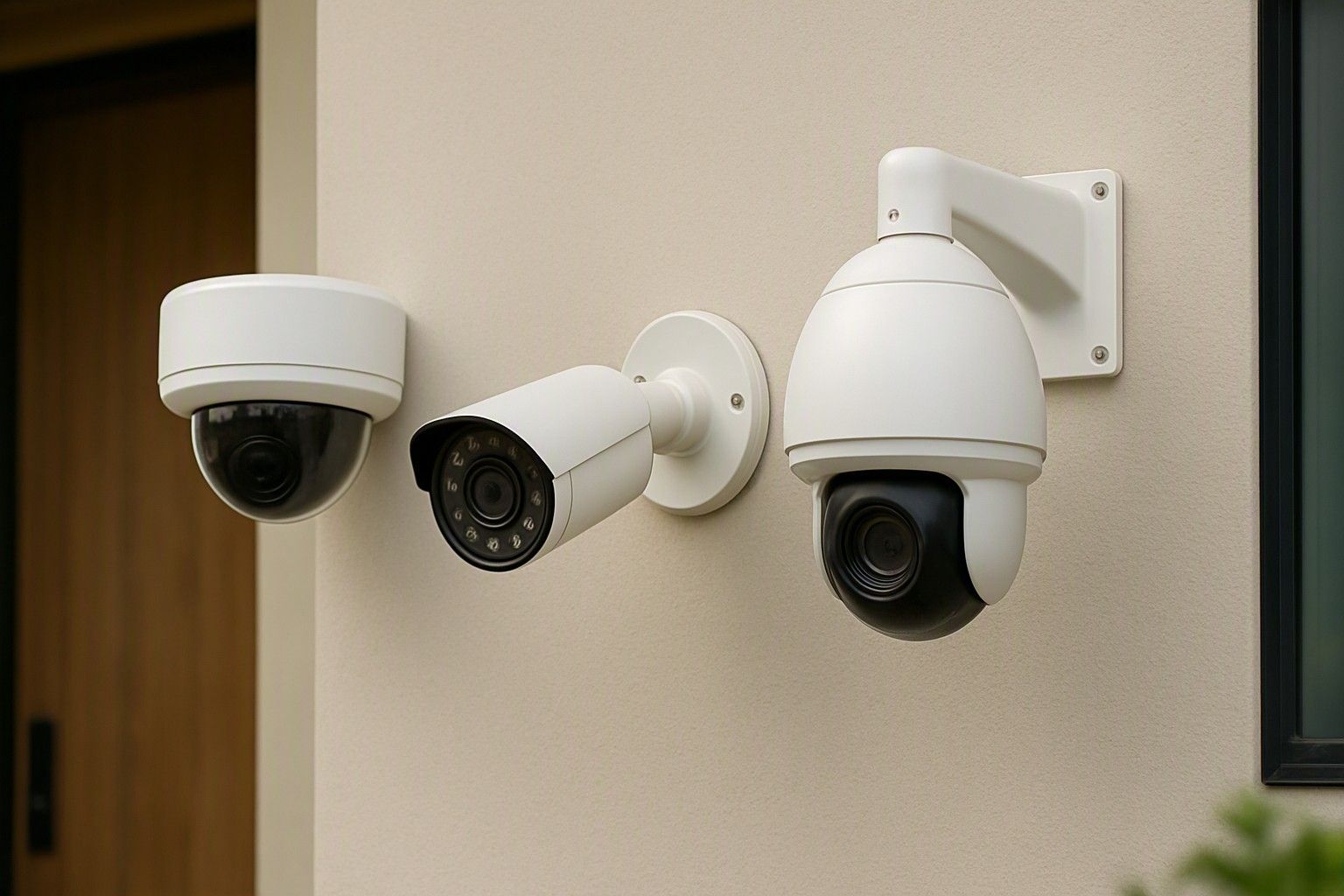
A dome camera is the small, rounded, ceiling-mounted unit you see in shops and lobbies. Its compact housing hides the lens direction, which makes it harder for someone to tell exactly where it's pointed, and its low profile means it doesn't announce itself the way a larger camera does. Domes are almost always meant for indoor or covered ceiling placement, and their fixed lens covers a wide arc from one mounting point rather than a long, narrow throw.
A bullet camera is the cylindrical, torch-shaped unit you'll usually see fixed to an outer wall, pointed down a driveway or across a boundary wall. Its shape is built to project a visible, directional presence — the camera is obviously watching one direction, which itself acts as a deterrent to anyone casing the property. Because the lens sits at the tip of a longer body, bullet cameras are easier to aim precisely down a lane, gate or corridor, and their housings are generally rated to handle outdoor exposure better out of the box.
A PTZ (pan-tilt-zoom) camera is a motorised unit that can rotate horizontally, tilt vertically and zoom in on a specific point, either on a schedule, on motion, or on manual control through an app. Instead of covering one fixed frame, a single PTZ can sweep across a large open area — a compound, a terrace, a parking stretch — and zoom in when something needs a closer look. This flexibility comes at a cost: PTZ units sit toward the higher end of the ₹800–₹18,000 range most home CCTV cameras fall into, well above the ₹3,000 that a standard dome or bullet camera costs.
Coverage Area, Viewing Angle and Deterrence Compared
Coverage is where the three types genuinely diverge, and it's the main reason you can't pick one shape and use it everywhere. A dome camera typically offers a wide, fixed viewing angle from a single ceiling point, which suits enclosed spaces like a living room, hallway or shop floor where you want to see everyone moving through a defined area rather than track something far away. A bullet camera trades that wide fixed spread for a longer, narrower throw — it's built to see clearly down a specific line, like a gate approach or a side lane, rather than an entire room. A PTZ camera covers the most ground overall because it isn't fixed at all; its motorised sweep can substitute for two or three static cameras in a large open compound, though it can only look at one part of that sweep at any given instant unless paired with recording that captures the full patrol.
Deterrence works differently across the three as well. A bullet camera's visible, directional body is the most obviously intimidating to a stranger at the gate, precisely because its aim is easy to read. A dome's hidden lens direction makes it less obviously threatening but also less clearly deterrent from a glance. A PTZ's visible movement — swivelling to track motion — often unsettles people more than a static camera of either shape, simply because it looks alert. None of this changes what the lens can actually resolve, though, and that depends on sensor and lens quality rather than body shape, which is covered in detail in how resolution and field of view change what each type captures.
Best Placements for Gates, Corridors and Living Rooms
Matching placement to camera type is really the core decision, and it comes down to the shape of the space rather than the price you're willing to pay. A main gate or compound entrance is a bullet camera's natural home — you want a long, aimed view of anyone approaching, and the visible housing works as a first-line warning before someone even reaches the door. A corridor or staircase landing inside a building usually suits a dome better, since the wide fixed angle from a ceiling mount captures anyone passing through without needing to track movement, and the low profile doesn't clutter a narrow indoor space.
A living room, especially in a layout with an open kitchen or dining area attached, is also dome territory — one ceiling-mounted dome with a wide field of view can usually cover the whole seating and entry zone from a single point. A large terrace, an open compound with multiple access points, or a stretch of parking that's hard to cover with one fixed angle is where a PTZ earns its higher price, letting one unit patrol what would otherwise need two or three static cameras. For a single side passage or a back door that just needs a narrow, focused view, a smaller bullet camera at the lower end of the ₹1,200 range often does the job without needing motorised features at all.
Matching Camera Type to Indian Home Layouts
Most Indian homes aren't single-entrance boxes — there's a main gate, sometimes a side gate for staff or deliveries, a stairwell if it's an independent house, a terrace, and an indoor living area that opens into a kitchen or hallway. This layout is exactly why the dome-vs-bullet-vs-PTZ question rarely has one answer for the whole house. A typical independent house does well with one or two bullet cameras at the gate and boundary wall, a dome at the main indoor entry point or stairwell, and skips PTZ entirely unless there's a large open terrace or compound to patrol.
Apartment owners usually need less: a dome just inside the main door covers the living area, and a compact bullet or dome combination handles the balcony or service entrance depending on how exposed it is to weather. That last point matters more than people expect, because a camera's shape doesn't automatically make it outdoor-ready — a bullet body handles rain and sun better by default, but not every dome does, and mounting the wrong build in an exposed spot shortens its working life fast. That's the deciding factor covered in why outdoor spots need weatherproof camera bodies, and it's worth checking before you finalise which shape goes where.
Choosing the Right Mix of Camera Types
Very few homes need only one camera type, and treating this as a single either-or choice usually means overspending on flexibility you don't need or under-covering a spot that needed a dedicated angle. A realistic setup for most independent houses mixes one or two bullet cameras for the gate and boundary, a dome for the main indoor entry or corridor, and reserves a PTZ only for a genuinely large open area that can't be covered by fixed angles alone. This kind of mix generally lands within the ₹3,500 to ₹8,000 range depending on how many points you're covering and whether you add a PTZ at all, and there's no reason to hold off buying because that range already reflects normal pricing rather than an inflated one — cameras in the ₹800 to ₹18,000 spread have held fairly steady, so waiting doesn't change the maths much.
Once you know which shape goes where, the remaining decisions — how many channels your recorder needs, whether you want app-based viewing, how much storage to budget for — sit outside this specific question. It's worth going back to tie your camera-type choices back to the full purchase plan so the shape decisions you've just made line up with the rest of the system you're building around them.
You now have a working answer to which camera shape suits which spot: bullet for aimed, outdoor throws like gates and boundaries, dome for wide indoor coverage in living rooms and corridors, and PTZ only where one motorised unit genuinely needs to replace several fixed ones. The right setup for most homes isn't one type used everywhere — it's a deliberate mix, chosen point by point rather than by habit.

Comments
Be the first to comment.