CGM or Finger-Prick Glucometer: Which One Does Your Diabetes Routine Actually Need?
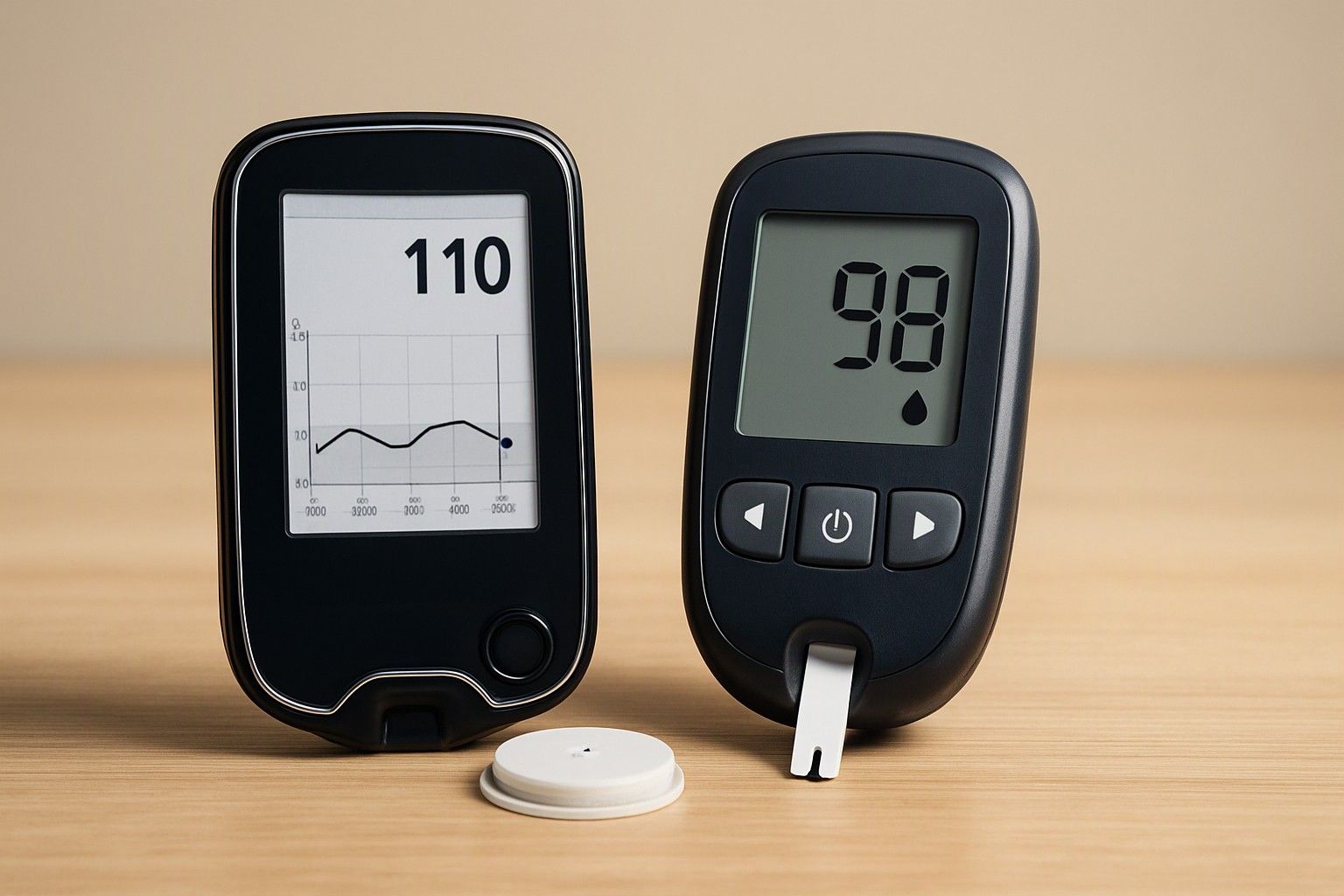
If you already check your sugar with a glucometer and it gives you numbers you can act on, you do not automatically need a CGM. A CGM earns its place when once or twice a day is not enough to explain what your sugar is doing, mainly if you use insulin, have lows you cannot predict, or have an HbA1c that does not match your readings. This article helps you work out which side of that line you are on.
Interstitial Fluid vs Blood: Why the Two Readings Never Match Exactly
A glucometer measures glucose in a drop of capillary blood from your fingertip. A CGM sensor sits just under the skin and measures glucose in the interstitial fluid, the thin layer of fluid around your cells. Glucose reaches that fluid from the blood with a delay, so the sensor value trails the fingertip value by several minutes.
Most of the time this gap is invisible, because sugar moves slowly. It shows up when glucose is changing fast: after a high-carb meal, during a brisk walk, or when a low is developing. At those moments a fingertip test and a sensor reading taken together can differ noticeably, and neither is "wrong".
So do not judge a CGM by whether it matches your glucometer to the decimal. Judge it by whether the trend arrow and the overall curve tell you something useful. Many sensor systems still ask you to confirm with a fingertip test when you feel unwell or the reading does not fit how you feel, so a glucometer stays in your kit even after you switch.
What 14 Days of Continuous Data Shows That Twice-Daily Pricks Miss
Two fingertip readings a day give you two points on a line that moves all day and all night. A sensor worn for 14 days fills in the rest, and the gaps it fills are often the ones that matter.
- Overnight patterns: a slow dip at 3 a.m. or a rise before waking is invisible to a fasting morning prick.
- Post-meal spikes: you can see how a plate of rice, a paratha or a mithai affects you, rather than guessing from one reading two hours later.
- Exercise effects: a morning walk may bring sugar down, while a hard workout can push it up first.
- Time in range: instead of a single number, you see how many hours a day you spend within your target.
This is also why one reading can mislead. A perfect fasting value can sit beside long afternoon highs that never get checked. Two weeks of continuous data turns "my sugar seems fine" into a pattern you and your doctor can actually adjust food, activity or medication around.
Who Gains the Most: Insulin Users, Frequent Lows and Unexplained HbA1c
Three groups get the clearest return from a CGM.
Insulin users. If you dose based on your current sugar, more frequent information means better dosing decisions, and a trend arrow shows whether you are rising or falling before you inject. If you are weighing whether a real-time alerting sensor suits insulin-dependent users, the deciding factor is usually how much you want alarms to catch a low without you having to look.
People with frequent or unpredictable lows. Lows at night or without warning symptoms are the hardest to catch with pricks. A sensor shows when they happen and how long they last, which helps your doctor adjust the regimen.
People with an HbA1c that does not match their readings. If your fingertip values look reasonable but HbA1c stays high, or the reverse, continuous data often reveals the hidden highs or lows behind the average.
If none of these describes you, the benefit is real but smaller, and the decision leans more on cost and personal preference. Discuss the choice with your doctor before buying.
When a Glucometer Alone Is Still Enough
A glucometer remains a sound choice for many people. If your diabetes is stable on diet and tablets, your HbA1c tracks your home readings, and you rarely have lows, a fasting reading plus an occasional post-meal check usually covers what your doctor needs.
It also suits you if you are newly diagnosed and still learning the basics. Pricing a few well-timed readings around meals teaches you a lot, and you can add a sensor later if questions remain.
A few practical reasons also favour sticking with strips. A sensor on your arm means a patch that can irritate skin, needs to survive bathing and sleep, and has to be replaced on schedule. Constant readings can also feel stressful for some people, who start reacting to every wiggle in the graph.
Finally, a glucometer is cheap to keep running and works anywhere without a phone or reader. If your routine is working and your doctor is happy with it, staying put is a perfectly reasonable decision, not a compromise.
Running Cost Gap Between Test Strips and Sensors
Strips look cheap because you pay per test, but the bill rises with how often you test. Someone pricking four to six times a day, as insulin users often do, spends steadily every month on strips and lancets. Someone testing once a day spends very little.
A CGM front-loads the cost differently. In this category, products are priced from ₹2,000 to ₹18,000, with an average price of CGM is around ₹4,500, and the tiers fall roughly into ₹3,000, ₹5,000 and ₹10,000. Those figures only become meaningful once you divide them across the days a sensor lasts, and that is the number to compare with your monthly strip spend. For that calculation, see how sensor spending compares with a month of test strips.
The fair comparison is not a sensor versus one strip but a sensor versus the number of strips you would use to get similar information. Heavy testers often find the gap narrower than expected. Light testers will find sensors clearly costlier, so ask whether the extra information is worth that difference for you.
Deciding Whether to Make the Switch
Run through four questions. Do you use insulin or a medicine that can cause lows? Do you have lows or highs you cannot explain? Does your HbA1c disagree with your home readings? Is your doctor asking for more data than pricks can supply? Two or more yeses make a CGM worth serious consideration now, rather than something to postpone.
If you answered no to all four, a glucometer is likely enough, and you can revisit the question if your treatment changes.
If you lean towards a sensor, the next step is choosing one, and that involves more than price: alerts, sensor life, app support, and how it fits your daily routine. The full checklist is in weighing a switch from strips to sensors against every other CGM factor. Keep your glucometer either way. It is the backup that confirms a reading when something feels off, and it costs little to hold on to.
So, do you need a CGM if you already use a glucometer? If you use insulin, have unexplained lows or highs, or your HbA1c does not match your readings, yes, it is likely worth a serious look. If your routine is stable and your readings line up with your lab results, your glucometer is still doing its job, and you can decide with the current prices in front of you rather than putting it off.

Comments
Be the first to comment.