Using a CGM for Prediabetes and Diet Tracking With Indian Meals
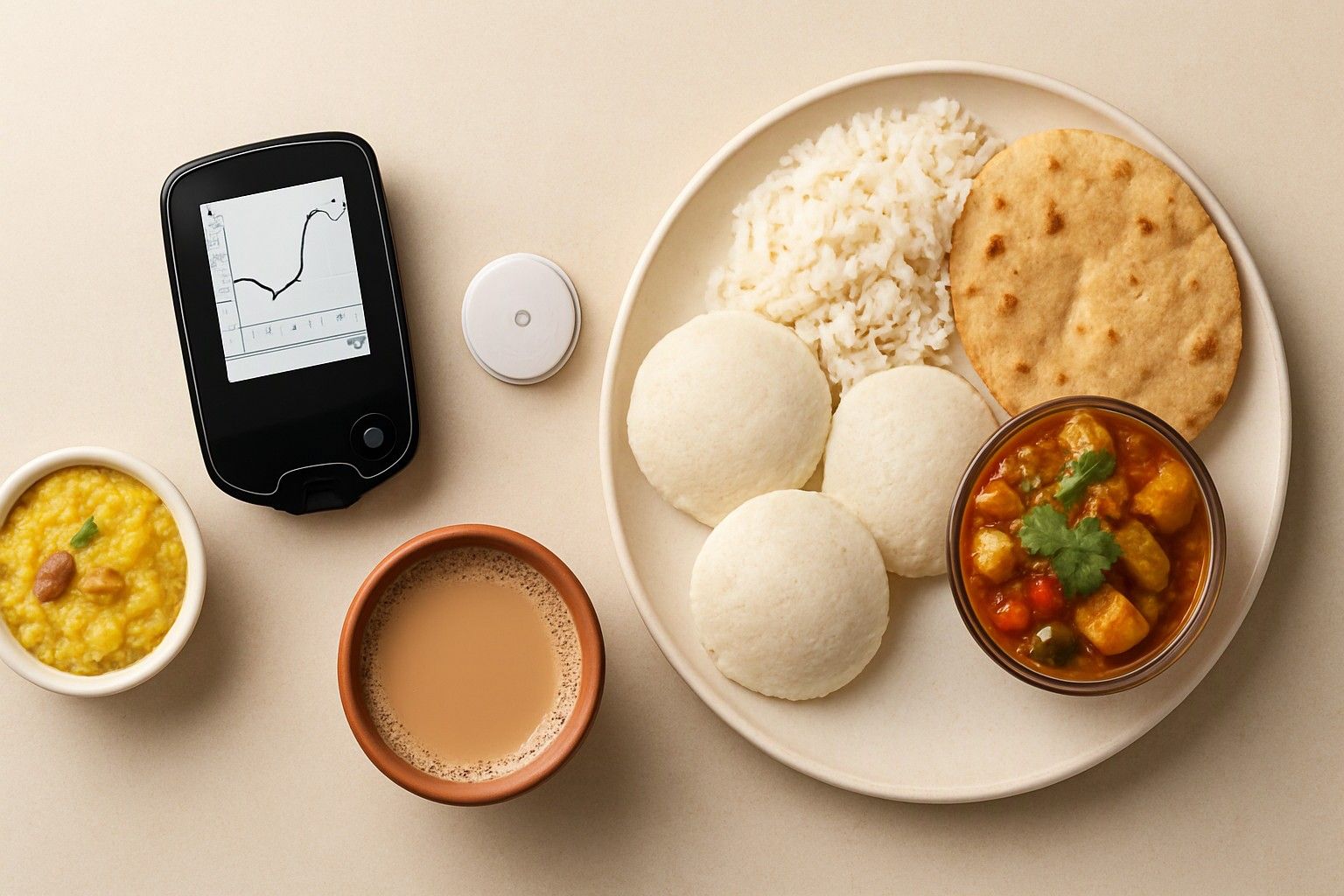
If you are prediabetic, or simply curious about how your own body handles rice, rotis, mithai and chai, a CGM can show you in real time what a fasting blood test never will. This article is for you if your goal is learning your personal food patterns rather than managing a diagnosed condition. If you want to treat or adjust medication, that is a conversation for your doctor, and a different buying path.
What Spike Data Reveals About Rice, Roti, Idli and Sweets
The biggest thing a sensor shows is that two people eating the same plate of food can have very different curves. Your graph is the useful part, not a generic food chart. Many Indian users find that the surprises are not where they expected: a bowl of white rice eaten alone may climb faster than the same rice eaten after dal, sabzi and curd, and a plain idli meal with little protein can behave differently from one with sambar and a side of chutney or egg.
Rotis tend to be more nuanced. Portion size, the flour used and what sits next to the roti all change the shape of the curve, so two rotis with a vegetable and paneer may look nothing like four rotis with only a little dal. Sweets and sugary chai usually produce sharp, quick rises, but the size depends on whether they come on an empty stomach or at the end of a full meal.
The practical way to use this is to repeat the same meal a few times and change one thing, such as the order you eat, the portion or a protein add-on. A single reading is noise. A pattern across three or four repeats is information you can act on.
Meal Timing, Late Dinners and Post-Meal Walks
Timing is where a sensor often earns its cost for people with Indian routines. Late dinners are common, whether from long commutes, work calls or family schedules, and a heavy meal eaten close to bedtime can leave your glucose elevated for longer than the same meal at an earlier hour. Seeing that on your own overnight graph is far more convincing than being told to eat early.
Post-meal walks are the easiest experiment to run. Eat a normal meal one day and sit afterwards, then eat the same meal another day and take a short, easy walk. Many users see a visibly flatter curve with the walk, and that gives them a reason to keep a habit that costs nothing.
Try the same logic with other routines. Compare tea with sugar on an empty stomach against tea after breakfast, or a fruit snack on its own against fruit with nuts. Keep notes in the app on what you ate and when, because a curve without context is hard to read a week later. The aim is a handful of dependable personal rules, not a perfect graph every day.
Medical Sensors vs Wellness Subscriptions With Coaching Apps
Buyers without diabetes usually meet two kinds of offers. One is a regular medical-style sensor that you buy and read through its own app or reader. The other is a wellness subscription that bundles a sensor with a coaching app, meal scoring and sometimes guidance from a nutritionist. For a fuller look at the sensor types underneath, see how wellness subscriptions compare with regular medical sensors.
A regular sensor generally gives you more control and a lower running cost. You see the raw curve, log meals yourself and draw your own conclusions. That suits someone who is comfortable reading graphs and wants a short, focused trial.
A wellness subscription costs more for the same sensing, because you are also paying for the app layer: automatic meal tagging, scores, reminders and human or automated coaching. That helps if you tend to give up on self-tracking, or if you want someone to explain what the numbers mean in the context of an Indian diet. It helps less if you only want to test a few meals.
Across the category, CGM prices run from ₹2,000 to ₹18,000, with an average of ₹4,500. Check what is actually included at the price you see, such as number of sensors, coaching access and app features, before comparing one offer to another.
Is One Sensor Enough or Do You Need Repeat Cycles?
For most people with no diagnosis, one sensor cycle is enough to answer the first big question: which of my regular foods and habits cause the sharpest rises? Over one cycle you can usually test your staple breakfast, a few lunches, a sweet or two, a late dinner and a walk-versus-no-walk comparison. If your results are mostly steady, you have learned something reassuring and can stop.
Repeat cycles make sense in a few situations. If you are prediabetic and have made changes, such as swapping portions, adding walks or shifting dinner time, a second cycle some weeks later shows whether those changes show up on your graph. Travel, festival seasons and changes in work schedule are also worth checking separately, since your normal pattern may not hold.
What you do not need is continuous wear forever. Once you know your top few triggers, extra sensors give diminishing returns.
For a clear view of the numbers, read about budgeting for one trial sensor versus repeated monthly cycles. As a rough guide, a single trial sensor often sits in the ₹3,000 or ₹5,000 range, while a plan with several cycles and coaching moves toward ₹10,000. Decide on the number of cycles by your goal, then pick the product that fits it.
Reading Results Without Over-Restricting Your Diet
A glucose graph can make you anxious if you treat every rise as a failure. A rise after eating is normal, and what matters more is how high it goes, how long it stays up and how often it happens. A peak after a good meal that settles back down is not a reason to cut that food.
The common trap is dropping rice, fruit or rotis entirely after one bad curve. Try smaller changes first: reduce the portion, eat vegetables and protein before the carbohydrate, walk for ten minutes afterwards or move the sweet to after a meal rather than between meals. These keep your food culture and family meals intact, which makes them far easier to sustain.
Also remember that sleep, stress, illness and a hard workout can all change your readings, so one odd day does not prove a food is a problem. Look for the same result across several days.
If you are prediabetic, share your graphs and notes with your doctor or a dietitian instead of building your own strict rules. A sensor is a feedback tool for habits, not a diagnostic device, and any worrying pattern, such as persistently high readings, deserves a proper blood test and medical advice.
Deciding If a Diet-Tracking Sensor Fits Your Goals
A sensor is worth it if you can name the question you want answered, such as whether your regular breakfast is the issue, how much late dinners affect you, or whether a walk helps. It is also worth it if you are prepared to log meals and change one thing at a time. If you would only wear it for a week and ignore the results, the money is better spent on a blood test and a dietitian visit.
It is less useful if you expect it to diagnose prediabetes, replace lab tests or give you a list of foods to ban. It also may not suit you if seeing numbers tends to trigger anxiety or obsessive food rules.
A simple way to decide: pick a goal, choose one trial cycle first and set a budget within the range that suits you, from ₹2,000 upward. Today's prices already reflect what this category typically costs, so what matters is matching features to your purpose rather than holding off. For the wider picture of sensor types and brands of features, start with seeing where a short diet-tracking trial fits among wider CGM choices.
So, is a CGM worth it if you are prediabetic or not diabetic? It is, when you want to see how your own body reacts to rice, rotis, idli, sweets and chai, and you will use one focused cycle to change a few habits. Skip it if you want a diagnosis or a strict food list. Pick the goal first, then the simplest plan that answers it.
Comments
Be the first to comment.