Microwave Features Worth Paying For vs Marketing Gimmicks
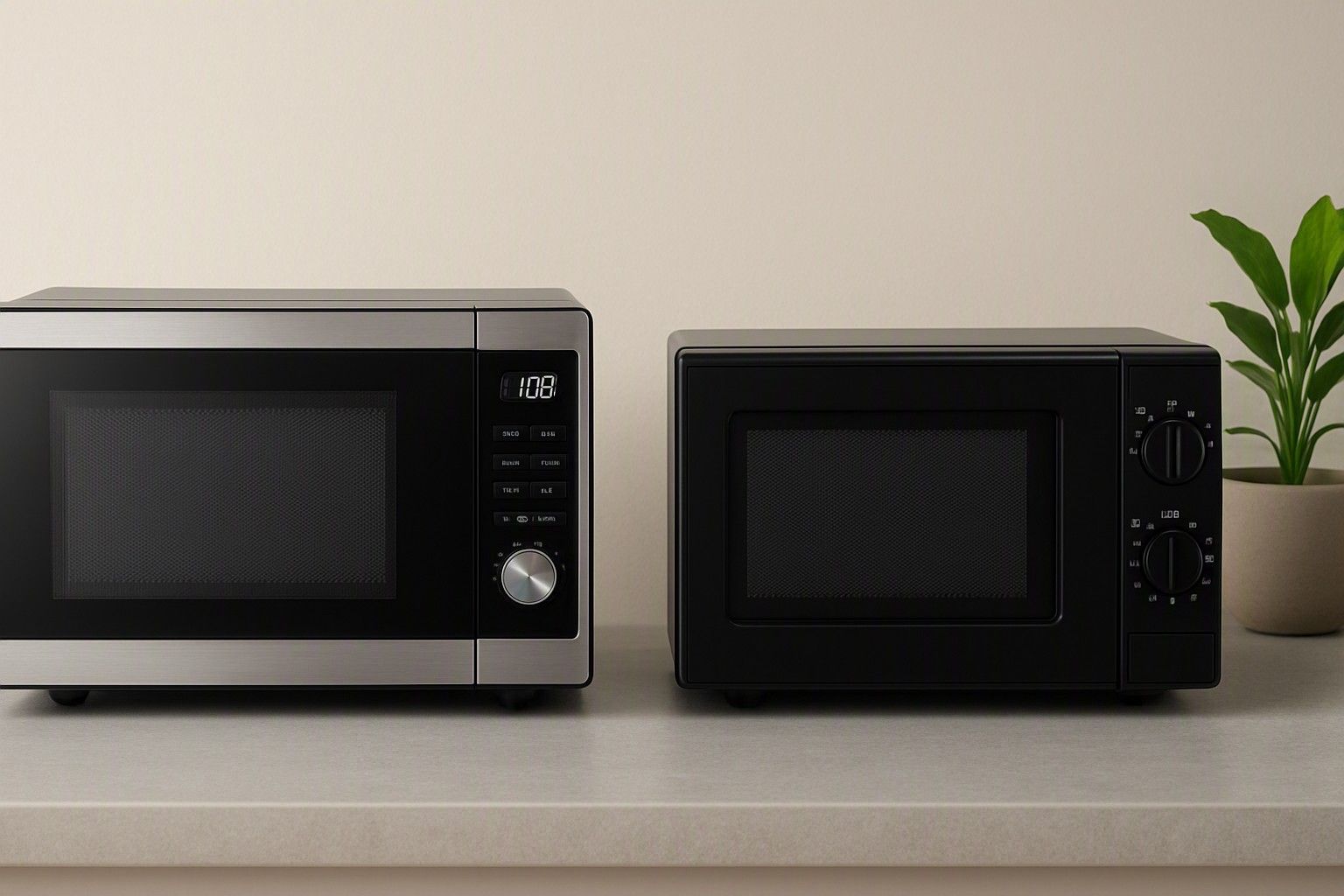
Every microwave listing throws terms like "inverter technology," "10 auto-cook menus," and "child lock with LED display" at you, and it's genuinely hard to tell which of these change how the oven cooks versus which just sound good on a spec sheet. This article goes feature by feature so you can decide which ones justify a higher price and which you can skip without missing anything. By the end, you'll know exactly what to look for on the box instead of guessing based on how long the feature list is.
Wattage and Power Levels Explained
Wattage is the one spec that actually determines how a microwave performs, and it's worth understanding before anything else on the box. Most microwaves sold in India fall between 700W and 1500W depending on type, and higher wattage generally means faster, more even cooking, especially for reheating dense food or cooking raw ingredients from scratch. A 700-800W solo microwave will take noticeably longer to heat a bowl of dal than a 1200W convection model, and if you're using the oven daily for actual cooking rather than occasional reheating, that gap adds up in wasted time.
What matters more than the peak number, though, is whether the microwave gives you real control over power levels. A unit that lets you dial down to 30% or 50% power is far more useful than one that only offers a handful of preset combinations, because low power is what lets you melt chocolate, prove dough, or defrost meat without cooking the edges. Some budget models advertise a high wattage figure but only offer two or three fixed power settings, which limits what you can actually do with that power. When comparing two ovens, check the number of manual power levels before you check the peak wattage figure, since that's the setting you'll actually touch every day.
Auto-Cook Menus and Presets: Useful or Not
Auto-cook menus are the feature most likely to be oversold. The idea is appealing: press a button labelled "rice" or "milk" and the microwave figures out time and power for you. In practice, these presets are calibrated for a generic quantity and container that rarely matches what you're actually cooking, so you end up under- or over-shooting and adjusting manually anyway. A microwave with 20 auto-cook options isn't meaningfully more useful than one with 6, because most buyers settle into using the same three or four presets and ignore the rest.
Where presets do help is for genuinely repetitive, low-stakes tasks: reheating a plate of food, popping corn, or softening butter. These are forgiving enough that a slightly imperfect preset still saves you the trouble of guessing time and power manually. For anything you cook often and care about getting right, like a specific curry or baked dish, you'll get better results dialing in your own time and power once you know your oven, rather than relying on a preset built for an idealised quantity. When comparing models, don't let a long list of auto-cook menus push the price up if you're the kind of cook who prefers manual control. It's a convenience feature, not a performance one, and it shouldn't be a deciding factor on its own.
Inverter vs Standard Microwave Technology
This is the one distinction in microwave shopping that's genuinely worth spending extra for, and it's also the most misunderstood. A standard microwave delivers power by cycling the magnetron fully on and off, so when you set it to 50% power, it's actually alternating between 100% and 0% in short bursts. An inverter microwave instead delivers a continuous, steady stream of power at the level you choose. The practical difference shows up most clearly when defrosting or cooking delicate food: standard microwaves tend to overcook the edges while the centre stays cold, because the outer layer keeps getting hit with full power in bursts. Inverter models cook more evenly because the power level stays constant throughout.
The trade-off is price. Inverter technology sits toward the upper end of what you'd pay for a microwave, and it's rarely found in the most basic solo models. If your main use case is reheating pre-cooked food and occasional light cooking, a standard microwave will serve you fine and there's no real gap in outcome. But if you regularly defrost meat, cook rice or eggs, or bake at lower power settings, inverter tech noticeably reduces the guesswork and uneven results that standard magnetron cycling produces. Given the price range runs from ₹3,000 to ₹25,000 with an average around ₹7,500, inverter models typically sit in the higher band of that spread, and that premium is one of the more defensible ones on this list.
Child Lock, Timers and Convenience Settings
Child lock is a genuinely practical feature if there are young children or elderly family members at home who might accidentally start the oven or open it mid-cycle. It's a simple button-lock mechanism, costs the manufacturer very little to include, and by now it's present on most mid-range and higher models, so there's rarely a reason to pay a premium specifically for it. Treat its absence as a red flag on an otherwise similarly priced model rather than treating its presence as a reason to pay more.
Timers and delay-start functions are similarly low-cost but genuinely convenient additions. A delay-start timer that lets you set food to begin cooking at a specific time is handy if you want a meal ready the moment you're back from work, though it's a feature many buyers set up once and never touch again. End-of-cycle reminder beeps, a clock display, and a keep-warm function after cooking are all small quality-of-life additions that make daily use smoother without meaningfully affecting your cooking outcomes. None of these should be a reason to move up a budget tier on their own. They're worth having, but they shouldn't be weighted the same as wattage, power-level control, or inverter technology when you're deciding where to spend more.
Interior Coating, Turntable and Cleaning-Friendly Design
The interior finish of a microwave affects how much daily upkeep it demands, which matters more over months of use than it seems to at the point of purchase. Cavities coated with ceramic or anti-bacterial enamel resist staining and are easier to wipe clean than plain painted steel interiors, which can discolour and hold onto odours over time, particularly if the oven is used for anything oily or strongly spiced. A smooth, seamless interior with no visible screws or rough welds is also simply easier to clean thoroughly, since food splatter doesn't collect in hard-to-reach joints.
The turntable itself is another practical detail. Glass turntables are standard, easy to clean, and durable, but check that the turntable and its supporting roller ring are simple to lift out and wash separately, since a fixed or awkwardly mounted turntable makes routine cleaning more of a chore. Flatbed microwaves, which skip the turntable entirely in favour of a fixed flat base with a rotating antenna, are worth considering if you want to fit rectangular dishes without worrying about clearance, though they're less common in the budget-to-mid segment. These design details won't show up in a spec sheet comparison the way wattage or auto-cook counts do, but they directly affect how much time and effort the oven demands from you every week. It's worth taking a closer look to understand how interior design affects long-term maintenance before finalising a model, since cleaning ease is as much a running-cost factor as electricity use.
Features That Only Add to the Price Tag
Some features are genuinely marketing dressing rather than functional upgrades. Elaborate digital displays with animated graphics, multiple language options for the interface, or a large number of decorative pre-set icons don't change how your food cooks, and they're often used to justify a price jump between otherwise similar models. Similarly, an unusually high number of auto-cook menus, as covered earlier, tends to be a number game rather than a real usability gain once you're past the handful of presets you'll actually use.
Specialty combo functions like built-in grill and convection modes are only worth paying for if you'll genuinely use them for baking or grilling; if your cooking is mostly reheating and basic prep, paying extra for a triple-function oven means paying for capability that sits unused. Premium exterior finishes, touch-panel controls in place of simple dial or button controls, and larger-than-needed capacity for a small household all fall into the same category: real features, but not ones that improve your day-to-day cooking outcome if they don't match how you actually use the oven. The practical approach is to list what you'll genuinely use weekly, then match features to the right budget tier rather than buying up to a feature list that looks impressive on paper. Within a spread of ₹3,000 to ₹25,000, the difference between ₹4,500 and ₹18,000 is often exactly this kind of feature padding rather than a meaningful jump in core cooking performance.
Sorting features this way, wattage and manual power-level control, inverter technology if you cook regularly, and a cleanable interior are the ones worth paying for, while long preset lists, decorative displays, and oversized capacity you won't use are the ones inflating the price without improving how your food turns out. With that separation clear, you're in a position to compare specific models on what actually matters rather than on how full their spec sheet looks.
Comments
Be the first to comment.