Will a Robot Vacuum Work in Your Home? Thresholds, Rugs and Stairs
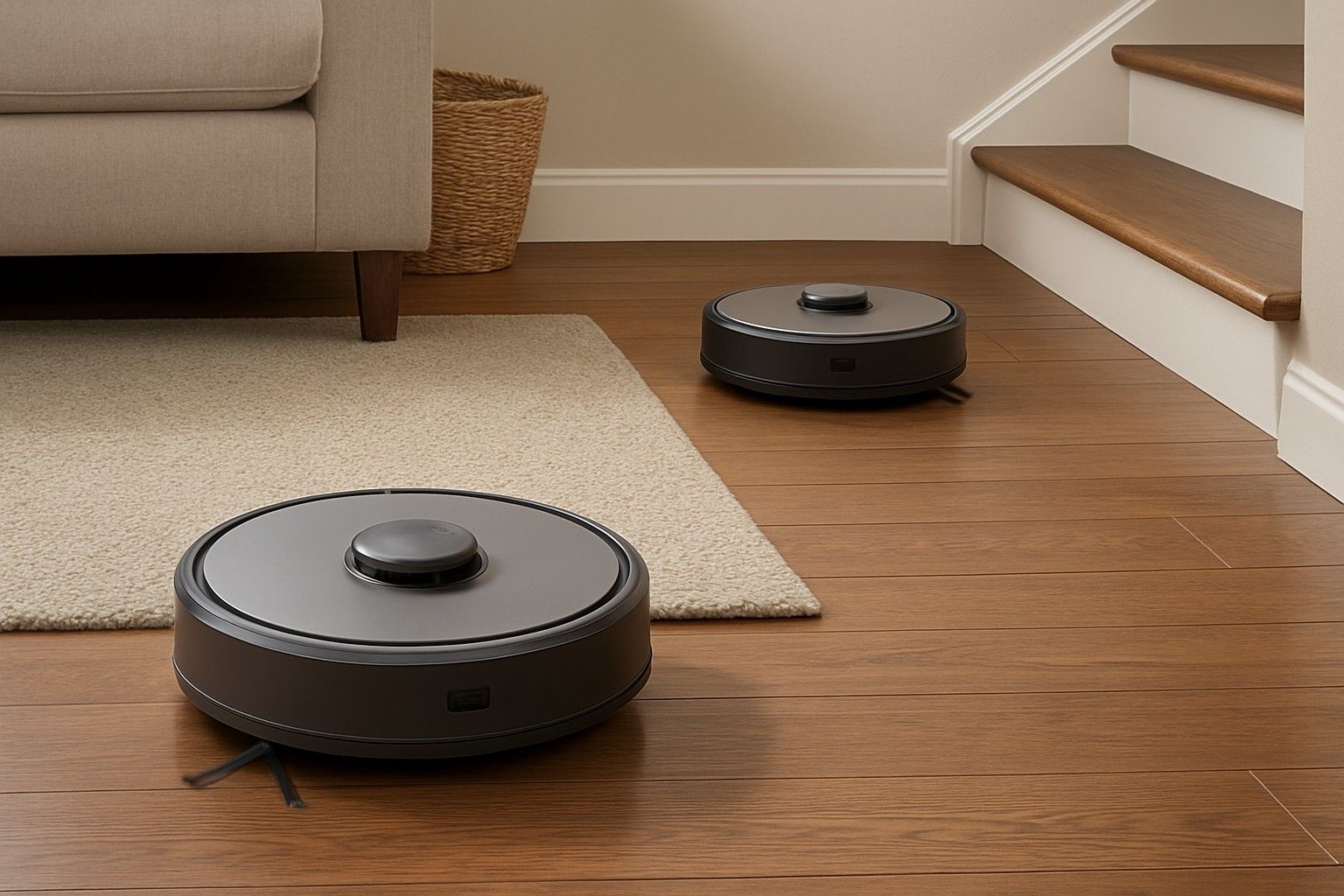
Before you compare specs or prices, ask a more basic question: will the robot even move freely through your rooms? Indian homes bring three recurring obstacles — raised door sills, layered rugs and chowkis, and multi-level layouts — that decide whether a robot vacuum is a daily helper or a machine that gets stuck in the hallway. This article walks through each of these constraints so you know exactly what to check before you buy.
Raised Thresholds and Door Sills: Climbing Limits
Most robot vacuums, regardless of price, are built to climb obstacles somewhere between 1.5 cm and 2 cm in height. That figure matters a lot in Indian homes, where raised marble or granite thresholds between rooms, balconies and bathrooms are common and often sit higher than this. A robot that cannot clear a sill simply stops at it, treats it as a wall, and either reroutes around the room or ends its cycle without ever entering that space.
Cheaper models near ₹8,000 to ₹10,000 tend to have lower ground clearance and smaller wheels, so they struggle with anything beyond a thin door strip. Models priced higher, in the ₹25,000 to ₹50,000 range, often have larger wheels and better suspension that can handle taller sills, but even these have a ceiling — no robot on the market is designed to climb a proper step-up threshold of 3-4 cm without a ramp.
The practical fix is simple: measure your highest interior threshold before you shop. If it is under 2 cm, most mid-range robots will cross it without issue. If it is taller, you either need to check climbing specs closely against that exact number, or accept that certain rooms — a puja room with a raised chowki-style entrance, for instance — will need manual cleaning regardless of what you buy. Buying a costlier unit does not guarantee a taller threshold gets crossed; verify the number, not the price tier.
Multi-Storey Houses and Why Robots Can't Climb Stairs
A robot vacuum cleans one floor level at a time, full stop. It has no mechanism to climb or descend stairs, and every model — from the cheapest to the most expensive at ₹90,000 — relies on drop sensors purely to avoid falling down a staircase, not to navigate one. If your home spans two or three floors, a single robot only covers the floor you place it on and leave it running.
This is a real constraint for independent houses and duplexes, which are common outside dense metro apartment blocks. Owners in this situation usually take one of two approaches. Some carry the same robot upstairs and downstairs on different days or different times, manually restarting it on each level — workable if the floors don't need daily cleaning. Others buy a second unit for the other floor, treating each level as its own cleaning zone with its own base station, which adds to the overall cost but removes the daily carrying hassle.
Neither approach is wrong; it depends on how often each floor is used and how much manual effort you're willing to put in. What matters is setting this expectation before purchase, not after — a robot vacuum solves single-floor cleaning very well, but it is not a whole-house automation solution for a multi-storey layout unless you're prepared to manage it floor by floor.
Carpets, Rugs and Chowkis: What Trips Robots Up
Floor coverings are where a lot of robot vacuum frustration in Indian homes actually starts. Thin, flat-woven rugs and low-pile carpets are usually fine — most robots detect the texture change and either boost suction automatically or simply roll over them without trouble. The problem is thicker items: shag rugs, layered dhurries, folded bedside mats, and especially wooden chowkis or low platforms that double as seating or puja stands.
A robot's front bumper and lidar or camera sensors read these as either a wall (if tall enough) or a hazard, and its wheels — even on higher-end models — often don't have enough torque to climb a rug edge thicker than a centimetre or so without stalling or bunching the rug up as it pushes. Fringed or tasselled rugs bring a separate risk: the fringe can wind into the brush roll and force the robot to stop mid-clean until it's manually freed.
The fix isn't a specific price tier, it's housekeeping. Fold back rug fringes or replace fringed mats with bound-edge ones. Keep chowkis and low stools consolidated in one corner rather than scattered mid-room, or lift them onto a slightly taller surface the robot can pass under. If a rug is thick enough to genuinely stall the machine, the more reliable habit is picking it up before each cleaning run rather than hoping a costlier robot will handle it — climbing ability over soft, thick pile improves only marginally as price rises.
Small Apartments vs Large Bungalows: Coverage Needs
Home size changes what you actually need from a robot vacuum, separate from any threshold or rug question. In a compact one or two-bedroom apartment, most rooms are visible from a single vantage point, corners are close together, and even a robot with basic random-pattern navigation will eventually cover the whole floor in a reasonable time. This is exactly where budget models in the ₹10,000 range perform adequately — there simply isn't enough square footage for their navigation limitations to show up as missed rooms or repeated passes.
A larger bungalow or multi-room independent house is a different problem entirely. More rooms, longer corridors, and doorways that break line of sight mean the robot needs to build and remember an actual map rather than bounce around semi-randomly. Without that, you get uneven cleaning — some rooms visited three times in a session while another is skipped entirely because the robot never found its way in. This is exactly why bigger homes need stronger navigation to map every room, and why that capability becomes worth paying for once your floor plan grows past a small apartment's footprint.
As a rough guide: if your entire cleanable floor area is under roughly 600-700 square feet, don't over-invest in navigation hardware — spend on brush design and suction instead. Past that size, treat mapping and room-recognition as a non-negotiable line item, not an optional upgrade.
Preparing Your Home for Reliable Cleaning
A robot vacuum performs closer to its potential when the home is set up to help it, and this prep work costs nothing beyond a bit of time. Start by walking through each room the robot will clean and clearing loose cables, charger wires and phone cords off the floor — these are the single most common cause of a robot stalling mid-cycle, regardless of price.
Next, address the thresholds and rugs you've already identified: decide which raised sills the robot can cross unassisted, and which rooms you'll close off or clean manually. Push in dining chairs, since thin chair legs are a frequent trap for both wheels and brush rolls. If you have a designated puja area with a chowki, treat it as a no-go zone from the start rather than letting the robot attempt it and fail.
Most mid-range and higher robots let you set virtual no-go zones through their app, which is worth configuring in the first week of ownership rather than after repeated stalls. Also check that your Wi-Fi signal reaches every room the robot needs to cover — a dead zone in a back bedroom can cause the robot to lose connection and pause. None of this preparation depends on how much you spent; a ₹8,000 model in a well-prepared home often outperforms a ₹90,000 model dropped into a cluttered one.
How Home Fit Shapes the Rest of Your Decision
Once you know your thresholds, your floor count, and which rugs need to be picked up beforehand, you've actually answered the harder half of this purchase. Everything else — suction strength, mopping features, app sophistication — only matters for a robot that can physically reach and stay on the floor you want cleaned. A machine with excellent suction is worthless in a room it can never enter.
Use what you've worked out here as a filter, not an afterthought. If your home has minimal thresholds, a single floor, and mostly bare or thin-rug floors, you have far more flexibility to shop by price and features alone. If you're dealing with tall sills, multiple floors, or thick rugs and chowkis, let those constraints narrow your options first, then compare navigation and suction within what's actually workable for your layout. It's worth taking these specifics and going through them alongside the rest of your criteria — you can bring your home's constraints into the full buying guide to see how they weigh against budget, suction and mopping needs together.
The question of whether a robot vacuum will actually work in your home rarely comes down to price — it comes down to a tape measure, a walk-through of your rugs and chowkis, and an honest count of your floors. Get those three things sorted first, and whatever budget tier you land in, from ₹10,000 to ₹50,000, will do the job you actually need it to do.
Comments
Be the first to comment.