Robot Vacuum Running Costs: Filters, Brushes, Mop Pads and Battery
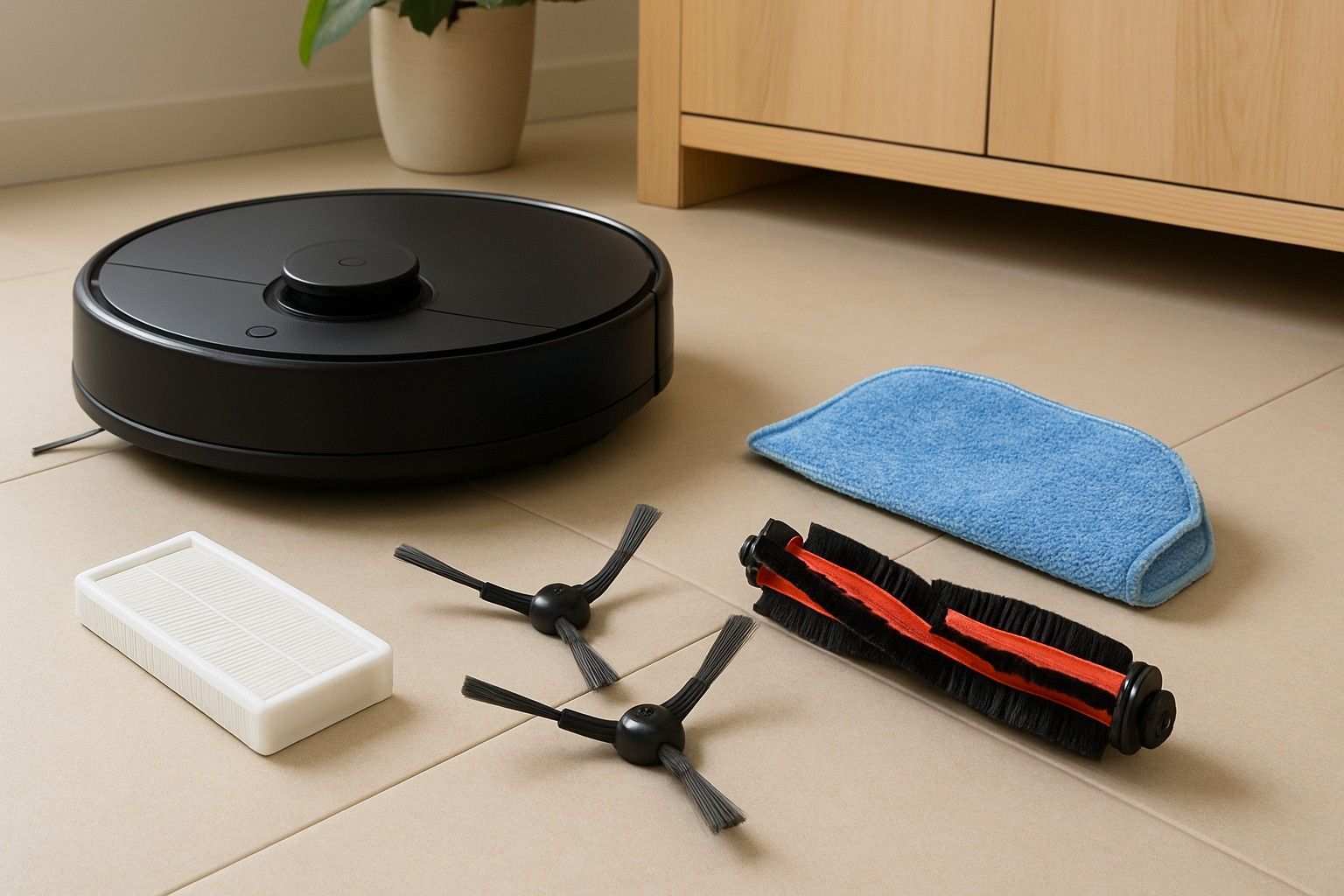
A robot vacuum's price tag is only part of what you'll spend on it. Filters, brushes, mop pads and eventually the battery all wear out and need replacing, and how much that costs — and how easily you can even get the parts in India — varies a lot between machines. If you're trying to figure out what owning a robot vacuum actually costs over two or three years, this is the number to work out before you buy, not after.
Filters, Side Brushes and Roller Brushes: Replacement Cycles
These three parts wear out the fastest because they're in direct, constant contact with dust, hair and debris. A HEPA or foam filter typically needs replacing every two to three months with regular use, sooner if your home has pets or you run the vacuum daily. Side brushes — the spinning arms that sweep debris from corners and edges into the main path — usually last three to six months before the bristles bend out of shape or snap off. The main roller brush, which does the actual lifting of dirt off the floor, tends to hold up longer, often six months to a year, but hair and thread wrap around it over time and reduce suction even before it physically fails.
None of these are optional upgrades — a clogged filter chokes suction, and a worn roller brush stops picking up debris cleanly regardless of how powerful the motor is. Budget models near ₹10,000 and mid-range machines in the ₹25,000 bracket both need this upkeep; a higher price doesn't exempt you from replacing consumables, it just sometimes means the parts last a little longer or the design collects less hair to begin with. Factor in a small recurring spend every few months rather than treating the vacuum as a one-time purchase.
Mop Pads and Cleaning Solution Costs
If you've bought a vacuum with a mopping function, the microfiber or reusable pads that attach to the base need washing after every mop cycle and replacing once they thin out or lose their scrubbing texture — usually every few months depending on how often you mop and how rough your flooring is. Some machines use disposable pads instead, which cost less individually but add up faster since you're buying a fresh batch regularly rather than washing and reusing the same set.
Cleaning solution is the other recurring cost people forget about. Machines with a dedicated solution tank need it topped up regularly, and while plain water works in a pinch, dedicated solutions are formulated to avoid streaking and to keep the mopping mechanism from getting gummed up over time. This isn't a huge expense on its own, but combined with pad replacement it's a genuine monthly line item, not a rounding error. If you're specifically weighing a mopping-capable machine, it's worth checking how the pads attach and whether replacements are sold as a simple two-pack or only in a proprietary multi-pad set, since that affects how much a top-up actually costs.
Battery Life and Replacement After a Few Years
Every robot vacuum's battery degrades with age, the same way a phone or laptop battery does. Expect meaningfully shorter runtime after roughly two to three years of regular use — the vacuum that once cleaned your whole home on a single charge starts needing a mid-cycle top-up, or it simply covers less ground before heading back to dock. This is normal battery chemistry, not a defect, but it does mean the machine's real usable lifespan is tied to how long a replacement battery stays available and affordable for that specific model.
This is where price tier matters less than you'd expect and brand support matters more. A machine bought at the lower end near ₹8,000 and one bought near the upper end around ₹90,000 will both eventually need a battery swap if you keep them long enough — the question is whether the manufacturer or an authorized service center still stocks that battery two or three years later. Before buying, it's worth a quick check on whether the brand sells standalone batteries for older models or whether replacement effectively means buying a new vacuum. This single factor can decide whether a machine remains worth repairing at all once the original battery starts fading.
Spare-Part Availability and Service in India
This is the ownership issue that catches Indian buyers off guard more than any other. A robot vacuum bought from a smaller or newer brand might perform perfectly well on day one, but if that brand has thin distribution in India, sourcing a replacement filter or brush six months down the line can mean a long wait for an import, or resorting to generic third-party parts that don't quite fit. Established brands with a real Indian retail and service presence tend to stock consumables through their own website or major marketplaces, which makes the two-to-three-month filter replacement cycle a non-issue rather than a recurring hassle.
Before buying, it's worth spending five minutes checking whether the brand's spare parts are actually listed for sale in India, not just mentioned in a global product spec sheet. Search for the specific filter or brush pack by name and see if it ships domestically with a reasonable delivery window. A machine priced around the category average of ₹25,000 that has strong local parts support will often work out cheaper to own over three years than a slightly less expensive one where every consumable has to be sourced with difficulty. Robot vacuum cleaner running cost can help you see how these recurring expenses add up. Availability, not just price, is a real part of the ownership decision here.
Warranty Coverage and What It Excludes
Most robot vacuums in India come with a standard one-year warranty covering manufacturing defects in the motor, main board and chassis. What it typically does not cover is just as important: consumables like filters, brushes and mop pads are considered wear items and are excluded from day one, and battery degradation is usually treated as normal wear rather than a defect unless it fails outright very early. Accidental damage — a fall down stairs, water damage from an overflowing mop tank, or a wheel snapped by getting stuck under furniture — is almost never covered either.
Read the warranty card before you buy, not after something breaks, and pay attention to whether service is handled through authorized centers in your city or requires shipping the unit elsewhere. A vacuum with vague warranty terms or no listed service centers near you is a real risk, and weak warranty and service is a red flag to watch for when you're comparing otherwise similar-looking models. A slightly higher price for a brand with clear, well-documented warranty terms and accessible service centers is often worth it once you consider what a mid-cycle repair without coverage would cost.
Total Cost of Ownership Beyond the Sticker Price
Add it up and a robot vacuum's real cost over two or three years looks different from its purchase price alone. Filters every two to three months, side brushes every three to six months, a roller brush once or twice a year, mop pads on an ongoing basis if you mop, and eventually a battery replacement — none of these are large individually, but together they form a steady background cost that a buyer comparing only sticker prices across the ₹10,000, ₹25,000 and ₹50,000 ranges can easily miss.
This is exactly why two vacuums priced the same on day one can end up costing noticeably different amounts by year two, depending on how often their parts need replacing and how easy those parts are to find in India. It's worth treating consumable and spare-part costs as part of the purchase decision itself rather than an afterthought you deal with later, and to add these costs to your overall buying calculation before deciding between models that otherwise look similar. Factoring in real running costs, rather than just the number on the price tag, is what separates a confident purchase from one you second-guess a year in.
Owning a robot vacuum in India means budgeting for filters, brushes, mop pads and eventually a battery, not just the price you pay at checkout. Check spare-part availability and warranty terms before you buy, and you'll have a much clearer, more honest picture of what the machine will actually cost you to keep running well past the first year.
Comments
Be the first to comment.