Robot Vacuum Specifications That Actually Matter: Suction, Battery and App
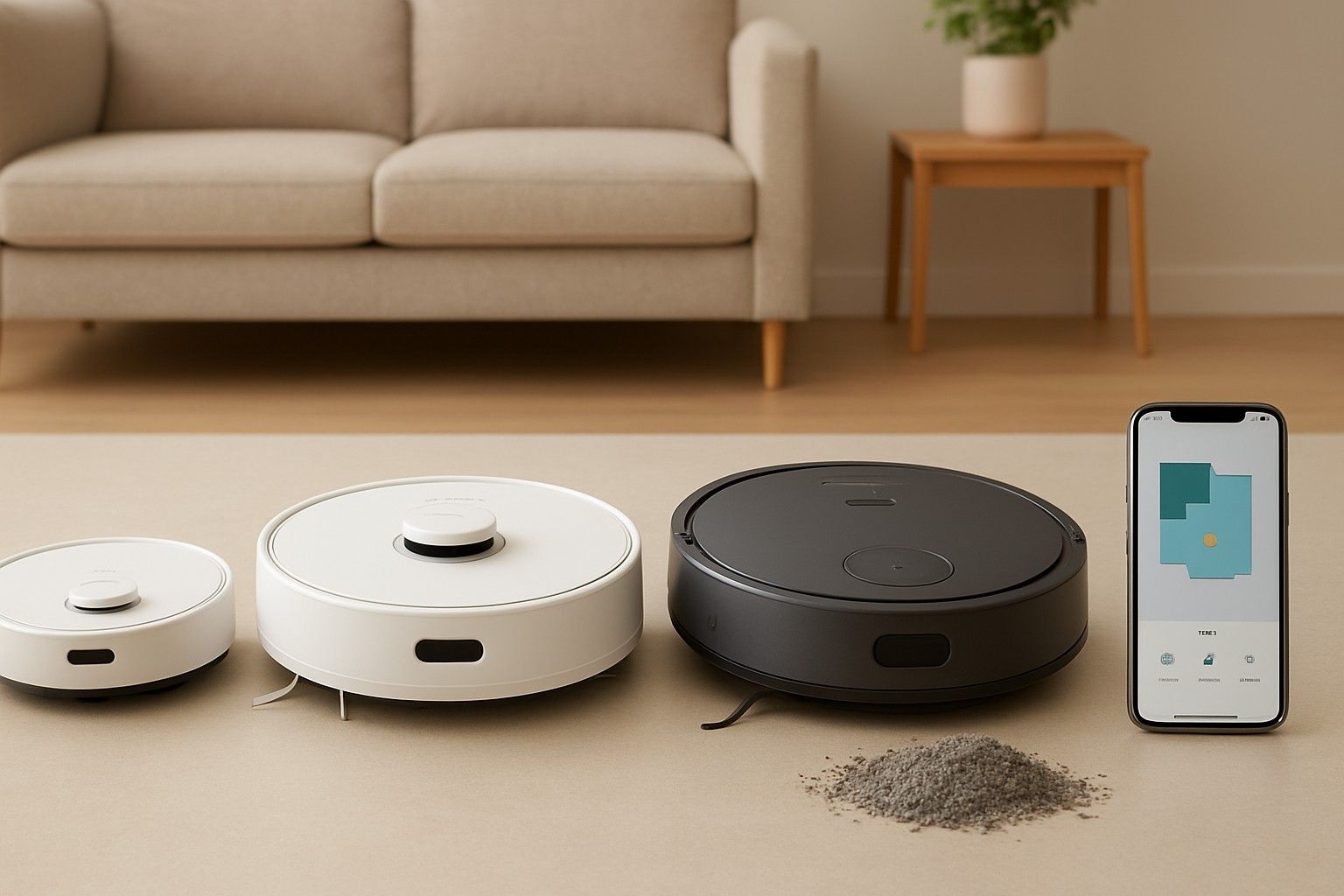
Spec sheets for robot vacuums throw numbers at you fast — 2500Pa here, 3000mAh there, "smart app control" everywhere — and most of it is marketing noise dressed up as detail. This article strips that down to what actually changes your day-to-day cleaning: how much suction you need for Indian floors and dust, how long the battery lasts before it gives up mid-room, and which app or dock features are worth paying extra for. By the end, you'll know exactly which numbers to check before you buy, and which ones you can safely ignore.
Suction Power (Pa): How Much Is Enough for Indian Dust?
Suction is quoted in Pascals (Pa), and it's the spec most buyers fixate on — but higher isn't automatically better once you're past a sensible threshold. Indian homes deal with a specific mix: fine construction dust, loose sand tracked in from outside, pet hair, and crumbs on both hard floors and rugs. For hard floors, tiles and marble, a suction rating in the lower-mid range handles daily dust and hair without trouble. If you have carpets, rugs, or a lot of pet shedding, you want a robot rated meaningfully higher, since carpet fibres trap dust that needs stronger airflow to lift out. Below roughly 2000Pa, robots tend to struggle with anything beyond bare floors and thin mats. Between 2000Pa and 4000Pa covers most mixed-flooring Indian homes comfortably, including moderate carpet use. Above that, you're paying for marginal gains that matter mainly in homes with thick carpets, long-haired pets, or allergy-sensitive residents who need maximum particle pickup. Also check whether the suction figure is a fixed rating or a "max" burst mode — many robots run at a lower default suction to save battery and only hit peak Pa in a boosted carpet mode. A robot priced around ₹25,000 typically sits in a suction band that's genuinely sufficient for hard floors plus light-to-moderate carpet, so don't assume you need to stretch into premium pricing just to get usable suction for a typical Indian flat.
Battery Life and Coverage Area per Charge
Battery life determines whether one cleaning cycle actually finishes your home or leaves rooms half-done. Manufacturers quote runtime in minutes, usually 90 to 180 minutes on a single charge, but the number that matters more is coverage area — how many square feet that runtime translates to on your actual floor type, since carpets and cluttered rooms drain battery faster than open hard floors. For a compact 1-2 BHK, most robots in the ₹10,000 and ₹25,000 range comfortably finish the whole home in one go. For larger homes, duplexes, or heavily furnitured layouts, check that the model explicitly supports auto-recharge-and-resume, meaning it returns to the dock, tops up charge, and continues from where it stopped rather than restarting the whole cleaning cycle. Without this feature, a low battery mid-clean simply means an unfinished job until you manually restart it. Battery capacity (measured in mAh) is a rough proxy for runtime, but it's less useful than the manufacturer's stated coverage figure, since actual battery drain depends heavily on suction mode and floor type. If your home has multiple floors or a sprawling layout, prioritise stated square footage coverage over a raw runtime number — a robot advertising 150 minutes but rated for a smaller area may still leave you refilling cleaning gaps manually across a large Indian bungalow.
Dustbin Size, Water Tank and Auto-Empty Docks
Dustbin capacity decides how often you personally empty the robot versus how often the robot handles it for you. Base-model robots typically carry a dustbin in the 300-500ml range, which is fine if you're emptying it every clean or two in a smaller home, but becomes a chore fast in dustier Indian conditions or larger households generating more debris. This is where auto-empty docks change the equation: the robot empties its own bin into a larger base-station bag after each run, and you only intervene every few weeks instead of every session. It's a genuine convenience upgrade, but it also affects your ongoing costs, since those docks use replaceable dust bags that add to your running expenses — auto-empty and larger tanks change your consumable spend in ways worth understanding before you commit to one. If you're considering a 2-in-1 vacuum-and-mop model, also check the water tank size separately from the dustbin — small tanks (under 200ml) mean frequent refills for larger floor areas, while integrated fresh/dirty water tanks in higher-tier models handle more square footage per fill. Don't assume a bigger dustbin always means a better robot overall; it's one spec to weigh against suction and battery, not a standalone deciding factor.
App Control, Scheduling and Voice Assistant Support
Almost every robot vacuum sold today comes with a companion app, but the depth of what that app actually lets you do varies a lot between budget and higher-priced models. At minimum, expect start/stop control and basic scheduling — setting the robot to run at a fixed time daily. More useful app features include room-by-room mapping, where the app shows a floor plan and lets you clean specific rooms on demand rather than the whole home every time, and no-go zones, which let you fence off areas like pet bowls, loose cables, or a study desk without needing a physical barrier. Cleaning history and reports are a smaller nice-to-have, mostly useful for confirming the robot actually did its job while you were out. Voice assistant support (via common smart-home ecosystems) adds hands-free start/stop and basic commands, which is genuinely convenient if you already have smart speakers at home, but it's not worth chasing as a primary reason to upgrade budget tiers. Where app quality matters most is in multi-room Indian homes where you want targeted cleaning rather than a blanket run — a good room-mapping app effectively substitutes for manual navigation supervision. Before buying, it's worth checking recent user reviews on app reliability specifically, since even capable hardware can be let down by an app that disconnects often or maps rooms inconsistently.
Height, Climbing Ability and Obstacle Avoidance
Robot height and obstacle handling decide whether the vacuum can actually access every room you want cleaned, and this is one spec buyers overlook until the robot gets stuck under furniture or refuses to cross a threshold. Most robots sit between 8cm and 10cm tall — low enough to slide under most beds and sofas, but the exact clearance under your specific furniture is worth measuring before you buy, since a few millimetres decide whether a robot cleans under a bed or bumps against it every session. Climbing ability, usually specified as a maximum threshold height in millimetres, determines whether the robot can cross door sills, marble-to-tile transitions, or slightly raised thresholds common in Indian homes — most capable models handle up to 2cm, but cheaper units may stall at anything beyond a flat floor. Obstacle avoidance technology (sensor or camera-based) affects how well the robot detects and steers around loose wires, slippers, pet waste, or low furniture legs without getting tangled or damaging items; budget models rely on basic bump sensors, while better-equipped ones use more precise mapping to avoid contact altogether. Since robot height matters if your home has thresholds and door sills, it's worth measuring your own home's transitions and furniture clearances against a model's stated specs before assuming it will cover every room unattended.
Matching Specs to Your Type and Budget
Once you understand suction, battery, dustbin, app, and height specs individually, the real task is matching them against your actual home rather than chasing the highest number in each category. A small hard-floor apartment doesn't need flagship suction or a massive auto-empty dock; a large home with carpets and pets benefits from prioritising suction and battery coverage over app polish. Robots in the ₹10,000 tier typically cover basic suction and short-runtime cleaning for compact homes, ₹25,000 adds better battery coverage, app mapping, and moderate dustbin capacity, and ₹50,000 is where auto-empty docks, stronger climbing ability, and more refined obstacle avoidance start appearing together. Prices across the category span ₹8,000 to ₹90,000, with the ₹25,000 mark representing a reasonable midpoint where most of these specs meet in a balanced way rather than trading off heavily against each other. Rather than treating this as a checklist to max out, decide which two or three specs matter most for your specific floor plan and dust load, then let those drive your budget tier. To make sure you haven't missed a factor outside pure specifications — like navigation type or maintenance costs — it helps to cross-check these specs against the full buying checklist before finalising a model.
With suction, battery, dustbin, app control, and physical clearance all mapped against your actual home rather than a generic spec sheet, you're no longer guessing which numbers matter — you know what to check first and what to skip. That's the difference between buying on marketing figures and buying on what will genuinely keep your floors clean day to day.

Comments
Be the first to comment.