Robot Vacuum Navigation: LiDAR vs Gyroscope vs Camera Mapping
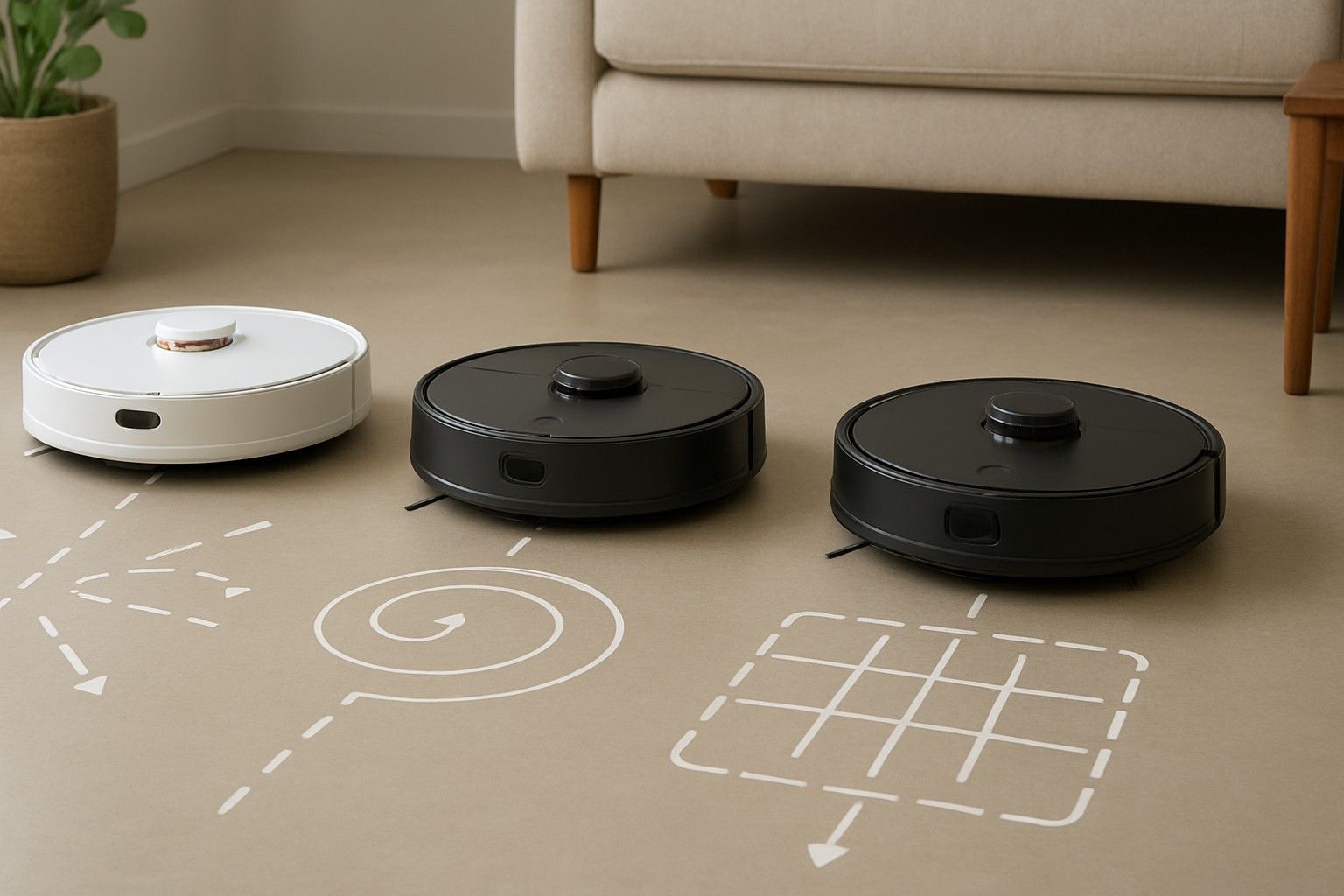
If you've been comparing robot vacuums and noticed the price jump between models, navigation is usually why. Gyroscope, LiDAR and camera-based (vSLAM) systems don't just affect how "smart" a robot feels — they decide whether it actually cleans your whole floor or bumps around missing entire rooms. This article breaks down what each system does, where it struggles, and whether paying extra for LiDAR makes sense for your specific home.
Why Navigation Decides Coverage and Missed Spots
Navigation is the part of a robot vacuum that decides where it has already cleaned and where it still needs to go. Get this wrong and the robot doesn't fail dramatically — it fails quietly. It cleans the same open patch of living room three times while a bedroom behind a half-closed door never gets touched, or it stops mid-cycle because it can't figure out how to get back to a spot it skipped earlier. This is the single biggest reason two robot vacuums at very different prices can leave very different results on the same floor.
The core trade-off across the ₹8,000 to ₹90,000 range is between cost and mapping precision. A robot with weak navigation has to rely on random bouncing or basic pattern movement, which works reasonably well in a single, mostly-empty room but breaks down fast once furniture, multiple rooms, or stairs come into play. A robot with strong navigation builds an actual map, remembers it between cleaning sessions, and plans efficient paths instead of guessing.
This matters because navigation, not suction power, is usually what buyers underestimate when comparing specs on paper. Two robots can list similar suction ratings, yet the one with better mapping will finish faster, cover more of the floor, and leave fewer patches untouched. That's the real reason navigation deserves more attention than it usually gets before you decide how much to spend.
Gyroscope Navigation: The Budget Entry Point
Gyroscope-based navigation, sometimes paired with basic infrared sensors, is what you'll typically find in robot vacuums priced under ₹10,000. Instead of building a real map of your home, these robots use a gyroscope to sense turns and movement direction, then follow a semi-structured pattern — often a mix of straight lines and wall-following — while bumping softly off obstacles to redirect themselves.
This approach works, but with real limits. It's genuinely serviceable in a single room with predictable furniture, especially studio apartments or one bedroom that needs a quick daily clean. Where it struggles is anywhere with complexity: multiple rooms connected by narrow doorways, homes with a lot of chair and table legs, or layouts where the robot needs to remember it already cleaned a zone twenty minutes ago. Without persistent mapping, these robots often re-clean areas unnecessarily and leave others out entirely, especially on larger floor plans.
There's no app-based room selection, no saved floor plan, and no-go zones are usually handled with physical magnetic strips rather than software boundaries. For a lot of small Indian homes and single-occupant flats, this is a fair compromise — you're paying for basic autonomous cleaning, not precision mapping, and at this price point that's a reasonable trade rather than a shortfall to be embarrassed about.
LiDAR Mapping: Accuracy, No-Go Zones and Room Selection
LiDAR (Light Detection and Ranging) navigation uses a spinning laser sensor, usually visible as a small turret on top of the robot, to continuously measure distances to walls and furniture. This lets the robot build an accurate, to-scale map of your home in its very first run, then use that map on every subsequent clean. You'll find this navigation type concentrated in the ₹25,000 to ₹50,000 range, and it's the single biggest reason prices rise through that band.
The practical payoff is real. LiDAR-equipped robots let you select specific rooms to clean from an app rather than running the whole floor every time, draw precise no-go zones around things like pet bowls or loose cables, and set cleaning order so high-traffic rooms get done first. Because the map is genuinely accurate rather than estimated, these robots also navigate around furniture legs and tight corners with noticeably less bumping and backtracking than gyroscope-based models.
LiDAR also holds up in low light and darkness since it doesn't depend on visible light to function — a meaningful advantage if you run cleaning cycles at night or in rooms with curtains drawn during the day. The main trade-off is cost: the sensor itself adds to the bill of materials, which is why LiDAR is rarely found on the cheapest robots in the ₹8,000 range. For anyone with more than two rooms to clean, or anyone who wants software-based no-go zones instead of physical barrier strips, this is generally where the extra spend starts paying for itself in fewer missed spots and less manual intervention.
Camera-Based (vSLAM) Navigation and Low-Light Performance
Camera-based navigation, often called vSLAM (visual Simultaneous Localization and Mapping), uses an upward or forward-facing camera to recognize landmarks — ceiling fixtures, furniture edges, wall art — and build a map from those visual reference points. It sits in a middle ground, appearing across the ₹25,000 range and sometimes overlapping with LiDAR models at similar prices.
When there's enough ambient light, vSLAM performs close to LiDAR in terms of mapping accuracy and can support similar features like room-based cleaning and virtual boundaries. The catch is right there in how it works: without sufficient light, the camera has fewer reliable landmarks to track, and the robot can lose its place on the map, re-scan areas it already covered, or move more cautiously and take longer to finish. This makes vSLAM a weaker fit for rooms that are consistently dim, homes with heavy curtains kept drawn during the day, or anyone who prefers running the robot at night with lights off.
It's also worth knowing that vSLAM maps can occasionally drift or need re-building if furniture is moved significantly, since the system is re-orienting based on visual landmarks rather than fixed laser-measured distances. For well-lit Indian homes with consistent daytime cleaning schedules, this isn't a dealbreaker and can even come at a slightly lower price than an equivalent LiDAR model. But if your cleaning happens after dark or in naturally darker rooms, this is the navigation type most likely to underperform relative to what the spec sheet promises.
Which Navigation Suits Multi-Room and Multi-Storey Indian Homes
The navigation question changes shape once you factor in how many rooms, floors, and thresholds your home actually has. A single studio or one-bedroom flat rarely needs the full precision of LiDAR — gyroscope navigation, or even a well-lit vSLAM robot, can realistically keep up. But once you're dealing with three or more rooms, connecting corridors, or a mix of tile and carpet, the ability to save multiple maps and switch between floors becomes far more valuable than it sounds on a spec sheet.
Multi-storey homes are where this decision gets concrete. Most robot vacuums, regardless of navigation type, can't carry themselves up and down stairs, so cleaning multiple floors means either buying multiple docks or manually relocating the robot between levels. LiDAR-based robots handle this transition better because they can store and recall separate maps for each floor without re-learning the layout every time you move them, while gyroscope models typically start fresh each time and camera-based ones may need to re-orient to new visual landmarks.
Open-plan homes with few walls also benefit more from LiDAR's precise room division, since there aren't natural physical boundaries to help a simpler system understand where one zone ends and another begins. Ultimately, your home layout also affects how much mapping you actually need, and matching the navigation type to your actual floor plan — rather than defaulting to whatever has the most impressive-sounding tech — is what determines whether you get consistent coverage or recurring missed spots.
How Navigation Fits the Overall Choice
Navigation is a major price driver, but it's one factor among several that determine whether a robot vacuum suits your home — suction strength, dustbin capacity, mopping capability and battery runtime all matter too, and none of them fix a navigation system that isn't right for your layout. A robot with excellent suction but poor mapping will still leave patches uncleaned, just as a LiDAR robot with weak suction will map your home perfectly while leaving dust behind.
At an average price of ₹25,000, most robots in the middle of the market are making a deliberate trade-off between navigation sophistication and other features, so it's worth deciding which one actually solves your specific problem before comparing anything else. If you want to understand how navigation weighs against these other factors when making a final decision, see where navigation ranks among all buying factors for the fuller picture.
Whether LiDAR is worth the extra spend really comes down to your floor plan: a single well-lit room rarely needs it, but multi-room or multi-storey Indian homes get a genuine, measurable benefit from its precision and saved maps. Gyroscope keeps costs down for simple layouts, camera-based systems hold their own in good light, and LiDAR earns its higher price where coverage and room selection matter most — match the system to your home, and the rest of the buying decision gets a lot easier.
Comments
Be the first to comment.