Safety Features and ISI Checks to Confirm Before Paying for a Room Heater
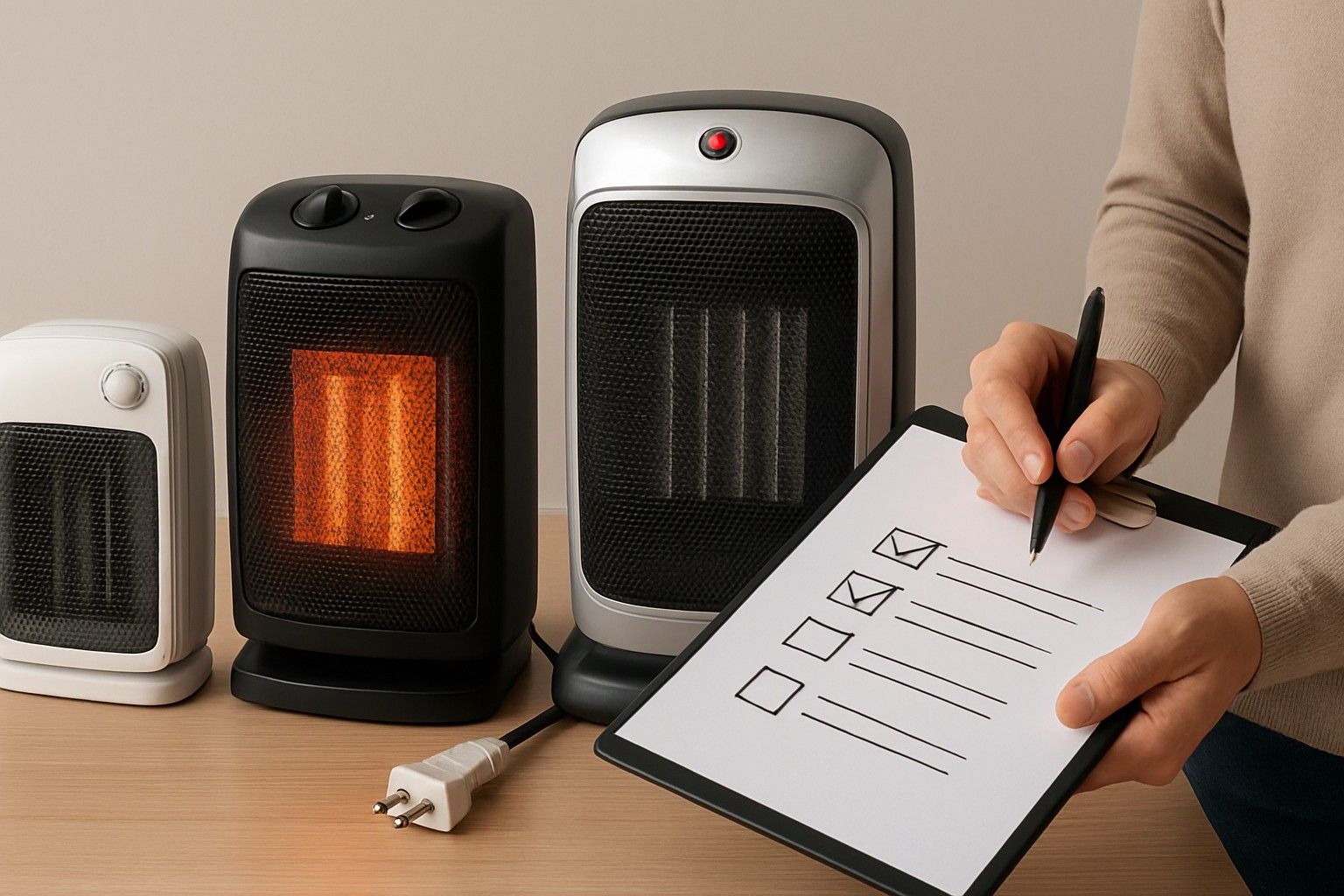
If you have picked a room heater and are about to pay, this article covers the safety checks to make first: the ISI mark, the built-in cut-offs, the plug and socket, and the warranty. A heater runs for hours at high load, often in a bedroom, so a few minutes of checking matters more here than with most appliances. These checks apply whatever type or wattage you have chosen, and they are the difference between a heater you can leave on a winter night and one you cannot.
The ISI Mark: How to Tell a Genuine One From a Fake
A genuine ISI mark is printed or embossed on the heater's rating plate or body, not only on the carton or in the listing photos. It is a clean, sharply formed logo, and the licence details sit alongside it, so look for a licence number and the Indian Standard reference printed near the mark. A blurry, uneven or oddly spaced logo, or a sticker that peels off easily, should make you doubt the product.
The word "ISI" typed into a product title or description proves nothing. Online, ask the seller for a clear photo of the rating plate, or look for one in the listing images. In a shop, turn the heater around and read the plate yourself. It should also show rated voltage, wattage and the manufacturer's name and address.
If the licence number is present, you can check it against the Bureau of Indian Standards' own verification tools rather than trusting the seller's word. Do this if the price or the seller makes you uneasy. A heater whose certification you cannot verify is a heater whose wiring, insulation and cut-offs have not been checked by anyone you can hold accountable, so treat a missing or doubtful mark as a reason to choose another model.
Overheat Protection and Tip-Over Switches
These are the two internal safeguards that matter most, and neither is visible from outside, so you have to ask for them. Overheat protection is a thermal cut-off that switches the heating element off if the internal temperature rises too far, for example when a vent is blocked by a blanket or curtain. Some heaters reset themselves once they cool, while others use a one-time thermal fuse that must be replaced after tripping. Either is acceptable, but the product page or manual should say which one it has.
A tip-over switch cuts power the moment the heater is knocked over or tilted sharply. In Indian homes, where heaters sit on floors near children, pets and bedding, this matters a great deal. It is a particular concern for compact fan heaters and rod or halogen types, which are light and easy to push over.
Check that the listing or box names both features specifically. "Safety protection" with no detail is not an answer. In a shop, ask the dealer to show you the tip-over switch working, usually a small button or pin under the base that the weight of the heater presses down. If the seller cannot explain either feature, assume it may be missing.
Plug, Cord and Socket: Why Heavy-Duty Power Points Matter in Indian Homes
Many Indian rooms have light-duty 6-amp sockets meant for chargers, lamps and fans, while heavy appliances like geysers and ACs sit on 16-amp points. A heater is a continuous heavy load. A 2000-watt model draws roughly 9 amps at 230 volts, and it does so for hours, not minutes. On a worn or loosely fitted socket, that is where plugs get hot, discolour and sometimes melt.
So inspect three things. First, the plug: it should have thick pins, a firm moulded body and no wobble in the socket. Second, the cord: it should feel thick and flexible, not thin and stiff, and it should be reasonably long so you never need to stretch it or add an extension. Third, your wall socket: if it is loose, blackened or warm after other appliances run, get an electrician to replace it before the heater goes in.
The higher the wattage, the more this matters, and why a high-wattage model needs a heavier socket than a small heater comes down to the current it pulls through the same point. Buy for the socket you actually have, or upgrade the socket first.
Why a Heater Should Never Run Off an Extension Board
Plugging a heater into an extension board is one of the most common causes of heater-related electrical fires, and the reason is simple. Most extension boards are built for low loads such as phone chargers, a TV or a laptop. Their internal copper strips and cable are thin, and their sockets grip pins loosely. Run a heater through one for several hours and the board becomes the weakest, hottest point in the circuit.
The risk grows when the board is cheap, uncertified or already carrying other devices. Multi-plug adapters and daisy-chained boards are worse still. A melted board often goes unnoticed until you smell burning, by which time the damage may already be spreading to the wall or the bedding nearby.
The safer habits are straightforward:
- Plug the heater straight into a wall socket rated for its load.
- If the nearest socket is too far, move the heater or have an electrician add a proper heavy-duty point, rather than stretching a cord.
- Do not share that socket with other high-draw appliances.
- Check the plug and cord with your hand after the first half hour. Noticeable heat means stop and investigate.
If your room has no suitable socket, sort that out before buying the heater, not after.
Red Flags in Unbranded and Roadside-Market Heaters
Roadside and unbranded heaters are tempting because they look similar to branded ones, but the savings usually come from the parts you cannot see. The warning signs are consistent:
- No rating plate, or one with no manufacturer name and address.
- No ISI mark, or one that looks smudged or pasted on.
- A thin, stiff cord and a light plug that wobbles in the socket.
- A strong plastic or burning smell on first use.
- A wattage claim that looks too high for such a small, light body.
- No manual, no warranty card and no proper invoice.
Price is a signal too. Across this category, listings run from ₹599 to ₹15,999, with an average around ₹2,499. A heater that certified parts, wiring and cut-offs have gone into cannot be sold for nothing, so look out for prices too low to be credible for a given heater type and compare them with what that type normally costs. Even in the lowest tier (₹799), the heater should still show a verifiable mark, a named maker and a warranty card.
If a seller will not let you see the rating plate or give a proper bill, walk away. Your decision today is better served by a verifiable heater than by a marginally cheaper unknown one.
Warranty Terms and Service Reach in Smaller Towns
A warranty is only worth what you can actually claim on, and that depends on service reach as much as on the number of months printed. Before paying, read the warranty card on all branded heaters also or listing for three things: the duration, what is covered (the whole unit, or only the heating element or motor), and what voids it, such as using an extension board or opening the unit.
In smaller towns, the key question is whether an authorised service centre or technician exists in your district. A national toll-free number is not enough if the nearest centre is several hours away and the process means couriering a heater back and forth in the middle of winter. Ask the dealer directly where claims are handled, and whether they will take the heater back and arrange replacement or repair themselves. For online purchases, check the seller's return window and whether replacement is offered for a unit that is dead on arrival.
Keep the GST invoice and warranty card together, because a claim usually cannot start without them. A heater is needed most in the cold months, when service queues are longest, so a maker with a reachable service network is worth preferring over one that only looks good on paper.
A Final Safety Checklist Before Checkout
Run through this list before you pay, in the shop or on the listing page:
- ISI mark printed on the rating plate or body, with licence details beside it, and a clear photo or live view of the plate.
- Overheat protection named specifically, with the reset type stated if possible.
- Tip-over switch named specifically and, in a shop, demonstrated.
- Plug and cord thick, firmly moulded and long enough to reach a wall socket without an extension.
- Wall socket rated for the heater's load and in good condition, not loose or scorched.
- Maker details and rated wattage clearly shown on the product.
- Warranty card and GST invoice included, with coverage terms you have actually read.
- Service centre or support reachable in your town.
If any item fails, the heater is not ready to buy, however good the price looks. To tie these safety checks back to your type and wattage choices, the buying guide walks through how type, room size and wattage fit together, so the heater you verify is also the right one for your room.
You now have the checks that matter before paying for a room heater: a verifiable ISI mark, named overheat and tip-over protection, a plug and socket that can carry the load, a direct wall connection instead of an extension board, and a warranty you can actually use where you live. A heater that passes all of these is one you can buy today and run through winter with confidence.
Comments
Be the first to comment.