Air Purifier Buying Mistakes and Fake Claims to Avoid
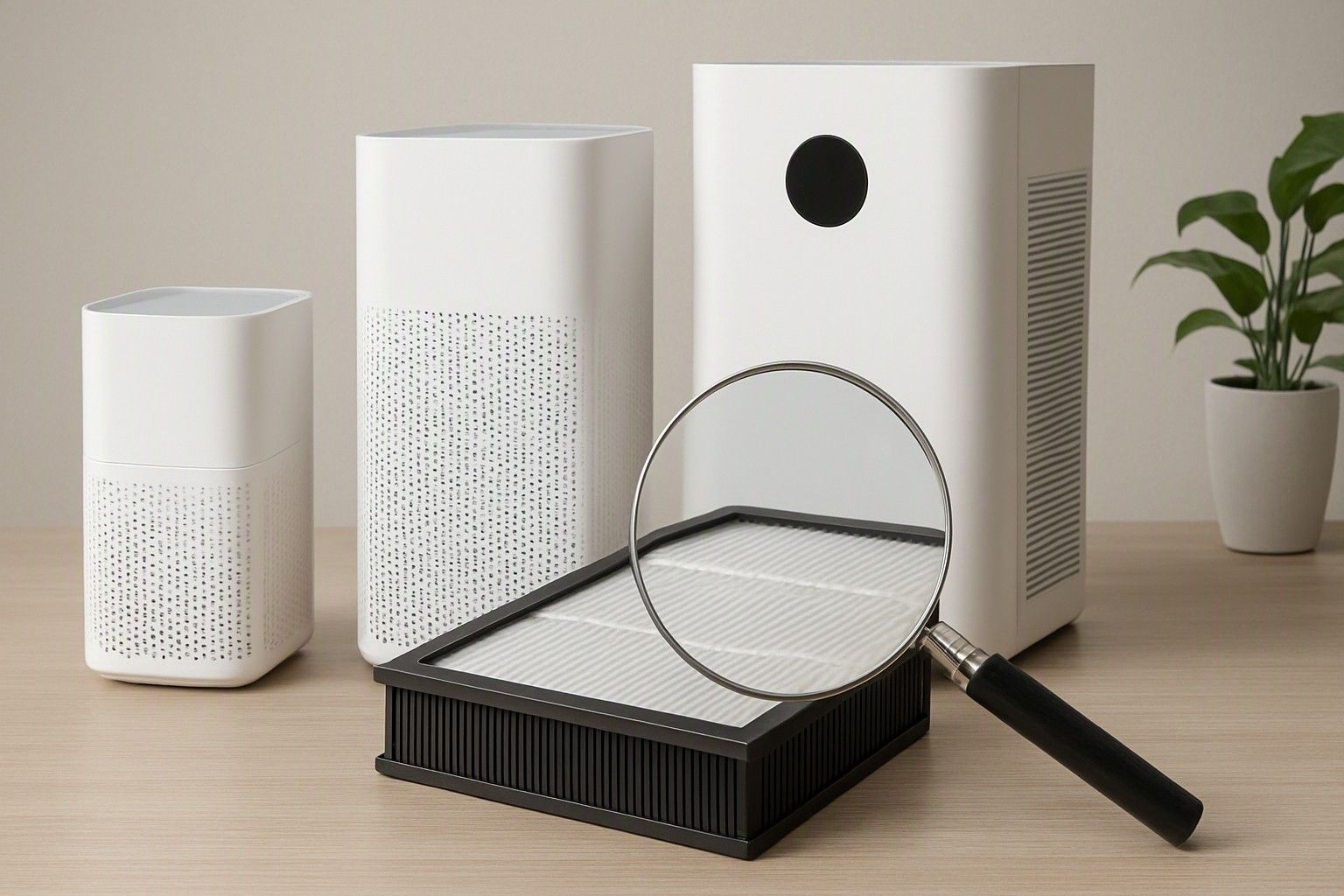
If you're close to paying for an air purifier, the biggest risk now isn't picking the wrong feature — it's falling for a claim that isn't true. Indian retail listings are full of inflated coverage numbers, ozone-based "ionisers" marketed as purifiers, and sensors that display numbers with no real calibration behind them. This is the checklist to run before you click buy, so the ₹15,000-ish you're about to spend actually buys clean air, not a good-looking spec sheet.
Coverage and CADR Numbers That Are Inflated
The single most common false claim on Indian air purifier listings is room coverage. A box that says it covers 600 sq ft may only be rated for that area under lab conditions with the fan on the highest, loudest speed — not the quiet mode most people actually run overnight. Sellers also love quoting CADR (Clean Air Delivery Rate) as a headline number without saying which pollutant it was measured against, since CADR for dust is almost always higher than CADR for smoke or bacteria. A purifier that looks like a steal at ₹4,500 to ₹6,000 but claims to handle a large living-cum-dining space is very likely overstating what it can do at a livable noise level.
The fix is simple: never take the printed coverage figure at face value, and don't size a purifier off the box copy alone. Match the number against your actual room's area and ceiling height, and check whether the stated CADR corresponds to a speed you'd realistically use at night. It's worth taking the time to verify claimed coverage against real room-sizing rules before you shortlist anything, because an undersized purifier running flat-out to compensate wears out faster and costs more in power and filters than a correctly sized one bought at a slightly higher price.
Ozone Generators and Unsafe 'Purifiers'
Some devices sold as air purifiers in India are actually ozone generators or ionisers that deliberately release ozone as their primary "purification" mechanism. Marketing around these often uses phrases like "kills viruses instantly" or "no filter needed, ever" — both are red flags. Ozone at the concentrations these devices produce is a lung irritant, not a safe air treatment, and there's no credible independent body that endorses it for continuous use in occupied rooms. If a listing brags about zero filter replacement cost, that's usually because there's no real filtration happening at all, just an electrical charge doing something to the air that isn't backed by evidence.
A genuine purifier will typically be upfront about needing filter changes, because mechanical filtration is how particulate actually gets removed. Some legitimate units include a small ioniser as a secondary feature alongside HEPA and carbon filtration, and that's fine — the problem is when ionisation or ozone is the whole story. If a product's entire pitch is "no maintenance, works forever," treat it as a warning sign rather than a selling point, especially if it's priced suspiciously below the ₹4,500 mark for what looks like a full-size unit.
Fake or Uncertified Filters and Sensors
Two more claims worth scrutinising: filter grade and the real-time AQI number on the display. "HEPA" is sometimes printed on a filter that hasn't actually been tested to the efficiency standards the term implies — genuine HEPA-grade media filters out a specific minimum percentage of fine particles at a defined size, and a listing that just says "HEPA filter" with no efficiency percentage or test standard mentioned should be read with caution. The same goes for "medical grade" or "hospital grade" language used loosely with no supporting certification named.
The onboard AQI or PM2.5 display is another area where claims outrun reality. Many budget sensors are uncalibrated dust sensors rebadged as AQI monitors, and they can show a reassuring green reading even when the room's air quality hasn't meaningfully changed, simply because the sensor isn't sensitive or accurate enough to register the difference. This matters directly for your buying decision because a display that always looks good gives you no way to judge whether the purifier is doing its job. Don't let a glowing display substitute for checking what filtration stage and rated efficiency are actually printed in the specifications, not just implied by the box design.
Ignoring Filter Costs Until It's Too Late
A purifier's sticker price is only part of what you'll spend on it. The filters need periodic replacement, and depending on the model, a single replacement set can cost a meaningful fraction of the purifier's original price — sometimes enough that skipping this math turns an apparently cheap unit at ₹6,000 into one of the more expensive options once you account for a year or two of upkeep. Buyers who focus only on the upfront number regularly end up either running filters far past their usable life to avoid the cost, which defeats the purpose of owning a purifier, or abandoning the unit altogether once replacement filters turn out to be hard to find or overpriced.
Before you commit to a specific model, check what the replacement filters actually cost and how often the manufacturer recommends changing them, and see whether that filter is easily available rather than something you'd need to import or special-order. This is exactly the kind of detail that's easy to skip when you're comparing purifiers purely on purchase price, so it's worth taking the time to know the real recurring costs before you commit rather than discovering the true cost of ownership after the first filter warning light comes on.
Warranty and After-Sales Traps
Warranty terms on air purifiers in India are inconsistent, and the fine print matters more than the headline duration. A one-year warranty that covers only the motor and not the electronics or sensor is a very different promise than one that covers the whole unit, and some sellers advertise the CADR-and-coverage numbers loudly while burying warranty exclusions deep in the product description. It's also worth checking whether the warranty is honoured by an authorised service network in your city, because a purifier bought online from a seller with no local service presence can leave you stuck if something fails outside the return window.
Another trap is the extended warranty upsell offered at checkout, which sometimes duplicates coverage the manufacturer already provides for the same period, or which excludes exactly the parts most likely to need service, like the sensor or fan motor. Read what's actually covered rather than trusting the duration alone, and check whether registering the product is required to activate the warranty, since some brands quietly void coverage if you skip that step. None of this should decide the purchase on its own, but it changes how much risk you're actually taking on at whatever price point you buy.
A Final Pre-Purchase Sanity Check
Before you pay, run the specific unit you're considering back through every warning above: is the coverage number realistic for your room at a speed you'd actually use, is the filtration genuinely HEPA-grade rather than loosely labelled, is there an ozone-based gimmick hiding behind vague marketing language, and do you know what the filters will cost you over the next year or two. A unit anywhere in the ₹4,500 to ₹80,000 range can be a good buy or a poor one depending on how many of these boxes it actually ticks, and the average price of ₹15,000 tells you very little on its own without that context.
If you've already read the deeper explainers on sizing, running costs, and certifications, this checklist is the last filter before you commit. If you haven't, it's worth stepping back to run these warnings against the whole decision framework so you're buying based on what a purifier can actually verify about its own performance, not just what the box claims.
Buying an air purifier in India comes down to seeing past the claims printed on the box, not just comparing prices. If you've checked the coverage number against your room, ruled out ozone gimmicks, confirmed the filter certification, priced in the recurring filter cost, and read the warranty fine print, you're not guessing anymore — you're buying with the same information a careful reviewer would use, at whatever price between ₹4,500 and ₹80,000 fits your room and budget.
Comments
Be the first to comment.