Air Purifier Filter Types Explained: HEPA, Carbon and Pre-Filters
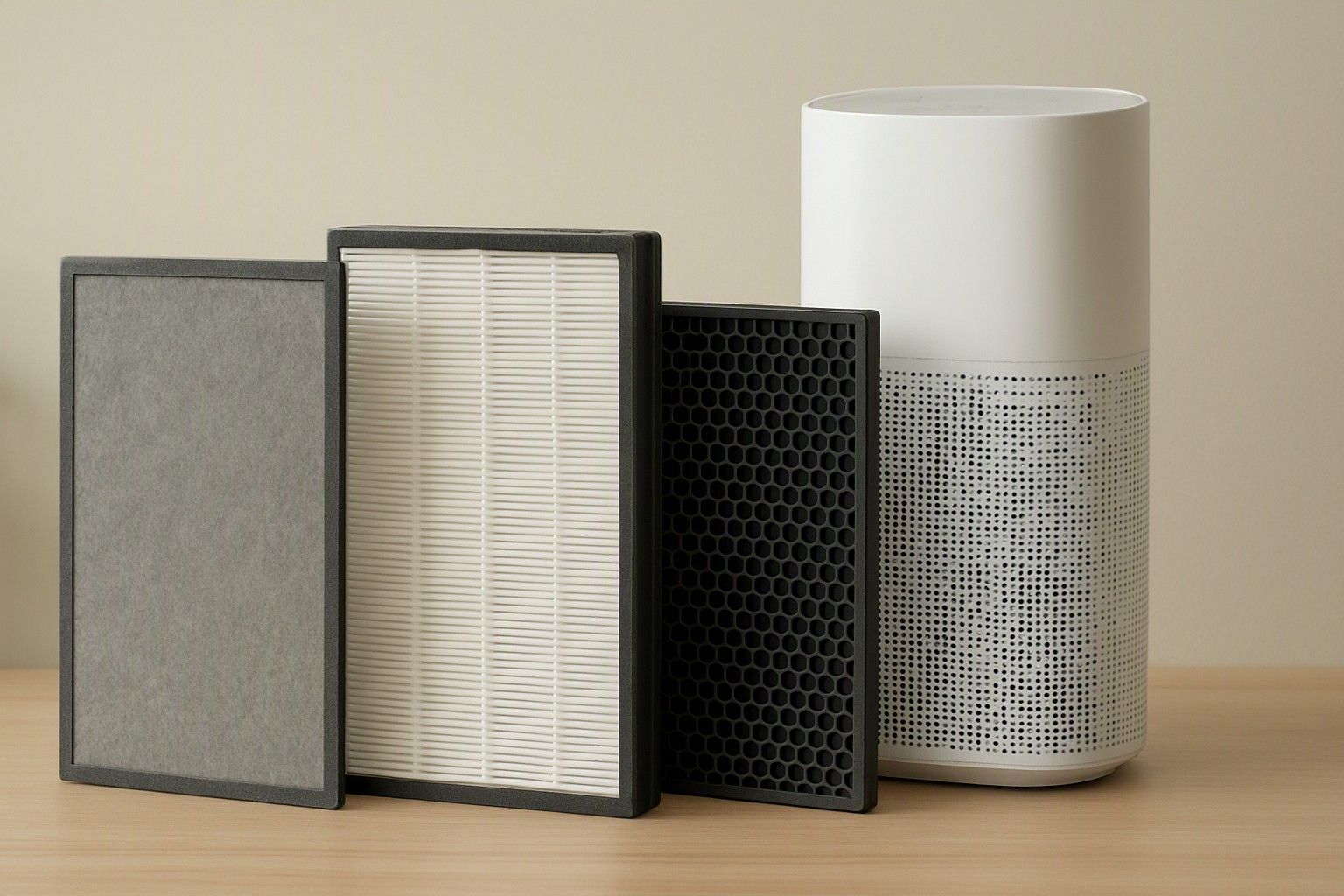
If you've spent any time comparing air purifiers, you've probably noticed in every air purifier price budget the same words are thrown at you - HEPA, activated carbon, ioniser, pre-filter - without explaining what any of it actually does to the air in your room. This article breaks down what each filter type actually removes, which ones are marketing dressing, and which ones genuinely matter for Indian homes dealing with dust, smoke and pollution. By the end, you'll know exactly what to check on a spec sheet instead of trusting the box.
True HEPA vs 'HEPA-Type' and Why It Matters
HEPA stands for High Efficiency Particulate Air, and a true HEPA filter is built to a specific standard: it must trap at least 99.97% of particles down to 0.3 microns in size. That covers most fine dust, pollen, pet dander, and a large chunk of the PM2.5 particles that make Indian city air genuinely harmful to breathe. The problem is that the term 'HEPA' has been stretched thin by marketing. You'll see filters labelled 'HEPA-type', 'HEPA-style', or 'HEPA-grade' - none of these carry any enforced efficiency standard, and in practice many of them capture somewhere between 85-95% of particles at best. That gap sounds small on paper but is significant when you're dealing with sustained exposure over months.
The only way to know if you're getting a true HEPA filter is to check whether the listing or manual explicitly states the 99.97% figure at 0.3 microns, rather than vague language like 'HEPA-grade filtration'. This distinction matters more in India than in most markets, because ambient particulate levels here are routinely several times higher than what purifiers in other countries are designed against, so a purifier working at 85% efficiency is letting through a meaningfully larger share of harmful particles than one might assume. If a listing avoids stating the exact standard, treat that as a signal to look elsewhere or verify further before deciding, rather than a small detail to overlook.
Activated Carbon for Odours, Smoke and VOCs
HEPA filters are built to catch solid and liquid particles, but they do nothing for gases, smells, or smoke odour - that's where activated carbon comes in. Activated carbon works through adsorption: the carbon is processed to have an enormous internal surface area riddled with microscopic pores, and gas molecules get trapped in those pores as air passes through. This makes it the layer responsible for pulling out cooking odours, tobacco smoke smell, paint fumes, and volatile organic compounds (VOCs) released by furniture, cleaning products, and synthetic materials - none of which a HEPA filter alone will touch.
For Indian households, this matters most in kitchens with open cooking areas, homes near traffic or industrial pollution where VOC and smoke exposure is constant, and any space where someone smokes indoors. The catch with activated carbon is that it saturates faster than HEPA media, especially in high-pollution or high-odour environments, and once the carbon's pores are full it simply stops adsorbing anything new without any obvious sign of failure. A thin carbon layer wrapped around a HEPA filter will do far less than a purifier with a genuinely thick, dedicated carbon filter stage. If odour and smoke are a real concern in your home, check the carbon filter's weight or thickness where listed, not just its presence, since a token amount of carbon dust sprinkled onto a HEPA sheet is common in budget models and offers minimal real-world benefit.
Pre-Filters and Handling India's Heavy Dust
A pre-filter is the first line of defence - a coarse mesh or fabric layer that catches larger particles like hair, lint, and visible dust before air reaches the HEPA and carbon stages behind it. It sounds like a minor component, but in Indian conditions it's arguably one of the most consequential filters in the whole unit, simply because dust load here is so much higher than in the markets these purifiers are often originally engineered for. Without an effective, easily accessible pre-filter, your HEPA filter ends up doing the coarse dust's job too, clogging far faster than its rated lifespan and forcing early, unplanned replacement.
The practical detail to check is whether the pre-filter is washable and easy to access, because that single feature determines how much manual maintenance your purifier will demand. A washable pre-filter that you can pull out, rinse, and dry every couple of weeks dramatically extends the working life of the more expensive HEPA and carbon layers sitting behind it. Purifiers without a separate pre-filter, or with one that's fused into the main filter unit, tend to need full filter changes noticeably more often - which shows up directly in your running costs down the line. If you live somewhere with visible dust accumulation on furniture within a day or two, treat pre-filter accessibility as a non-negotiable check rather than a nice-to-have.
Ionisers, UV and Ozone: Helpful or Hype?
Beyond the core filtration stack, many purifiers advertise ionisers, UV-C lights, or ozone-generating functions as bonus features - and this is where a lot of the confusing, exaggerated marketing lives. An ioniser releases charged particles into the air that attach to airborne dust and cause it to settle out of the air faster, but it doesn't remove anything itself, and depending on design it can produce trace ozone as a byproduct, which is a lung irritant rather than a benefit. UV-C light can neutralise certain bacteria and viruses given enough exposure time, but the brief transit time air spends near a UV lamp inside a purifier housing is often too short to meaningfully affect microbial load, making it more of a checkbox feature than a functional one in most consumer units.
Ozone generators specifically deserve caution: some devices marketed as producing 'fresh, ionised air' are in fact releasing ozone at levels that do measurable harm to respiratory health with prolonged exposure, particularly for children, elderly family members, or anyone with asthma. None of these three technologies substitute for solid HEPA and carbon filtration - they're add-ons at best. Before you pay extra for a model bragging about ioniser or UV features, it's worth learning to spot the misleading filter claims sellers push, because this is exactly the category of feature where sellers lean hardest on impressive-sounding terms to justify a higher price without real added benefit.
How Filter Choice Affects Long-Term Spending
The filter technology you choose doesn't just affect air quality - it directly shapes what you'll spend after the purchase, and this is where buyers most often get caught out. Across the market, purifiers range from ₹4,500 to ₹80,000, with the average sitting around ₹15,000, but that upfront number tells you almost nothing about total cost of ownership. A unit in the ₹6,000 range often uses combined HEPA-carbon filters that can't be washed or maintained separately, meaning the entire filter assembly needs replacing as one unit, more frequently, once dust and odour load builds up.
Models in the ₹15,000 and ₹35,000 bands more commonly separate the pre-filter, HEPA, and carbon stages, which lets you wash the pre-filter regularly and delay replacing the expensive HEPA and carbon cartridges. Over a year or two, this difference in filter architecture can matter more to your total spending than the initial purchase price gap between two purifiers. It's worth resisting the urge to fixate purely on sticker price against the ₹4,500-₹80,000 range and instead ask what a specific filter setup will cost you in replacements going forward - you can see how each filter type changes your yearly replacement bill to get concrete numbers before you commit to a model.
Turning Filter Knowledge Into a Shortlist
Knowing what HEPA, carbon, and pre-filters actually do is the foundation, but filter type is only one factor in a purchase decision that also involves room size coverage, noise levels, and running costs. Now that you can tell a true HEPA claim from a vague one, gauge whether a carbon layer is substantial enough to matter, and recognise when an ioniser or UV feature is just decoration on the spec sheet, the next step is putting that knowledge next to everything else that determines whether a purifier suits your home. That means checking it against room size, CADR ratings, and how a unit performs against your specific pollution sources - dust, smoke, or odour - rather than filters in isolation.
The most efficient way to do that is to line up filters against every other buying factor that matters, so you're not making a filter-only decision that overlooks noise output or a coverage area mismatched to your room. Filter quality earns its keep only when it's paired with the right capacity and maintenance routine for your actual living space.
You now have what you need to read a purifier's filter spec sheet the way it should be read - checking for a genuine 99.97% HEPA claim, judging whether the carbon layer is substantial enough to handle real odour and smoke, confirming the pre-filter is washable and built for Indian dust loads, and treating ioniser or UV features as bonus extras rather than deciding factors. That's the answer to what these filters actually do for you, and it's enough to stop marketing language from doing the deciding for you.

Comments
Be the first to comment.