Room Size and CADR: Picking the Right Purifier Coverage
If you've been staring at CADR numbers and "covers up to X sq ft" claims without knowing what they mean for your actual bedroom or hall, you're not alone — this is one of the most common ways buyers end up with a purifier that's either too weak to matter or overkill for the money. This article walks through how CADR translates to real coverage, how Indian room sizes fit into that math, and where noise and unit count come into the decision.
What CADR Actually Means for Your Room
CADR stands for Clean Air Delivery Rate, and it's the single most useful number on a purifier's spec sheet — yet most listings bury it under vaguer marketing terms like "coverage area" or "suitable for large rooms." In plain terms, CADR tells you how much filtered air a purifier pushes out per minute, usually expressed in cubic metres per hour or cubic feet per minute. A higher CADR means the machine clears smoke, dust, and pollen from a given space faster, at a given fan speed.
The catch is that CADR is measured under lab conditions, in a sealed test chamber, at the unit's highest fan setting. That's not how you'll actually run it at home — most people keep purifiers on low or medium speed for noise reasons, which cuts real-world CADR significantly. So when a brand advertises a room coverage figure, it's almost always calculated using the peak CADR number, not the speed you'll live with day to day.
The practical takeaway: don't just check whether a purifier's claimed coverage matches your room's square footage. Check the CADR value itself, then mentally discount it for the fan speed you're realistically going to run. A purifier rated for a 300 sq ft room at top speed might only comfortably handle 200 sq ft at the quieter setting you'll actually use most nights.
Matching Coverage to Indian Bedroom and Hall Sizes
Indian homes have fairly predictable room dimensions, which makes this easier than it sounds. A typical bedroom in a metro apartment runs somewhere between 100 and 150 sq ft, while a living-cum-dining hall in a mid-size flat is often 200 to 300 sq ft, and larger independent houses or open-plan halls can push past 350 sq ft. Matching CADR to these numbers is where most buyers either overspend or undersize.
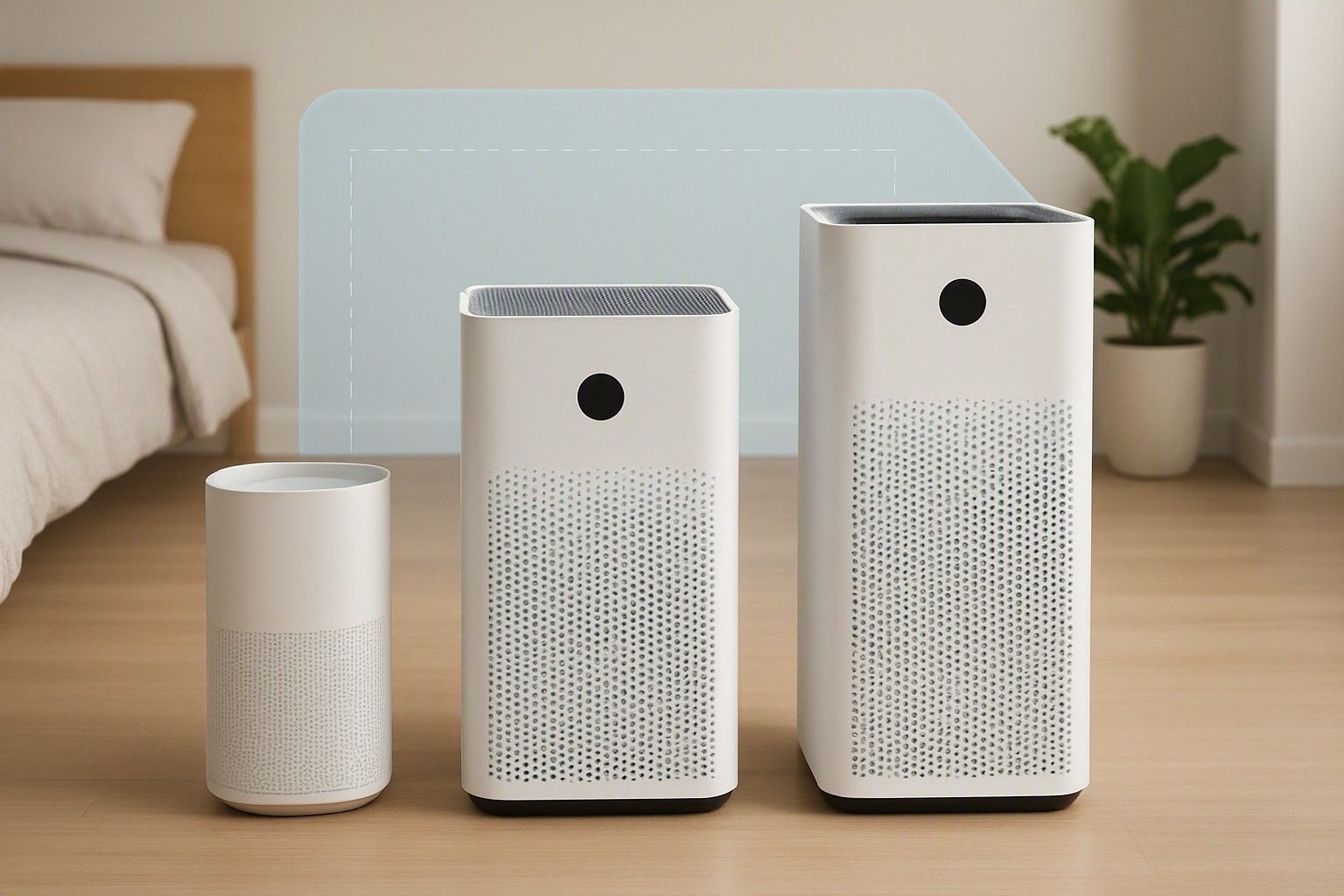
For a standard bedroom, a purifier at the lower end of the market — often priced in the ₹6,000 range — can genuinely handle the space if its CADR is rated appropriately, since smaller rooms need less air turnover to stay clean. Stepping up to a hall-sized space usually means looking at the ₹15,000 bracket, where CADR ratings are meaningfully higher and better suited to open, ventilated layouts. Larger halls or rooms with high footfall — think a hall that doubles as a work and dining space — often need the ₹35,000 tier to get a CADR that keeps up without running flat-out all day.
A common mistake is buying one mid-range purifier and placing it in the hall expecting it to also serviceably clean an adjoining bedroom through an open door — airflow doesn't work that way indoors, and closed doors or partial partitions cut effective coverage sharply. Size the purchase to the specific room it will live in, not the combined square footage of your home.
Why Ceiling Height and Air Changes Per Hour Matter
Square footage alone doesn't tell the full story — volume does, and that's where ceiling height quietly changes the math. A room with a standard 9 to 10 foot ceiling has meaningfully more air to clean than the same floor area with an 8 foot ceiling, yet most coverage charts assume a flat, average ceiling height and don't adjust for it. If your home has higher ceilings, typical of some older independent houses, a purifier rated for your room's square footage may still be underpowered for the actual air volume.
This is where Air Changes per Hour, or ACH, becomes the more honest metric than coverage area alone. ACH tells you how many times the purifier can theoretically filter the entire volume of air in a room within an hour. For general upkeep in a low-pollution home, 2 to 4 ACH is usually adequate. For someone dealing with seasonal smoke, heavy traffic-side pollution, or allergy concerns, aiming for 4 to 6 ACH gives a real margin of comfort rather than a bare-minimum clean.
The practical fix is simple: calculate your room's volume (length × width × height, not just floor area), check the purifier's CADR against that volume, and lean toward the higher end of the ACH range if you have higher ceilings or heavier pollution load. A purifier that looks adequately sized on floor area alone can quietly under-deliver once ceiling height is factored in.
One Big Purifier or Several Smaller Ones?
Once you've worked out the coverage math, a genuine trade-off shows up: buy one high-CADR unit that can theoretically cover your whole living area, or spread the budget across two or more smaller units placed room by room. Both approaches work, but they solve different problems.
A single large purifier, usually sitting in the ₹35,000 range, makes sense if you mostly live and sleep in one open-plan space, or if you're willing to physically move the unit between rooms as needed. It's simpler to maintain, has one filter to track and replace, and avoids the running cost of powering multiple machines. The downside is that it can't be in two rooms at once — if it's cleaning the hall during the day, your bedroom air is untouched until you move it before bedtime, which is a habit many buyers don't actually keep up.
Two smaller units, each in the ₹6,000 to ₹15,000 range, mean your bedroom stays continuously purified overnight while the hall unit runs independently during the day. This suits households where someone has allergies or breathing sensitivity and needs uninterrupted clean air specifically at night. The trade-off is more filters to replace, more sockets in use, and a higher combined purchase cost than one mid-tier unit — though not necessarily higher than one large flagship-tier purifier. If your home has genuinely separate zones with doors that stay shut, splitting coverage is usually the more reliable answer than hoping one unit reaches everywhere.
Noise Levels at the Speed You'll Actually Use
CADR numbers are measured at full fan speed, but full fan speed on most purifiers is loud enough that few people run it overnight or during a work call. This is the gap between lab-rated coverage and lived-in coverage, and it's worth checking before you buy rather than after. A purifier that claims to cover your hall at its top setting might be uncomfortably noisy at that setting, pushing you to run it on low — where its effective CADR, and therefore its real coverage, drops well below the room size printed on the box.
The fix is to check noise ratings (usually in decibels) at low and medium speed specifically, since that's where you'll likely leave it most of the time, and match that speed's CADR — not the peak figure — against your room size. If the numbers only work out at high speed, the unit is probably undersized for your room in practice, even if it looks fine on paper.
This matters even more if your home deals with cooking smoke, incense, or seasonal outdoor smoke, since those situations often force you to run the purifier at higher speeds for longer stretches regardless of noise tolerance. It's worth factor in fume-heavy rooms that need higher fan speeds when you're sizing coverage, since a unit that's merely adequate for dust and pollen may need a real CADR margin to keep up with smoke without being pushed to its loudest, least livable setting.
How Coverage Fits the Rest of Your Decision
Getting CADR and room size right solves one part of the purifier decision, but it's not the whole picture — filter type, running cost, and the pollution profile of your specific home all sit alongside it. A correctly sized purifier that uses the wrong filter for your pollutants, or one that fits your room but not your budget for ongoing filter replacement, still isn't the right buy. Coverage math is the filter that narrows your shortlist; it isn't the final answer on its own.
Once you know the CADR and room size that fit your space, it helps to bring room-sizing together with the other core buying checks, so you're weighing coverage against filter type, noise, and price history as one connected decision rather than four separate ones. Across the market, purifiers span from ₹4,500 to ₹80,000, with the average sitting around ₹15,000 — knowing where your correctly sized unit falls in that range tells you whether you're paying a fair price for the coverage you actually need, rather than for coverage claims you'll never use at the speed you'll run it.
You now have a working method: check CADR at the fan speed you'll realistically use, size it against your room's volume rather than just its floor area, and decide whether one larger unit or two smaller ones fits how your home is actually laid out. That's a more reliable way to buy than matching a square-footage sticker to your room and hoping it holds up once the doors are closed and the fan is on low.

Comments
Be the first to comment.